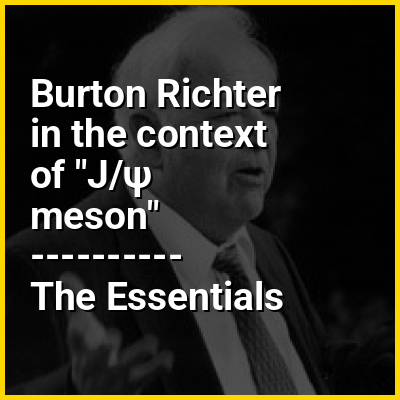
Burton Richter (March 22, 1931 – July 18, 2018) was an American physicist. He led the Stanford Linear Accelerator Center (SLAC) team which co-discovered the J/ψ meson in 1974, alongside the Brookhaven National Laboratory (BNL) team led by Samuel Ting for which they won Nobel Prize for Physics in 1976. This discovery was part of the November Revolution of particle physics. He was the SLAC director from 1984 to 1999.
HINT:
In this Dossier
- ⭐ Core Definition: Burton Richter
- Burton Richter in the context of Samuel Ting
- Burton Richter in the context of J/ψ particle
Burton Richter in the context of Samuel Ting
Chao Chung Ting (Chinese: 丁肇中; pinyin: Dīng Zhàozhōng, born January 27, 1936), also known by his English name Samuel, is a Taiwanese-American physicist who was awarded the Nobel Prize in Physics in 1976 with Burton Richter for discovering the subatomic J/ψ particle. He is the Thomas Dudley Cabot Professor of Physics at the Massachusetts Institute of Technology (MIT).
View the full Wikipedia page for Samuel TingBurton Richter in the context of J/ψ particle
The J/ψ (J/psi) meson /ˈdʒeɪ ˈsaɪ ˈmiːzɒn/ is a subatomic particle, a flavor-neutral meson consisting of a charm quark and a charm antiquark. Mesons formed by a bound state of a charm quark and a charm anti-quark are generally known as "charmonium" or psions. The J/ψ is the most common form of charmonium, due to its spin of 1 and its low rest mass. The J/ψ has a rest mass of 3.0969 GeV/c, just above that of the η
c (2.9836 GeV/c), and a mean lifetime of 7.2×10 s. This lifetime was about a thousand times longer than expected.
Its discovery was made independently by two research groups, one at the Stanford Linear Accelerator Center, headed by Burton Richter, and one at the Brookhaven National Laboratory, headed by Samuel Ting of MIT. They discovered that they had found the same particle, and both announced their discoveries on 11 November 1974. The importance of this discovery is highlighted by the fact that the subsequent, rapid changes in high-energy physics at the time have become collectively known as the "November Revolution". Richter and Ting were awarded the 1976 Nobel Prize in Physics.
View the full Wikipedia page for J/ψ particle