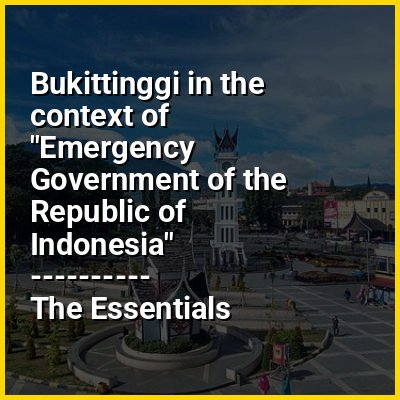
Bukittinggi in the context of Emergency Government of the Republic of Indonesia


Bukittinggi in the context of Emergency Government of the Republic of Indonesia

⭐ Core Definition: Bukittinggi

Bukittinggi (Minangkabau: Bukiktinggi, Jawi: بوكيت تيڠڬي, formerly Dutch: Fort de Kock) is the third largest city in West Sumatra, Indonesia, with a population of 111,312 in 2010 and 121,028 in 2020. An official estimate as of mid 2023 lists a population of 124,047, consisting of 61,949 males and 62,098 females. The city covers an area of 25.24 km. It is located in the Minangkabau Highlands, 90 km by road from the West Sumatran capital city of Padang. The city is completely surrounded by the Agam Regency (Bukittinggi was its regency seat until 1998), making it an enclave within the regency, and it is located at 0°18′20″S 100°22′9″E / 0.30556°S 100.36917°E / -0.30556; 100.36917, near the volcanoes Mount Singgalang (inactive) and Mount Marapi (still active). At 930 m above sea level, the city has a cool climate with temperatures between 16.1° to 24.9 °C.

Bukittinggi used to be known as Fort de Kock and was once dubbed as 'Parijs van Sumatera'. The city was the capital of Indonesia during the Emergency Government of the Republic of Indonesia (PDRI). Before it became the capital of PDRI, the city was a centre of government at the time of the Dutch East Indies and during the Japanese colonial period.
↓ Menu
HINT:

In this Dossier

Bukittinggi in the context of Marapi

The Marapi (Jawi: ماراڤي), or Mount Marapi (Indonesian: Gunung Marapi, Minangkabau: Gunuang Marapi, Jawi: ڬونوواڠ ماراڤي), is a complex volcano in West Sumatra, Indonesia, and is the most active volcano in Sumatra. Like that of its quasi-homonym on Java, its name means "Mountain of Fire". Its elevation is 2,885 metres (9,465.2 ft). Several cities and towns are situated around the mountain including Bukittinggi, Padang Panjang, and Batusangkar. The volcano is also popular among hikers.

View the full Wikipedia page for Marapi
↑ Return to Menu

Bukittinggi in the context of Japanese holdout

Japanese holdouts (Japanese: 残留日本兵, romanizedzanryū nipponhei, lit.'remaining Japanese soldiers') were soldiers of the Imperial Japanese Army (IJA) and Imperial Japanese Navy (IJN) in the Pacific Theatre of World War II who continued fighting after the surrender of Japan at the end of the war for a variety of reasons. Japanese holdouts either doubted that Japan had surrendered, were not aware that the war had ended because communications had been cut off by Allied advances, feared they would be executed if they surrendered to Allied forces, or felt bound by honor and loyalty to never surrender.

After Japan officially surrendered on 2 September 1945, Japanese holdouts in Southeast Asia and the Pacific islands that had been part of the Japanese Empire continued to fight local police, government forces, and Allied troops stationed to assist the newly formed governments. For nearly 30 years after the end of the war, dozens of holdouts were discovered in the jungles of Southeast Asia and the Pacific, with the last verified holdout, Private Teruo Nakamura, surrendering on the island of Morotai in 1974. Although newspapers throughout East Asia and the Pacific reported more holdouts and searches continued until 2005, no additional holdouts were found.

View the full Wikipedia page for Japanese holdout
↑ Return to Menu

Bukittinggi in the context of Capital of Indonesia

The capital of Indonesia, officially the capital of the Unitary State of the Republic of Indonesia (Indonesian: Ibukota Negara Kesatuan Republik Indonesia), is Jakarta, one of the oldest continuously inhabited cities in Southeast Asia. Jakarta, previously known as Batavia, was the de facto capital of the Dutch East Indies. In the early 20th century, the Dutch East Indies government attempted to relocate the capital from Batavia to Bandung. During Indonesia's struggle for independence, the Indonesian government moved the capital to Yogyakarta and then to Bukittinggi, where it remained for a short time until the restoration of control to Jakarta. In 2019, during his annual state of the union address at the parliament, President Joko Widodo announced a plan to relocate the capital to Kalimantan on the island of Borneo. As part of the plan, part of Kutai Kartanegara Regency and Penajam North Paser Regency in East Kalimantan will be carved out to create a new province-level planned city, and the capital will be relocated to a more central location within Indonesia. On 17 January 2022, the name was revealed to be Nusantara.

The plan is part of a strategy to reduce developmental inequality between Java and other islands in the Indonesian archipelago and to reduce Jakarta's burden as Indonesia's primary hub. In August 2019, the government announced that while the capital will be moved, $40 billion will be spent on saving Jakarta from sinking in the next decade.

View the full Wikipedia page for Capital of Indonesia
↑ Return to Menu

Bukittinggi in the context of Jamee language

The Jamee language (Jamee: Bahaso Jamu, Acehnese: Bahsa/Basa Jamèë, lit.'language of the guests'), also known as the Aneuk Jamee language, is a dialect of the Minangkabau language that is predominantly spoken by the Aneuk Jamee people in Aceh, Indonesia, who are descendants of Minangkabau migrants who began migrating from present-day West Sumatra to Aceh in the 17th century, which over time have gradually assimilated into Acehnese society and culture. The Jamee language is primarily spoken along the southern and western coasts of Aceh, particularly in the coastal areas of South Aceh, Southwest Aceh, West Aceh, and Aceh Singkil Regency. Additionally, it is also spoken by Aneuk Jamee migrants in Simeulue and the nearby islands, following the migration of these communities from mainland Aceh to the island.

Today, most Aneuk Jamee people, particularly those residing in Acehnese-dominated areas like West Aceh Regency, are either bilingual or trilingual. In addition to their native tongue, they also commonly use Acehnese in their daily lives, alongside Indonesian. In contrast, in regions with a higher concentration of Aneuk Jamee populations, such as specific districts in South Aceh and Southwest Aceh Regencies, the Aneuk Jamee language is more widely used and remains an integral part of daily communication. The Jamee language has differed significantly from standard Minangkabau still spoken in West Sumatra, such as in Bukittinggi, in terms of phonology, lexicon, and morphology. Although Jamee is generally still considered a dialect of Minangkabau, it is no longer entirely the same language. Assimilation with local languages, such as Acehnese, has made the Jamee language diverged significantly from standard Minangkabau.

View the full Wikipedia page for Jamee language
↑ Return to Menu

Bukittinggi in the context of Padang Panjang

Padang Panjang (sometimes written as Padangpanjang, and spelt as Padang Pandjang in the Dutch East Indies era, lit.'long field', Jawi: ڤادڠ ڤنجڠ‎) is a city located at 0°27′S 100°25′E / 0.450°S 100.417°E / -0.450; 100.417 in the highlands of West Sumatra, around 70 km inland from the provincial capital Padang. It sits on a plateau beneath the volcanoes Mount Marapi and Mount Singgalang, thus creating cooler temperatures. It was a popular tourist destination during Dutch rule in Indonesia, and it later became one of the centres of Islamic education in Sumatra.

Home to a famous performing arts conservatorium, Institut Seni Indonesia Padang Panjang (Indonesian Art Institute Padang Panjang), the town stretches up the hill from the marketplace and central mosque to the soccer field and bus terminal up to ISI. The main road through Padang Panjang links coastal Padang and the highland capital, Bukittinggi. The city is also home to the Minangkabau Cultural Documentation and Information Center (Indonesian: Pusat Dokumentasi dan Informasi Kebudayaan Minangkabau or PDIKM).

View the full Wikipedia page for Padang Panjang
↑ Return to Menu