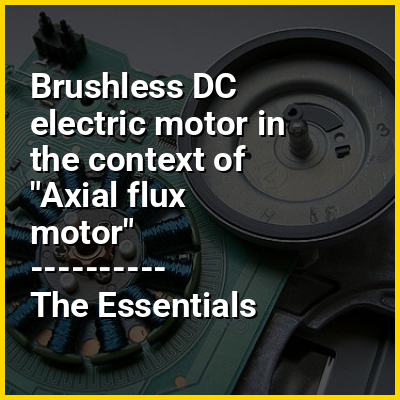
An axial flux motor (axial gap motor, or pancake motor) is a geometry of electric motor construction where the gap between the rotor and stator, and therefore the direction of magnetic flux between the two, is aligned parallel with the axis of rotation, rather than radially as with the concentric cylindrical geometry of the more common radial flux motor. With axial flux geometry torque increases with the cube of the rotor diameter, whereas in a radial flux the increase is only quadratic. Axial flux motors have a larger magnetic surface and overall surface area (for cooling) than radial flux motors for a given volume.
>>>PUT SHARE BUTTONS HERE<<<
In this Dossier
Brushless DC electric motor in the context of Armature (electrical)
In electrical engineering, the armature is the winding (or set of windings) of an electric machine which carries alternating current. The armature windings conduct AC even on DC machines, due to the commutator action (which periodically reverses current direction) or due to electronic commutation, as in brushless DC motors. The armature can be on either the rotor (rotating part) or the stator (field coil, stationary part), depending on the type of electric machine.
Shapes of armatures used in motors include double-T and triple-T armatures.
Brushless DC electric motor in the context of Brushed motor
A brushed DC electric motor is an internally commutated electric motor designed to be run from a direct current power source and utilizing an electric brush for contact.
Brushed motors were the first commercially important application of electric power to driving mechanical energy, and DC distribution systems were used for more than 100 years to operate motors in commercial and industrial buildings. Brushed DC motors can be varied in speed by changing the operating voltage or the strength of the magnetic field. Depending on the connections of the field to the power supply, the speed and torque characteristics of a brushed motor can be altered to provide steady speed or speed inversely proportional to the mechanical load. Brushed motors continue to be used for electrical propulsion, cranes, paper machines and steel rolling mills. Since the brushes wear down and require replacement, brushless DC motors using power electronic devices have displaced brushed motors from many applications.