Brown dwarf in the context of "Planetary ring"

Play Trivia Questions online!

or

Skip to study material about Brown dwarf in the context of "Planetary ring"

Ad spacer

⭐ Core Definition: Brown dwarf

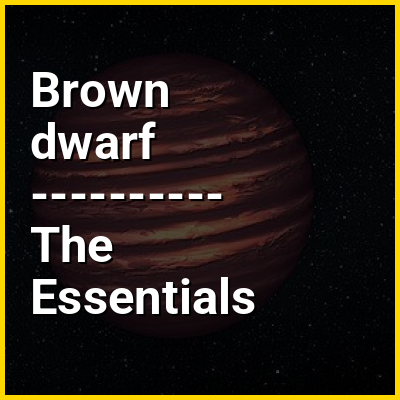
Brown dwarfs are substellar objects that have more mass than the biggest gas giant planets, but less than the least massive main-sequence stars. Their mass is approximately 13 to 80 times that of Jupiter (MJ)—not big enough to sustain nuclear fusion of hydrogen into helium in their cores, but massive enough to emit some light and heat from the fusion of deuterium, H, an isotope of hydrogen with a neutron as well as a proton, that can undergo fusion at lower temperatures. The most massive ones (> 65 MJ) can fuse lithium (Li).

Astronomers classify self-luminous objects by spectral type, a distinction intimately tied to the surface temperature, and brown dwarfs occupy types M (2100–3500 K), L (1300–2100 K), T (600–1300 K), and Y (< 600 K). As brown dwarfs do not undergo stable hydrogen fusion, they cool down over time, progressively passing through later spectral types as they age.
↓ Menu

>>>PUT SHARE BUTTONS HERE<<<
In this Dossier

Brown dwarf in the context of Planets

A planet is a large, rounded astronomical body that is generally required to be in orbit around a star, stellar remnant, or brown dwarf, and is not one itself. The Solar System has eight planets by the most restrictive definition of the term: the terrestrial planets Mercury, Venus, Earth, and Mars, and the giant planets Jupiter, Saturn, Uranus, and Neptune. The best available theory of planet formation is the nebular hypothesis, which posits that an interstellar cloud collapses out of a nebula to create a young protostar orbited by a protoplanetary disk. Planets grow in this disk by the gradual accumulation of material driven by gravity, a process called accretion.

The word planet comes from the Greek πλανήται (planḗtai) 'wanderers'. In antiquity, this word referred to the Sun, Moon, and five points of light visible to the naked eye that moved across the background of the stars—namely, Mercury, Venus, Mars, Jupiter, and Saturn. Planets have historically had religious associations: multiple cultures identified celestial bodies with gods, and these connections with mythology and folklore persist in the schemes for naming newly discovered Solar System bodies. Earth itself was recognized as a planet when heliocentrism supplanted geocentrism during the 16th and 17th centuries.

↑ Return to Menu

Brown dwarf in the context of SPECULOOS

SPECULOOS (Search for habitable Planets EClipsing ULtra-cOOl Stars) is a project consisting of SPECULOOS Southern Observatory (SSO) at the Paranal Observatory in Chile and SPECULOOS Northern Observatory (SNO) at the Teide Observatory in Tenerife.

The SSO consists of four Ritchey–Chrétien telescopes of 1-metre primary aperture, made by ASTELCO. Each telescope is equipped with a NTM-1000 robotic mount and will search for Earth-sized exoplanets around 1000 ultra-cool stars and brown dwarfs. As of June 2019, the SNO consists of one telescope, but more might be added in the future with up to three telescopes for SNO. SPECULOOS is complemented by SAINT-EX and TRAPPIST.

↑ Return to Menu

Brown dwarf in the context of 2MASS

The Two Micron All-Sky Survey (2MASS) was an astronomical survey of the whole sky in infrared light. It took place between 1997 and 2001, in two different locations: at the U.S. Fred Lawrence Whipple Observatory on Mount Hopkins, Arizona, and at the Cerro Tololo Inter-American Observatory in Chile, each using a 1.3-meter telescope for the Northern and Southern Hemisphere, respectively. It was conducted in the short-wavelength infrared at three distinct frequency bands (J, H, and K) near 2 micrometres, from which the photometric survey with its HgCdTe detectors derives its name.

2MASS produced an astronomical catalog with over 300 million observed objects, including minor planets of the Solar System, brown dwarfs, low-mass stars, nebulae, star clusters and galaxies. In addition, 1 million objects were cataloged in the 2MASS Extended Source Catalog (2MASX). The cataloged objects are designated with a "2MASS" and "2MASX" prefix, respectively.

↑ Return to Menu

Brown dwarf in the context of List of nearest stars and brown dwarfs

This list covers all known stars, white dwarfs, brown dwarfs, and sub-brown dwarfs/rogue planets within 20 light-years (6.13 parsecs) of the Sun. So far, 131 such objects have been found. Only 22 are bright enough to be visible without a telescope, for which the star's visible light needs to reach or exceed the dimmest brightness visible to the naked eye from Earth, which is typically around 6.5 apparent magnitude.

The known 131 objects are bound in 94 stellar systems. Of those, 103 are main sequence stars: 80 red dwarfs and 23 "typical" stars having greater mass. Additionally, astronomers have found 6 white dwarfs (stars that have exhausted all fusible hydrogen), 21 brown dwarfs, as well as 1 sub-brown dwarf, WISE 0855−0714 (possibly a rogue planet). The closest system is Alpha Centauri, with Proxima Centauri as the closest star in that system, at 4.2465 light-years from Earth. The brightest, most massive and most luminous object among those 131 is Sirius A, which is also the brightest star in Earth's night sky; its white dwarf companion Sirius B is the hottest object among them. The largest object within the 20 light-years is Procyon.

↑ Return to Menu

Brown dwarf in the context of Orion Nebula

The Orion Nebula (also known as Messier 42, M42, or NGC 1976) is a diffuse nebula in the Milky Way situated south of Orion's Belt in the constellation of Orion, and is known as the middle "star" in the "sword" of Orion. It is one of the brightest nebulae and is visible to the naked eye in the night sky with an apparent magnitude of 4.0. It is 1,344 ± 20 light-years (412.1 ± 6.1 pc) away and is the closest region of massive star formation to Earth. M42 is estimated to be 25 light-years across (so its apparent size from Earth is approximately 1 degree). It has a mass of about 2,000 times that of the Sun. Older texts frequently refer to the Orion Nebula as the Great Nebula in Orion or the Great Orion Nebula.

The Orion Nebula is one of the most scrutinized and photographed objects in the night sky and is among the most intensely studied celestial features. The nebula has revealed much about the process of how stars and planetary systems are formed from collapsing clouds of gas and dust. Astronomers have directly observed protoplanetary disks and brown dwarfs within the nebula, intense and turbulent motions of the gas, and the photo-ionizing effects of massive nearby stars in the nebula.

↑ Return to Menu

Brown dwarf in the context of Binary system

A binary system is a system of two astronomical bodies of the same kind that are comparable in size. Definitions vary, but typically require the center of mass to be located outside of either object. (See animated examples.)

The most common kinds of binary system are binary stars and binary asteroids, but brown dwarfs, planets, neutron stars, black holes and galaxies can also form binaries.

↑ Return to Menu

Brown dwarf in the context of Doppler spectroscopy

Doppler spectroscopy (also known as the radial-velocity method, or colloquially, the wobble method) is an indirect method for finding extrasolar planets and brown dwarfs from radial-velocity measurements via observation of Doppler shifts in the spectrum of the planet's parent star.As of June 2025, over 1,100 known extrasolar planets (about 19.0% of the total) have been discovered using Doppler spectroscopy.

↑ Return to Menu