Broadsheet in the context of Tabloid press


Broadsheet in the context of Tabloid press

Broadsheet Study page number 1 of 2

Play TriviaQuestions Online!

or

Skip to study material about Broadsheet in the context of "Tabloid press"


⭐ Core Definition: Broadsheet

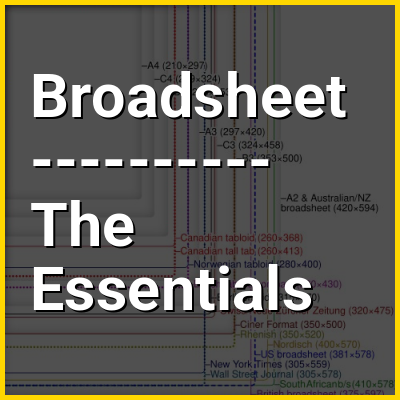
A broadsheet is the largest newspaper format and is characterized by long vertical pages, typically of 22.5 inches (57 cm) in height. Other common newspaper formats include the smaller Berliner and tabloidcompact formats.

Historically, the broadsheet format emerged in the 17th century as a means for printing musical and popular prints, and later became a medium for political activism through the reprinting of speeches. In Britain, the broadsheet newspaper developed in response to a 1712 tax on newspapers based on their page counts. Outside Britain, the broadsheet evolved for various reasons, including style and authority.

↓ Menu
HINT:

In this Dossier

Broadsheet in the context of Financial Times

The Financial Times (FT) is a British daily newspaper printed in broadsheet and also published digitally that focuses on business and economic current affairs. Based in London, the paper is owned by a Japanese holding company, Nikkei, with core editorial offices across Britain, the United States and continental Europe. In July 2015, Pearson sold the publication to Nikkei for £844 million (US$1.32 billion) after owning it since 1957. In 2019, it reported one million paying subscriptions, three-quarters of which were digital subscriptions. In 2023, it was reported to have 1.3 million subscribers of which 1.2 million were digital. The newspaper has a prominent focus on financial journalism and economic analysis rather than generalist reporting, drawing both criticism and acclaim. It sponsors an annual book award and publishes a "Person of the Year" feature.

The paper was founded in January 1888 as the London Financial Guide before rebranding a month later as the Financial Times. It was first circulated around metropolitan London by James Sheridan, who, along with his brother and Horatio Bottomley, sought to report on city business opposite the Financial News. The succeeding half-century of competition between the two papers eventually culminated in a 1945 merger, led by Brendan Bracken, which established it as one of the largest business newspapers in the world.

View the full Wikipedia page for Financial Times
↑ Return to Menu

Broadsheet in the context of Recto

Recto is the "right" or "front" side and verso is the "left" or "back" side when text is written or printed on a leaf of paper (folium) in a bound item such as a codex, book, broadsheet, or pamphlet.

In double-sided printing, each leaf has two pages – front and back. In modern books, the physical sheets of paper are stacked and folded in half, producing two leaves and four pages for each sheet. For example, the outer sheet in a 16-page book will have one leaf with pages 1 (recto) and 2 (verso), and another leaf with pages 15 (recto) and 16 (verso). Pages 1 and 16, for example, are printed on the same side of the physical sheet of paper, combining recto and verso sides of different leaves. The number of pages in a book using this binding technique must thus be a multiple of four, and the number of leaves must be a multiple of two, but unused pages are typically left unnumbered and uncounted. A sheet folded in this manner is known as a folio, a word also used for a book or pamphlet made with this technique.

View the full Wikipedia page for Recto
↑ Return to Menu

Broadsheet in the context of Pravda

Pravda (Russian: Правда, IPA: [ˈpravdə] , lit. 'Truth') is a Russian broadsheet newspaper, and was the official newspaper of the Central Committee of the Communist Party of the Soviet Union, when it was one of the most influential papers in the country with a circulation of 11 million. The newspaper began publication on 5 May 1912 in the Russian Empire but was already extant abroad in January 1911. It emerged as the leading government newspaper of the Soviet Union after the October Revolution. The newspaper was an organ of the Central Committee of the CPSU between 1912 and 1991.

After the dissolution of the Soviet Union, Pravda was sold by the then Russian president Boris Yeltsin to a Greek business family in 1992, and the paper came under the control of their private company Pravda International. In 1996, there was an internal dispute between the owners of Pravda International and some of the Pravda journalists that led to Pravda splitting into different entities. The Communist Party of the Russian Federation (CPRF) acquired the Pravda paper, while some of the original Soviet Pravda journalists separated to form Russia's first online paper Pravda Online (now Pravda.ru), which is not connected to the Communist Party. The Pravda paper is still run by the CPRF, whereas the online Pravda.ru is privately owned and has international editions published in Russian, English, French, and Portuguese. After a legal dispute between the rival parties, the Russian court of arbitration stipulated that both entities would be allowed to continue using the Pravda name.

View the full Wikipedia page for Pravda
↑ Return to Menu

Broadsheet in the context of English Dissenters

English Dissenters or English Separatists were Protestants who separated from the Church of England between the 16th and 19th centuries. English Dissenters opposed state interference in religious matters and founded their own churches, educational institutions and communities. They tended to see the established church as too Catholic, but did not agree on what should be done about it.

Some Dissenters emigrated to the New World, especially to the Thirteen Colonies and Canada. Brownists founded the Plymouth Colony. The English Dissenters played a pivotal role in the religious development of the United States and greatly diversified the religious landscape. Some originally agitated for a wide-reaching Protestant Reformation of the established Church of England, and they flourished during the Protectorate under Oliver Cromwell.

View the full Wikipedia page for English Dissenters
↑ Return to Menu

Broadsheet in the context of The Sunday Times

The Sunday Times is a British Sunday newspaper whose circulation makes it the largest in Britain's quality press market category. It was founded in 1821 as The New Observer. It is published by Times Newspapers Ltd, a subsidiary of News UK (formerly News International), which is owned by News Corp. Times Newspapers also publishes The Times. The two papers, founded separately and independently, have been under the same ownership since 1966. They were bought by News International in 1981.

In March 2020, The Sunday Times had a circulation of 647,622, exceeding that of its main rivals, The Sunday Telegraph and The Observer, combined. While some other national newspapers moved to a tabloid format in the early 2000s, The Sunday Times retained the larger broadsheet format and has said that it intends to continue to do so. As of December 2019, it sold 75% more copies than its sister paper, The Times, which is published from Monday to Saturday.

View the full Wikipedia page for The Sunday Times
↑ Return to Menu

Broadsheet in the context of The Daily Telegraph

The Daily Telegraph, known online and elsewhere as The Telegraph, is a British daily broadsheet conservative newspaper published in London by Telegraph Media Group and distributed in the United Kingdom and internationally. It was founded by Arthur B. Sleigh in 1855 as The Daily Telegraph and Courier. The Telegraph is considered a newspaper of record in the UK. The paper's motto, "Was, is, and will be", was included in its emblem which was used for over a century starting in 1858.

In 2013 The Daily Telegraph and The Sunday Telegraph, which started in 1961, were merged, although the latter retains its own editor. Both papers are politically conservative and support the Conservative Party, although the Daily Telegraph was moderately liberal before the late 1870s.

View the full Wikipedia page for The Daily Telegraph
↑ Return to Menu

Broadsheet in the context of Die Welt

Die Welt (German pronunciation: [diː ˈvɛlt], lit.'The World') is a German national daily newspaper, published as a broadsheet by Axel Springer SE.Die Welt is the flagship newspaper of the Axel Springer publishing group and it is considered a newspaper of record in Germany. Its leading competitors are the Frankfurter Allgemeine Zeitung, the Süddeutsche Zeitung and the Frankfurter Rundschau. The modern paper takes a self-described "liberal cosmopolitan" position in editing, but it is generally considered to be conservative.

During 2014, the average circulation of Die Welt was approximately 180,000. The paper may be obtained in more than 130 countries. Daily regional editions appear in Berlin and Hamburg. A daily regional supplement also appears in Bremen. The main editorial office is in Berlin, in conjunction with the Berliner Morgenpost.

View the full Wikipedia page for Die Welt
↑ Return to Menu

Broadsheet in the context of Tabloid (newspaper format)

A tabloid is a newspaper format characterized by its compact size, smaller than a broadsheet. The term originates from the 19th century, when the London-based pharmaceutical company Burroughs Wellcome & Co. used the term to describe compressed pills, later adopted by newspapers to denote condensed content. There are two main types of tabloid newspaper: red tops and compact, distinguished by editorial style.

Red top tabloids are distinct from broadsheet newspapers, which traditionally cater to more affluent, educated audiences with in-depth reporting and analysis. However, the line between tabloids and broadsheets has blurred in recent decades, as many broadsheet newspapers have adopted tabloid or compact formats to reduce costs and attract readers.

View the full Wikipedia page for Tabloid (newspaper format)
↑ Return to Menu

Broadsheet in the context of Chattanooga Times

The Chattanooga Times Free Press is a daily broadsheet newspaper published in Chattanooga, Tennessee, and is distributed in the metropolitan Chattanooga region of southeastern Tennessee and northwestern Georgia. It is one of Tennessee's major newspapers and is owned by WEHCO Media, Inc., a diversified communications company with ownership in 14 daily newspapers, 11 weekly newspapers and 13 cable television companies in six states.

View the full Wikipedia page for Chattanooga Times
↑ Return to Menu

Broadsheet in the context of The Sun (New York City)

The Sun was a New York newspaper published from 1833 until 1950. It was considered a serious paper, like the city's two more successful broadsheets, The New York Times and the New York Herald Tribune. The Sun was the first successful penny daily newspaper in the United States, and was for a time the most successful newspaper in America.

The paper had a central focus on crime news, in which it was a pioneer, and was the first journal to hire a police reporter. Its audience was primarily working class readers.

View the full Wikipedia page for The Sun (New York City)
↑ Return to Menu

Broadsheet in the context of Tabloid journalism

Tabloid journalism is a popular style of largely sensationalist journalism, which takes its name from the tabloid newspaper format: a small-sized newspaper also known as a half broadsheet. The size became associated with sensationalism, and tabloid journalism replaced the earlier label of yellow journalism and scandal sheets. Not all newspapers associated with tabloid journalism are tabloid size, and not all tabloid-size newspapers engage in tabloid journalism; since around the year 2000, many broadsheet newspapers converted to the more compact tabloid format.

In some cases, celebrities have successfully sued tabloids for libel, demonstrating that the tabloid's stories have defamed them. Publications engaging in tabloid journalism are also known as rag newspapers or simply rags. In the 21st century, tabloid journalism has shifted to online platforms targeting youth consumers with celebrity news and entertainment.

View the full Wikipedia page for Tabloid journalism
↑ Return to Menu

Broadsheet in the context of Rupert Murdoch

Keith Rupert Murdoch (/ˈmɜːrdɒk/ MUR-dok; born 11 March 1931) is an Australian and American former business magnate, investor, and media mogul. Through his company News Corp, he is the owner of hundreds of local, national, and international publishing outlets around the world, including in the United Kingdom (The Sun and The Times), in Australia (The Daily Telegraph, Herald Sun, and The Australian), in the United States (The Wall Street Journal and the New York Post), book publisher HarperCollins, and the television broadcasting channels Sky News Australia and Fox News (through Fox Corporation). He was also the owner of Sky (until 2018), 21st Century Fox (until 2019), and the now-defunct News of the World. With a net worth of US$21.7 billion as of 2 March 2022, Murdoch is the 31st richest person in the United States and the 71st richest in the world according to Forbes magazine. Due to his extensive wealth and influence over media and politics, Murdoch has been described as an oligarch.

After his father Keith Murdoch died in 1952, Murdoch took over the running of The News, a small Adelaide newspaper owned by his father. In the 1950s and 1960s, Murdoch acquired a number of newspapers in Australia and New Zealand before expanding into the United Kingdom in 1969, taking over the News of the World, followed closely by The Sun. In 1974, Murdoch moved to New York City, to expand into the American market; however, he retained interests in Australia and the United Kingdom. In 1981, Murdoch bought The Times, his first British broadsheet, and, in 1985, became a naturalized American citizen, giving up his Australian citizenship, to satisfy the legal requirement for American television network ownership. In 1986, keen to adopt newer electronic publishing technologies, Murdoch consolidated his British printing operations in London, causing bitter industrial disputes. His holding company News Corporation acquired Twentieth Century Fox (1985), HarperCollins (1989), and The Wall Street Journal (2007). Murdoch formed the British broadcaster BSkyB in 1990 and, during the 1990s, expanded into Asian networks and South American television. By 2000, Murdoch's News Corporation owned more than 800 companies in more than 50 countries, with a net worth of more than $5 billion.

View the full Wikipedia page for Rupert Murdoch
↑ Return to Menu

Broadsheet in the context of The Sun (United Kingdom)

The Sun is a British tabloid newspaper, published by the News Group Newspapers division of News UK, itself a wholly owned subsidiary of Lachlan Murdoch's News Corp. It was founded as a broadsheet in 1964 as a successor to the Daily Herald, and became a tabloid in 1969 after it was purchased by its current owner. The Sun had the largest daily newspaper circulation in the United Kingdom, but was overtaken by freesheet rival Metro in March 2018.

The paper became a seven-day operation when The Sun on Sunday was launched in February 2012 to replace the closed News of the World and employed some of its former journalists. In March 2020, the average circulation for The Sun was 1.21 million, The Sun on Sunday 1,013,777.

View the full Wikipedia page for The Sun (United Kingdom)
↑ Return to Menu

Broadsheet in the context of The Straits Times

The Straits Times (also known informally by its abbreviation ST) is a Singaporean daily English-language newspaper owned by the SPH Media Trust. Established on 15 July 1845, it is the most-widely circulated newspaper in the country and has a significant regional audience. The newspaper is published in the broadsheet format and online, the latter of which was launched in 1994. It is regarded as the newspaper of record for Singapore.

The newspaper has been generally received as having a close relationship with the government and toeing the party line.

View the full Wikipedia page for The Straits Times
↑ Return to Menu