Brain asymmetry in the context of "Left hemisphere"

Play Trivia Questions online!

or

Skip to study material about Brain asymmetry in the context of "Left hemisphere"


⭐ Core Definition: Brain asymmetry

In human neuroanatomy, brain asymmetry can refer to at least two quite distinct findings:

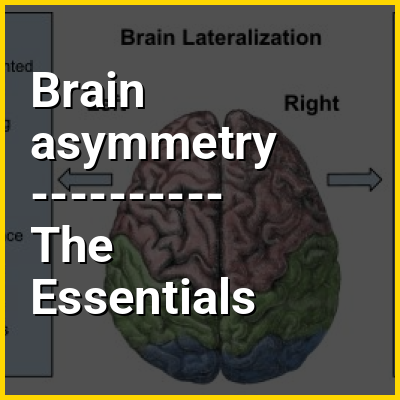
Neuroanatomical differences themselves exist on different scales, from neuronal densities, to the size of regions such as the planum temporale, to—at the largest scale—the torsion or "wind" in the human brain, reflected shape of the skull, which reflects a backward (posterior) protrusion of the left occipital bone and a forward (anterior) protrusion of the right frontal bone. In addition to gross size differences, both neurochemical and structural differences have been found between the hemispheres. Asymmetries appear in the spacing of cortical columns, as well as dendritic structure and complexity. Larger cell sizes are also found in layer III of Broca's area.
↓ Menu

In this Dossier

Brain asymmetry in the context of Lateralization of brain function

The lateralization of brain function (or hemispheric dominance/ lateralization) is the tendency for some neural functions or cognitive processes to be specialized to one side of the brain or the other. The median longitudinal fissure separates the human brain into two distinct cerebral hemispheres connected by the corpus callosum. Both hemispheres exhibit brain asymmetries in both structure and neuronal network composition associated with specialized function.

Lateralization of brain structures has been studied using both healthy and split-brain patients. However, there are numerous counterexamples to each generalization and each human's brain develops differently, leading to unique lateralization in individuals. This is different from specialization, as lateralization refers only to the function of one structure divided between two hemispheres. Specialization is much easier to observe as a trend, since it has a stronger anthropological history.

↑ Return to Menu