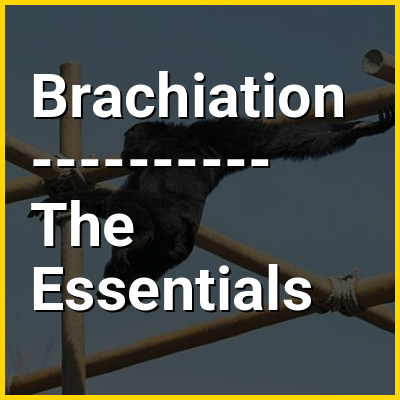
Brachiation (from "brachium", Latin for "arm"), or arm swinging, is a form of arboreal locomotion in which primates swing from tree limb to tree limb using only their arms. During brachiation, the body is alternately supported under each forelimb. This form of locomotion is the primary means of locomotion for the small gibbons and siamangs of southeast Asia. Gibbons in particular use brachiation for as much as 80% of their locomotor activities. Some New World monkeys, such as spider monkeys and muriquis, were initially classified as semibrachiators and move through the trees with a combination of leaping and brachiation. Some New World species also practice suspensory behaviors by using their prehensile tail, which acts as a fifth grasping hand. Evidence has shown that the extinct ape Proconsul from the Miocene of East Africa developed an early form of suspensory behaviour, and was therefore referred to as a probrachiator.
Upon further observations and more in depth understandings of the anatomy and behaviour of primates, the terms semibrachiator and probrachiator have largely fallen out of favour within the scientific community. Currently, researchers classify gibbons and siamangs as the only true brachiators and classify the great apes as modified brachiators. All other brachiation behaviours that do not meet either of these classifications are referred to as forearm suspensory postures and locomotion.