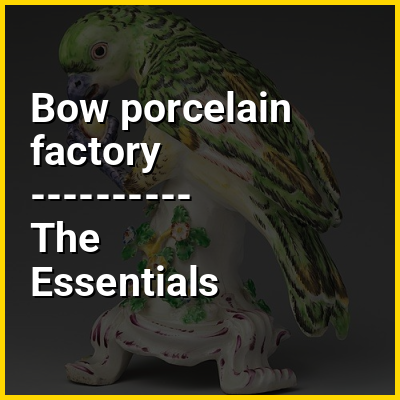
The Bow porcelain factory (active c. 1747–64 and closed in 1776) was an emulative rival of the Chelsea porcelain factory in the manufacture of early soft-paste porcelain in Great Britain. The two London factories were the first in England. It was originally located near Bow, in what is now the London Borough of Tower Hamlets, but by 1749 it had moved to "New Canton", sited east of the River Lea, and then in Essex, now in the London Borough of Newham.
Designs imitated imported Chinese and Japanese porcelains and the wares being produced at Chelsea, at the other end of London. From about 1753, Meissen figures were copied, both directly and indirectly through Chelsea. Quality was notoriously uneven; the warm, creamy body of Bow porcelains is glassy and the glaze tends towards ivory. The paste included bone ash, and Bow figures were made by pressing the paste into moulds, rather than the slipcasting used at Chelsea. Bow appears to have been the largest English factory of its period. After about 1760, quality declined, as more English factories opened, and the dependence on Chelsea models increased, perhaps aided by an influx of Chelsea workers after 1763, as production there decreased.