Bonus Army in the context of "U.S. Attorney General"

Play Trivia Questions online!

or

Skip to study material about Bonus Army in the context of "U.S. Attorney General"


⭐ Core Definition: Bonus Army

The Bonus Army was a group of 43,000 demonstrators—17,000 veterans of U.S. involvement in World War I, their families, and affiliated groups—who gathered in Washington, D.C., in mid-1932 to demand early cash redemption of their service bonus certificates. Organizers called the demonstrators the Bonus Expeditionary Force (B.E.F.), to echo the name of World War I's American Expeditionary Forces, while the media referred to them as the "Bonus Army" or "Bonus Marchers". The demonstrators were led by Walter W. Waters, a former sergeant. Many of the war veterans had been out of work during the beginning of the Great Depression. The World War Adjusted Compensation Act of 1924 had awarded all World War I veterans "bonuses" in the form of certificates they could not redeem until 1945. Each certificate, issued to a qualified veteran soldier, bore a face value equal to the soldier's promised payment with compound interest. The principal demand of the Bonus Army was the immediate cash payment of their certificates.

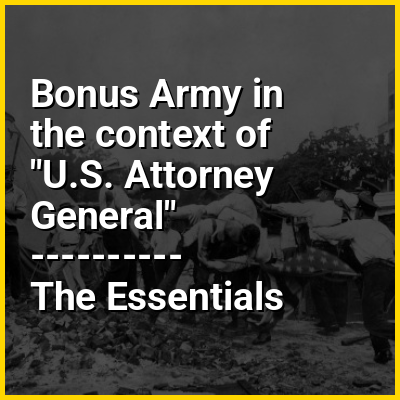
On July 28, 1932, U.S. Attorney General William D. Mitchell ordered the veterans removed from all government property. Washington police met with resistance, shot at the protestors, and two veterans were wounded and later died. President Herbert Hoover then ordered the U.S. Army to clear the marchers' campsite. Army Chief of Staff General Douglas MacArthur commanded a contingent of infantry and cavalry, supported by six tanks. The Bonus Army marchers with their wives and children were driven out, and their shelters and belongings burned.
↓ Menu

In this Dossier

Bonus Army in the context of Douglas MacArthur

Douglas MacArthur (26 January 1880 – 5 April 1964) was an American general who served as a top commander during World War II and the Korean War, achieving the rank of General of the Army. He served with distinction in World War I; as chief of staff of the United States Army from 1930 to 1935; as Supreme Commander, Southwest Pacific Area, from 1942 to 1945 during WWII; as Supreme Commander for the Allied Powers overseeing the occupation of Japan from 1945 to 1951; and as head of the United Nations Command in the Korean War from 1950 to 1951. MacArthur was nominated for the Medal of Honor three times, and awarded it for his WWII service in the Philippines. He is one of only five people to hold the rank of General of the Army, and the only person to hold the rank of Field Marshal in the Philippine Army.

MacArthur, the son of Medal of Honor recipient Arthur MacArthur Jr., was raised on Army posts in the Old West. He was valedictorian of the West Texas Military Academy, and First Captain at the U.S. Military Academy at West Point, where he graduated first in his class in 1903. During the 1914 U.S. occupation of Veracruz, he conducted a reconnaissance mission for which he was nominated for the Medal of Honor. In 1917, he was promoted from major to colonel and became chief of staff of the 42nd (Rainbow) Division. On the Western Front during World War I, he rose to the rank of brigadier general, was again nominated for a Medal of Honor, and was awarded the Distinguished Service Cross twice and the Silver Star seven times. From 1919 to 1922, MacArthur served as Superintendent of the U.S. Military Academy, where he initiated a series of reforms. His next posting was in the Philippines, where in 1924 he was instrumental in quelling the Philippine Scout Mutiny. In 1925, MacArthur became the Army's youngest major general at the age of 45, and in 1930 was appointed Chief of Staff of the U.S. Army. He was involved in the controversial expulsion of the Bonus Army protesters in Washington, D.C., in 1932, and organized the Civilian Conservation Corps. In 1935, MacArthur was appointed Military Advisor to the Commonwealth of the Philippines. He retired from the Army in 1937, but continued as an advisor and as a Field Marshal in the Philippine Army from 1936.

↑ Return to Menu