Black propaganda in the context of White propaganda


Black propaganda in the context of White propaganda

⭐ Core Definition: Black propaganda

Black propaganda is a form of propaganda intended to create the impression that it was created by those it is supposed to discredit. Black propaganda contrasts with gray propaganda, which does not identify its source, as well as white propaganda, which does not disguise its origins at all. It is typically used to vilify or embarrass the enemy through misrepresentation.

The major characteristic of black propaganda is that the audience are not aware that someone is influencing them, and do not feel that they are being pushed in a certain direction. Black propaganda purports to emanate from a source other than the true source. This type of propaganda is associated with covert psychological operations. Sometimes the source is concealed or credited to a false authority and spreads lies, fabrications, and deceptions. Black propaganda is the "big lie", including all types of creative deceit. Black propaganda relies on the willingness of the receiver to accept the credibility of the source. If the creators or senders of the black propaganda message do not adequately understand their intended audience, the message may be misunderstood, seem suspect, or fail altogether.
↓ Menu
HINT:

In this Dossier

Black propaganda in the context of Indonesian mass killings of 1965–66

From October of 1965 to March of 1966, a series of large-scale killings and civil unrest primarily targeting members and supposed sympathizers of the Communist Party of Indonesia (PKI) were carried out in Indonesia. Other affected groups included alleged communist sympathisers, Gerwani women, trade unionists, ethnic Javanese Abangan, ethnic Chinese, atheists, accused "kafir" (unbelievers in Islam), and alleged leftists in general. According to the most widely published estimates, at least 500,000 to 1 million people were killed. Some of the higher estimates reach figures as much as 2 to 3 million. The atrocities, sometimes described as a genocide or a politicide, were instigated by the Indonesian Army under Suharto. Research and declassified documents demonstrate the Indonesian authorities received support from foreign countries such as the United States and the United Kingdom.

The killings began as an anti-communist purge following a so-called attempted coup d'état by the 30 September Movement. It was a pivotal event in the transition to the "New Order" and the elimination of PKI as a political force, with impacts on the global Cold War. The Army, after banning all independent news source from issuing for a week, almost at once pinned the abortive coup attempt to the PKI. Additionally, the intelligence agencies of the United States, United Kingdom and Australia engaged in black propaganda campaigns against Indonesian communists. During the Cold War, the U.S., its government, and its Western allies had the goal of halting the spread of communism and bringing countries into the sphere of Western Bloc influence. Britain had additional reasons for seeking Sukarno's removal, as his government was involved in an undeclared war with neighbouring Malaysia, a Commonwealth federation of former British colonies.

View the full Wikipedia page for Indonesian mass killings of 1965–66
↑ Return to Menu

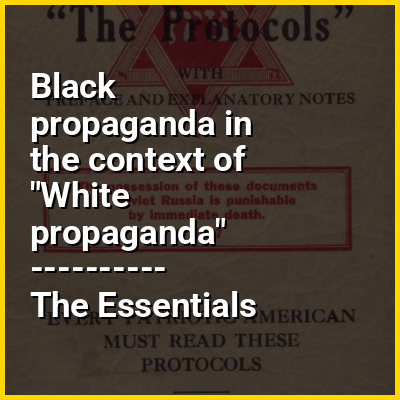
Black propaganda in the context of The Protocols of the Elders of Zion

The Protocols of the Elders of Zion is antisemitic propaganda purporting to detail a Jewish plot for global domination. Largely plagiarized from several earlier sources, it was first published in Imperial Russia in 1903, translated into multiple languages, and disseminated internationally in the early part of the 20th century. It played a key part in popularizing belief in an international Jewish conspiracy.

The text was exposed as fraudulent by the British newspaper The Times in 1921 and by the German newspaper Frankfurter Zeitung in 1924. Beginning in 1933, distillations of the work were assigned by some German teachers, as if they were factual, to be read by German schoolchildren throughout Nazi Germany. It remains widely available in numerous languages, in print and on the Internet, and continues to be presented by antisemitic groups as a genuine document. It has been described as "probably the most influential work of antisemitism ever written".

View the full Wikipedia page for The Protocols of the Elders of Zion
↑ Return to Menu

Black propaganda in the context of Information Research Department

The Information Research Department (IRD) was a secret Cold War propaganda department of the British Foreign Office, created to publish anti-communist propaganda, including black propaganda, provide support and information to anti-communist politicians, academics, and writers, and to use weaponised information, but also disinformation and "fake news", to attack not only its original targets but also certain socialists and anti-colonial movements. Soon after its creation, the IRD broke away from focusing solely on Soviet matters and began to publish pro-colonial propaganda intended to suppress pro-independence revolutions in Asia, Africa, Ireland, and the Middle East. The IRD was heavily involved in the publishing of books, newspapers, leaflets and journals, and even created publishing houses to act as propaganda fronts, such as Ampersand Limited. Operating for 29 years, the IRD is known as the longest-running covert government propaganda department in British history, the largest branch of the Foreign Office, and the first major anglophone propaganda offensive against the USSR since the end of World War II. By the 1970s, the IRD was performing military intelligence tasks for the British Military in Northern Ireland during The Troubles.

The IRD promoted works by many presumably anti-communist authors including George Orwell, Arthur Koestler, Bertrand Russell, and Robert Conquest.

View the full Wikipedia page for Information Research Department
↑ Return to Menu