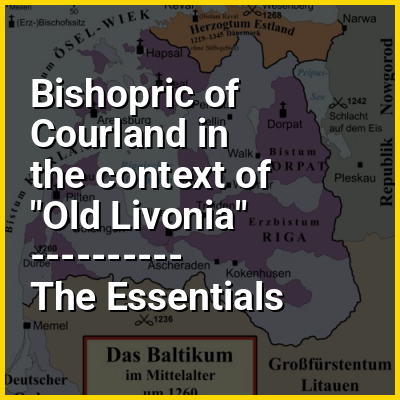
The Bishopric of Courland (Latin: Episcopatus Curoniensis, Low German: Bisdom Curland) was the second smallest (4500 km) ecclesiastical state in the Livonian Confederation founded in the aftermath of the Livonian Crusade. During the Livonian War in 1559 the bishopric became a possession of Denmark, and in 1585 sold by Denmark to Poland–Lithuania.
HINT:
In this Dossier
- ⭐ Core Definition: Bishopric of Courland
- Bishopric of Courland in the context of Livonia
- Bishopric of Courland in the context of Terra Mariana
Bishopric of Courland in the context of Livonia
Livonia, known in earlier records as Livland, is a historical region on the eastern shores of the Baltic Sea. It is named after the Livonians, who lived on the shores of present-day Latvia.
By the end of the 13th century, the name was extended to most of present-day Estonia and Latvia, which the Livonian Brothers of the Sword had conquered during the Livonian Crusade (1193–1290). Medieval Livonia, or Terra Mariana, reached its greatest extent after the Saint George's Night Uprising (1343–1345), which forced Denmark to sell the Duchy of Estonia (northern Estonia conquered by Denmark in the 13th century) to the State of the Teutonic Order in 1346. Livonia, as understood after the retreat of Denmark in 1346, bordered on the Gulf of Finland in the north, Lake Peipus and Russia to the east, and Lithuania to the south.
View the full Wikipedia page for LivoniaBishopric of Courland in the context of Terra Mariana
Terra Mariana (Medieval Latin for 'Land of Mary') was the formal name for Medieval Livonia or Old Livonia. It was formed in the aftermath of the Livonian Crusade, and its territories were composed of present-day Estonia and Latvia. It was established on 2 February 1207, as a principality of the Holy Roman Empire, and lost this status in 1215 when Pope Innocent III proclaimed it as directly subject to the Holy See.
The papal legate William of Modena divided Terra Mariana into feudal principalities: the Duchy of Estonia (dominum directum to the king of Denmark); the Archbishopric of Riga; the Bishopric of Courland; the Bishopric of Dorpat; the Bishopric of Ösel–Wiek; and territories under the military administration of the Livonian Brothers of the Sword. After the 1236 Battle of Saule, the surviving members of the Brothers merged in 1237 with the Teutonic Order of Prussia and became known as the Livonian Order. In 1346 the Livonian Order bought the Duchy of Estonia from Denmark.
View the full Wikipedia page for Terra Mariana