Bioerosion in the context of "Rogerella"

Play Trivia Questions online!

or

Skip to study material about Bioerosion in the context of "Rogerella"

Ad spacer

⭐ Core Definition: Bioerosion

Bioerosion describes the breakdown of hard ocean substrates – and less often terrestrial substrates – by living organisms. Marine bioerosion can be caused by mollusks, polychaete worms, phoronids, sponges, crustaceans, echinoids, and fish; it can occur on coastlines, on coral reefs, and on ships; its mechanisms include biotic boring, drilling, rasping, and scraping. On dry land, bioerosion is typically performed by pioneer plants or plant-like organisms such as lichen, and mostly chemical (e.g. by acidic secretions on limestone) or mechanical (e.g. by roots growing into cracks) in nature.

Bioerosion of coral reefs generates the fine and white coral sand characteristic of tropical islands. The coral is converted to sand by internal bioeroders such as algae, fungi, bacteria (microborers) and sponges (Clionaidae), bivalves (including Lithophaga), sipunculans, polychaetes, acrothoracican barnacles and phoronids, generating extremely fine sediment with diameters of 10 to 100 micrometres. External bioeroders include sea urchins (such as Diadema) and chitons. These forces in concert produce a great deal of erosion. Sea urchin erosion of calcium carbonate has been reported in some reefs at annual rates exceeding 20 kg/m.
↓ Menu

>>>PUT SHARE BUTTONS HERE<<<
In this Dossier

Bioerosion in the context of Trace fossil

A trace fossil, also called an ichnofossil (/ˈɪknˌfɒsɪl/; from Ancient Greek ἴχνος (íkhnos) 'trace, track'), is a fossil record of biological activity by lifeforms, but not the preserved remains of the organism itself. Trace fossils contrast with body fossils, which are the fossilized remains of parts of organisms' bodies, usually altered by later chemical activity or by mineralization. The study of such trace fossils is ichnology - the work of ichnologists.

Trace fossils may consist of physical impressions made on or in the substrate by an organism. For example, burrows, borings (bioerosion), urolites (erosion caused by evacuation of liquid wastes), footprints, feeding marks, and root cavities may all be trace fossils.

↑ Return to Menu

Bioerosion in the context of Acrothoracica

The Acrothoracica are an infraclass of barnacles.

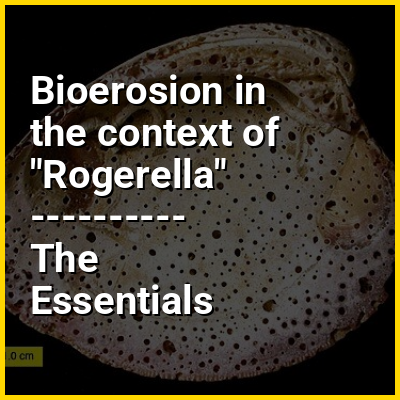
Acrothoracicans bore into calcareous material such as mollusc shells, coral, crinoids or hardgrounds, producing a slit-like hole in the surface known by the trace fossil name Rogerella. Acrothoracicans are typically smaller than other types of barnacle, being only a few millimetres in length. Being protected by the hard surfaces into which they have bored, they have no solid carapace of plates like other barnacles but have a soft, sac-like body fixed to the surface by a chitinous disc at the front of the head. They have from four to six pairs of feathery limbs, or "cirri", which they project out of their borings to catch drifting detritus for food. The mouthparts consist of mandibles, maxillules and maxillae. One pair of cirri is close to these while the others are at the other end of the body.

↑ Return to Menu