Binary operation in the context of "Associativity"

Play Trivia Questions online!

or

Skip to study material about Binary operation in the context of "Associativity"

Ad spacer

⭐ Core Definition: Binary operation

In mathematics, a binary operation or dyadic operation is a rule for combining two elements (called operands) to produce another element. More formally, a binary operation is an operation of arity two.

More specifically, a binary operation on a set is a binary function that maps every pair of elements of the set to an element of the set. Examples include the familiar arithmetic operations like addition, subtraction, multiplication, set operations like union, complement, intersection. Other examples are readily found in different areas of mathematics, such as vector addition, matrix multiplication, and conjugation in groups.

↓ Menu

>>>PUT SHARE BUTTONS HERE<<<
In this Dossier

Binary operation in the context of Material conditional

The material conditional (also known as material implication) is a binary operation commonly used in logic. When the conditional symbol is interpreted as material implication, a formula is true unless is true and is false.

Material implication is used in all the basic systems of classical logic as well as some nonclassical logics. It is assumed as a model of correct conditional reasoning within mathematics and serves as the basis for commands in many programming languages. However, many logics replace material implication with other operators such as the strict conditional and the variably strict conditional. Due to the paradoxes of material implication and related problems, material implication is not generally considered a viable analysis of conditional sentences in natural language.

↑ Return to Menu

Binary operation in the context of Exponentiation

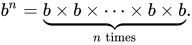
In mathematics, exponentiation, denoted b, is an operation involving two numbers: the base, b, and the exponent or power, n. When n is a positive integer, exponentiation corresponds to repeated multiplication of the base: that is, b is the product of multiplying n bases:In particular, .

The exponent is usually shown as a superscript to the right of the base as b or in computer code as b^n. This binary operation is often read as "b to the power n"; it may also be referred to as "b raised to the nth power", "the nth power of b", or, most briefly, "b to the n".

↑ Return to Menu

Binary operation in the context of Algebraic structures

In mathematics, an algebraic structure or algebraic system consists of a nonempty set A (called the underlying set, carrier set or domain), a collection of operations on A (typically binary operations such as addition and multiplication), and a finite set of identities (known as axioms) that these operations must satisfy.

An algebraic structure may be based on other algebraic structures with operations and axioms involving several structures. For instance, a vector space involves a second structure called a field, and an operation called scalar multiplication between elements of the field (called scalars), and elements of the vector space (called vectors).

↑ Return to Menu

Binary operation in the context of Algebraic operation

In mathematics, a basic algebraic operation is a mathematical operation similar to any one of the common operations of elementary algebra, which include addition, subtraction, multiplication, division, raising to a whole number power, and taking roots (fractional power). The operations of elementary algebra may be performed on numbers, in which case they are often called arithmetic operations. They may also be performed, in a similar way, on variables, algebraic expressions, and more generally, on elements of algebraic structures, such as groups and fields.

An algebraic operation on a set may be defined more formally as a function that maps to the tuples of a given length of elements of . The length of the tuples is called the arity of the operation, and each member of the tuple is called an operand. The most common case is the case of arity two, where the operation is called a binary operation and the operands form an ordered pair. A unary operation is an operation of arity one that has only one operand; for example, the square root. An example of a ternary operation (arity three) is the triple product.

↑ Return to Menu

Binary operation in the context of Unary operation

In mathematics, a unary operation is an operation with only one operand, i.e. a single input. This is in contrast to binary operations, which use two operands. An example is any function , where A is a set; the function is a unary operation on A.

Common notations are prefix notation (e.g. ¬, ), postfix notation (e.g. factorial n!), functional notation (e.g. sinx or sin(x)), and superscripts (e.g. transpose A). Other notations exist as well, for example, in the case of the square root, a horizontal bar extending the square root sign over the argument can indicate the extent of the argument.

↑ Return to Menu

Binary operation in the context of Operation (mathematics)

In mathematics, an operation is a function from a set to itself. For example, an operation on real numbers will take in real numbers and return a real number. An operation can take zero or more input values (also called "operands" or "arguments") to a well-defined output value. The number of operands is the arity of the operation.

The most commonly studied operations are binary operations (i.e., operations of arity 2), such as addition and multiplication, and unary operations (i.e., operations of arity 1), such as additive inverse and multiplicative inverse. An operation of arity zero, or nullary operation, is a constant. The mixed product is an example of an operation of arity 3, also called ternary operation.

↑ Return to Menu

Binary operation in the context of Subring

In mathematics, a subring of a ring R is a subset of R that is itself a ring when binary operations of addition and multiplication on R are restricted to the subset, and that shares the same multiplicative identity as R.
Cite error: There are <ref group=lower-alpha> tags or {{efn}} templates on this page, but the references will not show without a {{reflist|group=lower-alpha}} template or {{notelist}} template (see the help page).

↑ Return to Menu

Binary operation in the context of Group (mathematics)

In mathematics, a group is a set with an operation that combines any two elements of the set to produce a third element within the same set and the following conditions must hold: the operation is associative, it has an identity element, and every element of the set has an inverse element. For example, the integers with the addition operation form a group.

The concept of a group was elaborated for handling, in a unified way, many mathematical structures such as numbers, geometric shapes and polynomial roots. Because the concept of groups is ubiquitous in numerous areas both within and outside mathematics, some authors consider it as a central organizing principle of contemporary mathematics.

↑ Return to Menu

Binary operation in the context of Subgroup

In group theory, a branch of mathematics, a subset of a group G is a subgroup of G if the members of that subset form a group with respect to the group operation in G.

Formally, given a group G under a binary operation ∗, a subset H of G is called a subgroup of G if H also forms a group under the operation ∗. More precisely, H is a subgroup of G if the restriction of ∗ to H × H is a group operation on H. This is often denoted HG, read as "H is a subgroup of G".

↑ Return to Menu