Beth midrash in the context of "Yeshiva"

Play Trivia Questions online!

or

Skip to study material about Beth midrash in the context of "Yeshiva"


⭐ Core Definition: Beth midrash

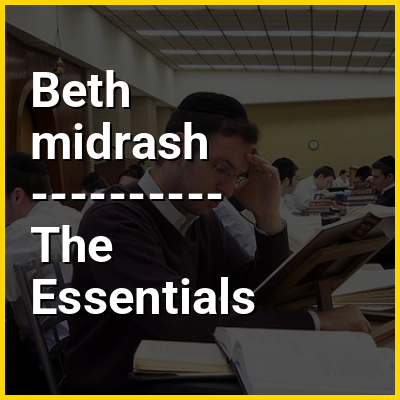
A beth midrash (Hebrew: בית מדרש, "house of learning"; pl.: batei midrash), also beis medrash, bais midrash, or beit midrash, is a hall dedicated for Torah study, often translated as a "study hall". It is distinct from a synagogue (beth knesseth), although the two are often coextensive. In Yiddish the beth midrash may be referred to as a zal, i.e. "hall". Beis midrash can also refer to a yeshiva gedolah, the undergraduate-level program in Orthodoxy, for boys over 12th grade.

The Arabic term "madrasah" is derived from the same Semitic root, and refers to any type of educational institution. The root דרש means "to seek [knowledge]" and is then generalized to mean "expound".

↓ Menu

👉 Beth midrash in the context of Yeshiva

A yeshiva (/jəˈʃvə/; Hebrew: ישיבה, lit.'sitting'; pl. ישיבות, yeshivot) is a traditional Jewish educational institution focused on the study of Rabbinic literature, primarily the Talmud and halacha (Jewish law), while Torah and Jewish philosophy are studied in parallel. The studying is usually done through daily shiurim (lectures or classes) as well as in study pairs called chavrusas (Aramaic for 'friendship' or 'companionship'). Chavrusa-style learning is one of the unique features of the yeshiva.

In the United States and Israel, different levels of yeshiva education have different names. In the U.S., elementary-school students enroll in a cheder, post-bar mitzvah-age students learn in a mesivta, and undergraduate-level students learn in a beit midrash or yeshiva gedola (Hebrew: ישיבה גדולה, lit.'large yeshiva' or 'great yeshiva'). In Israel, elementary-school students enroll in a Talmud Torah or cheder, post-bar mitzvah-age students learn in a yeshiva ketana (Hebrew: ישיבה קטנה, lit.'small yeshiva' or 'minor yeshiva'), and high-school-age students learn in a yeshiva gedola. A kollel is a yeshiva for married men, in which it is common to pay a token stipend to its students. Students of Lithuanian and Hasidic yeshivot gedolot (plural of yeshiva gedola) usually learn in yeshiva until they get married.

↓ Explore More Topics
In this Dossier

Beth midrash in the context of Synagogue

A synagogue, or synagog also called a shul or a temple, is a place of worship for Jews and Samaritans. It serves as a house of prayer (with a main sanctuary and sometimes smaller chapels) where Jews attend religious services or ceremonies such as weddings, bar and bat mitzvahs, choir performances, and children's plays. Synagogues often also contain study rooms, social halls, administrative and charitable offices, classrooms for religious and Hebrew studies, and spaces for community gatherings. They frequently display commemorative, historic, or modern artwork alongside items of Jewish historical significance or exhibits about the synagogue itself.

Synagogues are buildings used for Jewish prayer, study, assembly, and reading of the Torah. The Torah (Pentateuch or Five Books of Moses) is traditionally read in its entirety over a period of a year in weekly portions during services, or in some synagogues on a triennial cycle. However, the edifice of a synagogue as such is not essential for holding Jewish worship. Halakha (Jewish law from the Mishnah – the "Oral Torah") states that communal Jewish worship can be carried out wherever a minyan, a group of at least 10 Jewish adult men, is assembled, often (but not necessarily) led by a rabbi. This minyan is the essence of Jewish communal worship, which can also be conducted alone or with fewer than ten people, but that excludes certain prayers as well as communal Torah reading. In terms of its specific ritual and liturgical functions, the synagogue does not replace the long-destroyed Temple in Jerusalem.

↑ Return to Menu

Beth midrash in the context of Yeshivas Ner Yisroel

Ner Israel Rabbinical College (ישיבת נר ישראל), also known as NIRC and Ner Yisroel, is a Haredi yeshiva (Jewish educational institution) in Pikesville, Maryland. It was founded in 1933 by Rabbi Yaakov Yitzchok Ruderman, a disciple of Rabbi Nosson Tzvi Finkel (the Alter of Slabodka), dean of the Slabodka yeshiva in Lithuania. Rabbi Aharon Feldman, a disciple of Rabbi Ruderman and a member of the Moetzes Gedolei HaTorah of America, became its head in 2001.

The yeshiva is an all-male Lithuanian (Litvish)-style Talmudic academy and is politically affiliated with Agudath Israel of America. The yeshiva is composed of three departments: The Mechina for high school students (Mesivta Bochurim), the yeshiva for post high school students (Beis Medrash Bochurim), and the Kollel for married students (yungerleit—literally translated as "young men"). The graduates of Ner Yisroel are known for their dedication to Torah study and communal leadership.

↑ Return to Menu

Beth midrash in the context of Synagogues

A synagogue, or synagog also called a shul or a temple, is a place of worship for Jews and Samaritans. It serves as a house of prayer (with a main sanctuary and sometimes smaller chapels) where Jews attend religious services or ceremonies such as weddings, bar and bat mitzvahs, choir performances, and children's plays. Synagogues often also contain study rooms, social halls, administrative and charitable offices, classrooms for religious and Hebrew studies, and spaces for community gatherings. They frequently display commemorative, historic, or modern artwork alongside items of Jewish historical significance or exhibits about the synagogue itself.

Synagogues are buildings used for Jewish prayer, study, assembly, and reading of the Torah. The Torah (Pentateuch or Five Books of Moses) is traditionally read in its entirety over a period of a year in weekly portions during services, or in some synagogues on a triennial cycle. However, the edifice of a synagogue as such is not essential for holding Jewish worship. Halakha (Jewish law from the Mishnah – the "Oral Torah") states that communal Jewish worship can be carried out wherever a minyan, a group of at least 10 Jewish adults, is assembled, often (but not necessarily) led by a rabbi. This minyan is the essence of Jewish communal worship, which can also be conducted alone or with fewer than ten people, but that excludes certain prayers as well as communal Torah reading. In terms of its specific ritual and liturgical functions, the synagogue does not replace the long-destroyed Temple in Jerusalem.

↑ Return to Menu