Benz Patent-Motorwagen in the context of "Driving"

Play Trivia Questions online!

or

Skip to study material about Benz Patent-Motorwagen in the context of "Driving"

Ad spacer

⭐ Core Definition: Benz Patent-Motorwagen

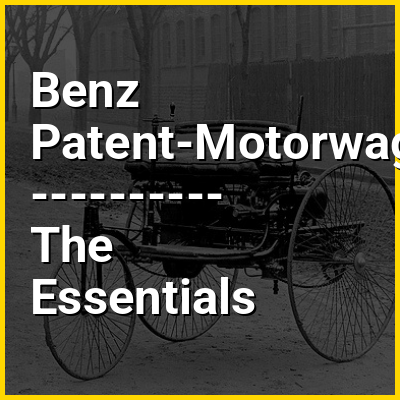
The Benz Patent-Motorwagen ("patent motorcar"), built in 1885 by the German engineer Karl Benz, is widely regarded as the first practical automobile and was the first car put into production. It was patented in January 1886 and unveiled in public later that year. The original cost of the vehicle was 600 imperial German marks, approximately 150 US dollars (equivalent to $5,200 in 2024).

Two years after Karl Benz drove the car in public in July 1886, Karl's wife Bertha demonstrated its feasibility in a trip from Mannheim to Pforzheim in August 1888. Around the same time, the Patent-Motorwagen became the first commercially available automobile in history. Émile Roger, who made Benz engines under license in France, was one of the first persons to buy Benz' car; from 1888, Roger was also the salesperson of the Benz Patent-Motorwagen in France, selling one to Émile Levassor in 1888. The Patent-Motorwagen was shown at an exhibition in Munich in 1888, winning a gold medal, and at the 1889 Paris Exposition.
↓ Menu

>>>PUT SHARE BUTTONS HERE<<<
In this Dossier

Benz Patent-Motorwagen in the context of Automobiles

A car, or an automobile, is a motor vehicle with wheels. Most definitions of cars state that they run primarily on roads, seat 1-8 people, have four wheels, and mainly transport people rather than cargo. There are around 1.644 billion cars in use worldwide as of January 2025.

The French inventor Nicolas-Joseph Cugnot built the first steam-powered road vehicle in 1769, while the Swiss inventor François Isaac de Rivaz designed and constructed the first internal combustion-powered automobile in 1808. The modern car—a practical, marketable automobile for everyday use—was invented in 1886, when the German inventor Carl Benz patented his Benz Patent-Motorwagen. Commercial cars became widely available during the 20th century. The 1901 Oldsmobile Curved Dash and the 1908 Ford Model T, both American cars, are widely considered the first mass-produced and mass-affordable cars, respectively. Cars were rapidly adopted in the US, where they replaced horse-drawn carriages. In Europe and other parts of the world, demand for automobiles did not increase until after World War II. In the 21st century, car usage is still increasing rapidly, especially in China, India, and other newly industrialised countries.

↑ Return to Menu

Benz Patent-Motorwagen in the context of Motorist

Driving is the controlled operation and movement of a land vehicle, including cars, taxis, ambulances, fire engines, tanks, vans, trucks and buses. A driver's permission to drive on public highways is granted based on a set of conditions being met, and drivers are required to follow the established road and traffic laws in the location they are driving. The word "driving" has etymology dating back to the 15th century. Its meaning has changed from primarily driving working animals in the 15th century to automobiles in the 19th century. Driving skills have also developed since the 15th century, with physical, mental and safety skills being required to drive. This evolution of the skills required to drive have been accompanied by the introduction of driving laws which relate not only to the driver but also to the driveability of a car.

The term "driver" originated in the 15th century, referring to the occupation of driving working animals such as pack or draft horses. It later applied to electric railway drivers in 1889 and motor-car drivers in 1896. The world's first long-distance road trip by automobile was in 1888, when Bertha Benz drove a Benz Patent-Motorwagen from Mannheim to Pforzheim, Germany. Driving requires both physical and mental skills, as well as an understanding of the rules of the road.

↑ Return to Menu

Benz Patent-Motorwagen in the context of Carl Benz

Carl (or Karl) Friedrich Benz (German: [kaʁl ˈfʁiːdʁɪç ˈbɛnts] ; born Karl Friedrich Michael Vaillant; 25 November 1844 – 4 April 1929) was a German engine designer and automotive engineer. His Benz Patent-Motorwagen from 1885 is considered the first practical, modern automobile and the first car to be put into series production. He received a patent for the motorcar in 1886, the same year he first publicly drove the Benz Patent-Motorwagen.

His company Benz & Cie., based in Mannheim, was the world's first automobile plant and largest of its day. In 1926, it merged with Daimler Motoren Gesellschaft to form Daimler-Benz, which produces the Mercedes-Benz among other brands.

↑ Return to Menu

Benz Patent-Motorwagen in the context of Bertha Benz

Bertha Benz (German: [ˈbɛʁta ˈbɛnts] ; née Cäcilie Bertha Ringer; 3 May 1849 – 5 May 1944) was a German automotive pioneer. She was the business partner, investor and wife of automobile inventor Carl Benz. On 5 August 1888, she was the first person to drive an internal-combustion-engined automobile over a long distance, field testing the Benz Patent-Motorwagen, inventing brake lining and solving several practical issues during the journey of 105 km (65 miles). In doing so, she brought the Patent-Motorwagen worldwide attention and got their company its first sales. Bertha Benz was not allowed to study in the Grand Duchy of Baden, and her financial and practical engineering contributions have long been overlooked until the 21st century.

↑ Return to Menu