Belgorod–Kharkov offensive operation in the context of "Battle of Kursk"

Play Trivia Questions online!

or

Skip to study material about Belgorod–Kharkov offensive operation in the context of "Battle of Kursk"

Ad spacer

⭐ Core Definition: Belgorod–Kharkov offensive operation

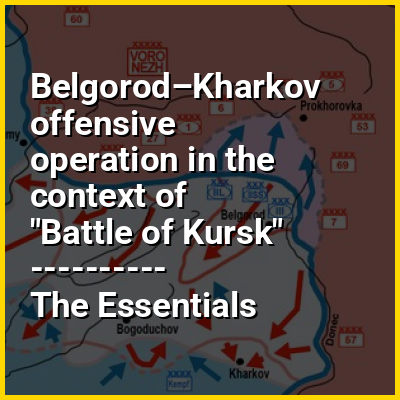
The Belgorod–Kharkov strategic offensive operation, or simply Belgorod–Kharkov offensive operation, was a Soviet strategic summer offensive that aimed to liberate Belgorod and Kharkov, and destroy Nazi German forces of the 4th Panzer Army and Army Detachment Kempf. The operation was codenamed Operation General Rumyantsev (Russian: Полководец Румянцев), after the 18th-century Field Marshal Peter Rumyantsev and was conducted by the Voronezh and Steppe Fronts (army groups) in the southern sector of the Kursk Bulge. The battle was referred to as the Fourth Battle of Kharkov (German: Vierte Schlacht bei Charkow) by the Germans.

The operation began in the early hours of 3 August 1943, with the objective of following up the successful Soviet defensive effort in the Battle of Kursk. The offensive was directed against the German Army Group South's northern flank. By 23 August, the troops of the Voronezh and Steppe Fronts had finally liberated Kharkov from German occupation and the last time that Kharkov changed hands in the Eastern Front. The operation led to the retreat of the German forces in Ukraine behind the Dnieper River and set the stage for the Second Battle of Kiev in autumn 1943.
↓ Menu

>>>PUT SHARE BUTTONS HERE<<<

👉 Belgorod–Kharkov offensive operation in the context of Battle of Kursk

The Battle of Kursk, also called the Battle of the Kursk Salient, was a major World War II Eastern Front battle between the forces of Nazi Germany and the Soviet Union near Kursk in southwestern Russia during the summer of 1943, resulting in a Soviet victory. The Battle of Kursk is the single largest battle in the history of warfare. It ranks only behind the Battle of Stalingrad several months earlier as the most often-cited turning point in the European theatre of the war. It was one of the costliest battles of the Second World War, the single deadliest armoured battle in history, the largest tank battle in history, and the opening day of the battle, 5 July, was the single costliest day in the history of aerial warfare in terms of aircraft shot down. The battle was further marked by fierce house-to-house fighting and hand-to-hand combat.

The battle began with the launch of the German offensive Operation Citadel (German: Unternehmen Zitadelle), on 5 July, which had the objective of pinching off the Kursk salient with attacks on the base of the salient from north and south simultaneously. After the German offensive stalled on the northern side of the salient, on 12 July, the Soviets commenced their Kursk Strategic Offensive Operation with the launch of Operation Kutuzov (Russian: Кутузов) against the rear of the German forces on the same side. On the southern side, the Soviets also launched powerful counterattacks the same day, one of which led to a large armoured clash, the Battle of Prokhorovka. On 3 August, the Soviets began the second phase of the Kursk Strategic Offensive Operation with the launch of the Belgorod–Kharkov offensive operation (Operation Polkovodets Rumyantsev, Полководец Румянцев) against the German forces on the southern side of the salient.

↓ Explore More Topics
In this Dossier