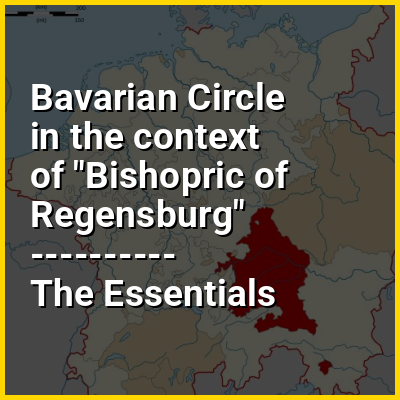
The Bavarian Circle (German: Bayerischer Reichskreis) was an imperial circle of the Holy Roman Empire. The most significant state by far in the circle was the Duchy of Bavaria (raised to an Electorate by Emperor Ferdinand II in 1623) with the Upper Palatinate territories. Other Imperial Estates like the Prince-Archbishopric of Salzburg, the Prince-Bishoprics of Freising, Passau and Regensburg as well as the imperial city of Regensburg, seat of the Imperial Diet from 1663, had a secondary importance. The elector of Bavaria and the archbishop of Salzburg acted as the circle's directors.
HINT:
In this Dossier
- ⭐ Core Definition: Bavarian Circle
- Bavarian Circle in the context of Prince-Archbishopric of Salzburg
- Bavarian Circle in the context of Imperial circle
Bavarian Circle in the context of Prince-Archbishopric of Salzburg
The Prince-Archbishopric of Salzburg (Latin: Archiepiscopatus Salisburgensis; German: Fürsterzbistum Salzburg; Erzstift Salzburg; Erzbistum Salzburg) was an ecclesiastical principality and state of the Holy Roman Empire. It comprised the secular territory ruled by the archbishops of Salzburg, as distinguished from the much larger Catholic diocese founded in 739 by Saint Boniface in the German stem duchy of Bavaria. The capital of the archbishopric was Salzburg, the former Roman city of Iuvavum.
From the late 13th century onwards, the archbishops gradually reached the status of Imperial immediacy and independence from the Bavarian dukes. Salzburg remained an ecclesiastical principality until its secularisation to the short-lived Electorate of Salzburg (later Duchy of Salzburg) in 1803. Members of the Bavarian Circle from 1500, the prince-archbishops bore the title of Primas Germaniae, though they never obtained electoral dignity; actually of the six German prince-archbishoprics (with Mainz, Cologne and Trier), Magdeburg, Bremen and Salzburg received nothing from the Golden Bull of 1356. The last prince-archbishop exercising secular authority was Count Hieronymus von Colloredo, who was a patron of the Salzburg-native composer Wolfgang Amadeus Mozart.
View the full Wikipedia page for Prince-Archbishopric of SalzburgBavarian Circle in the context of Imperial circle
During the early modern period, the Holy Roman Empire was divided into imperial circles (Latin: Circuli imperii; German: Reichskreise [ˈʁaɪçsˌkʁaɪzə]; singular: Circulus imperii, Reichskreis [ˈʁaɪçsˌkʁaɪs]), administrative groupings whose primary purposes were the organization of common defensive structure and the collection of imperial taxes. They were also used as a means of organization within the Imperial Diet and the Imperial Chamber Court. Each circle had a circle diet, although not every member of the circle diet would hold membership of the Imperial Diet as well.
Six imperial circles were introduced at the Diet of Augsburg in 1500. In 1512, three more circles were added, and the large Saxon Circle was split into two, so that from 1512 until the collapse of the Holy Roman Empire in the Napoleonic era, there were ten imperial circles. The Crown of Bohemia, the Swiss Confederacy and Italy remained unencircled, as did various minor territories which held imperial immediacy and mostly regrouped the semi-official Kingdom of Germany and the remains of the Kingdom of Arles.
View the full Wikipedia page for Imperial circle