Battle on the Ice in the context of Hermann of Dorpat


Battle on the Ice in the context of Hermann of Dorpat

⭐ Core Definition: Battle on the Ice

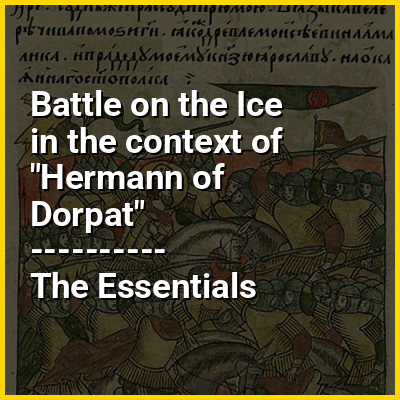
The Battle on the Ice, also known as the Battle of Lake Peipus, took place on 5 April 1242. It was fought on the frozen Lake Peipus when the united forces of the Republic of Novgorod and Vladimir-Suzdal, led by Prince Alexander Nevsky, emerged victorious against the forces of the Livonian Order and Bishopric of Dorpat, led by Bishop Hermann of Dorpat.

The outcome of the battle has been traditionally interpreted by Russian historiography as significant for the balance of power between Western Catholicism and Eastern Orthodox Christianity. It is disputed whether the battle should be considered a "crusade" or not, and whether it therefore represented a significant defeat for the Catholic forces during the Northern Crusades, thus bringing an end to their campaigns against the Orthodox Novgorod Republic and other Rus' territories. Estonian historian Anti Selart asserts that the crusades were not an attempt to conquer Rus', but still constituted an attack on the territory of Novgorod and its interests.
↓ Menu
HINT:

In this Dossier

Battle on the Ice in the context of Alexander Nevsky

Alexander Yaroslavich Nevsky (Russian: Александр Ярославич Невский; IPA: [ɐlʲɪˈksandr jɪrɐˈsɫavʲɪtɕ ˈnʲɛfskʲɪj] ; monastic name: Aleksiy; 13 May 1221 – 14 November 1263) was Prince of Novgorod (1236–1240; 1241–1256; 1258–1259) and Grand Prince of Vladimir (1252–1263).

A grandson of Vsevolod the Big Nest, Nevsky rose to legendary status after victories over Swedish invaders in the Battle of the Neva (1240), which earned him the title "Nevsky" in the 15th century, and over German crusaders in the Battle on the Ice (1242). He agreed to pay tribute to the Golden Horde, which allowed him to preserve the Eastern Orthodox Church, while fighting against foreign powers to the west and the south. Macarius, Metropolitan of Moscow canonized Alexander Nevsky as a saint of the Russian Orthodox Church in 1547.

View the full Wikipedia page for Alexander Nevsky
↑ Return to Menu