Battle of Stalingrad in the context of "Soviet Union in World War II"

Play Trivia Questions online!

or

Skip to study material about Battle of Stalingrad in the context of "Soviet Union in World War II"

Ad spacer

⭐ Core Definition: Battle of Stalingrad

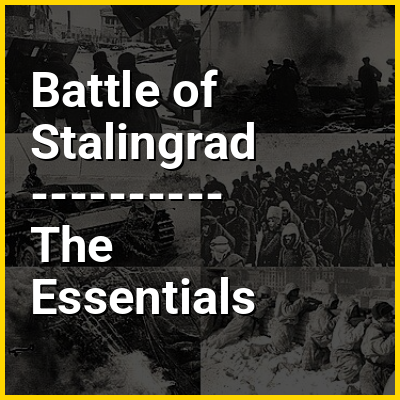
The Battle of Stalingrad (17 July 1942 – 2 February 1943) was a major battle on the Eastern Front of World War II, beginning when Nazi Germany and its Axis allies attacked and became locked in a protracted struggle with the Soviet Union for control over the Soviet city of Stalingrad (now known as Volgograd) in southern Russia. The battle was characterized by fierce close-quarters combat and direct assaults on civilians in aerial raids; the battle epitomized urban warfare, and it was the single largest and costliest urban battle in military history. It was the bloodiest and fiercest battle of the entirety of World War II—and arguably in all of human history—as both sides suffered tremendous casualties amidst ferocious fighting in and around the city. The battle is commonly regarded as the turning point in the European theatre of World War II, as Germany's Oberkommando der Wehrmacht was forced to withdraw a considerable amount of military forces from other regions to replace losses on the Eastern Front. By the time the hostilities ended, the German 6th Army and 4th Panzer Army had been destroyed and Army Group B was routed. The Soviets' victory at Stalingrad shifted the Eastern Front's balance of power in their favour, while also boosting the morale of the Red Army.

Both sides placed great strategic importance on Stalingrad, for it was one of the largest industrial centres of the Soviet Union and an important transport hub on the Volga River: controlling Stalingrad meant gaining access to the oil fields of the Caucasus and having supreme authority over the Volga River. The city also held significant symbolic importance because it bore the name of Joseph Stalin, the leader of the Soviet Union. As the conflict progressed, Germany's fuel supplies dwindled and thus drove it to focus on moving deeper into Soviet territory and taking the country's oil fields at any cost. The German military first clashed with the Red Army's Stalingrad Front on the distant approaches to Stalingrad on 17 July. On 23 August, the 6th Army and elements of the 4th Panzer Army launched their offensive with support from intensive bombing raids by the Luftwaffe, which reduced much of the city to rubble. The battle soon degenerated into house-to-house fighting, which escalated drastically as both sides continued pouring reinforcements into the city. By mid-November, the Germans, at great cost, had pushed the Soviet defenders back into narrow zones along the Volga's west bank. However, winter set in and conditions became particularly brutal, with temperatures often dropping tens of degrees below freezing. In addition to fierce urban combat, brutal trench warfare was prevalent at Stalingrad.
↓ Menu

>>>PUT SHARE BUTTONS HERE<<<
In this Dossier

Battle of Stalingrad in the context of Eastern Front (World War II)

The Eastern Front, also known as the Great Patriotic War in the Soviet Union and its successor states, and the German–Soviet War in modern Germany and Ukraine, was a theatre of World War II fought between the European Axis powers and Allies, including the Soviet Union (USSR) and Poland. It encompassed Central Europe, Eastern Europe, Northeast Europe (Baltics), and Southeast Europe (Balkans), and lasted from 22 June 1941 to 9 May 1945. Of the estimated 70–85 million deaths attributed to the war, around 30 million occurred on the Eastern Front, including 9 million children. The Eastern Front was decisive in determining the outcome in the European theatre of operations in World War II and is the main cause of the defeat of Nazi Germany and the Axis nations. Historian Geoffrey Roberts noted that "more than 80 percent of all combat during the Second World War took place on the Eastern Front".

The Axis forces, led by Germany, invaded the Soviet Union in Operation Barbarossa on 22 June 1941. Despite warnings and the deployment of Axis armies on his borders, Stalin refused to believe that Hitler would invade and forbade any defensive preparations. Thus the Soviets were caught completely unprepared. They were unable to halt deep Axis advances into Russia, which came close to seizing Moscow. However, the Axis failed to capture the city, and Hitler shifted his focus to the oil fields of the Caucasus the following year. German forces advanced into the Caucasus under Fall Blau ("Case Blue"), launched on 28 June 1942. The Soviets decisively defeated the Axis at the Battle of Stalingrad—the bloodiest battle in the war and arguably in all of history—making it one of the key turning points of the front. A second great Axis defeat, at the Battle of Kursk, crippled German offensive capabilities permanently and cleared the way for Soviet offensives. Several Axis allies defected to the Allies, such as Italy, Romania and Bulgaria. The Eastern Front concluded with the capture of Berlin, followed by the signing of the German Instrument of Surrender on 8 May, ending the Eastern Front and the war in Europe.

↑ Return to Menu

Battle of Stalingrad in the context of Stalingrad

Volgograd, formerly Tsaritsyn (1589–1925) and Stalingrad (1925–1961), is the largest city and the administrative centre of Volgograd Oblast, Russia. The city lies on the western bank of the Volga, covering an area of 859.4 square kilometres (331.8 square miles), with a population of slightly over one million residents. Volgograd is the 16th-largest city by population size in Russia, the third-largest city of the Southern Federal District, and the fourth-largest city on the Volga.

The city was founded as the fortress of Tsaritsyn in 1589. By the 19th century, Tsaritsyn had become an important river-port and commercial centre, leading to its rapid population growth. In November 1917, at the start of the Russian Civil War, Tsaritsyn came under Bolshevik control. It fell briefly to the White Army in mid-1919 but returned to Bolshevik control in January 1920. In 1925, the city was renamed Stalingrad in honor of Joseph Stalin, who took part in defending the city against the White Army who had then ruled the country. During World War II, Axis forces attacked the city, leading to the Battle of Stalingrad, the largest and bloodiest battle in World War II, from which it received the title of Hero City. The Soviet victory at Stalingrad is widely held to be the turning point of World War II, leading to the destruction of the German army in the East. In 1961, Nikita Khrushchev's administration renamed the city to Volgograd as part of de-Stalinization.

↑ Return to Menu

Battle of Stalingrad in the context of Battle of Kursk

The Battle of Kursk, also called the Battle of the Kursk Salient, was a major World War II Eastern Front battle between the forces of Nazi Germany and the Soviet Union near Kursk in southwestern Russia during the summer of 1943, resulting in a Soviet victory. The Battle of Kursk is the single largest battle in the history of warfare. It ranks only behind the Battle of Stalingrad several months earlier as the most often-cited turning point in the European theatre of the war. It was one of the costliest battles of the Second World War, the single deadliest armoured battle in history, the largest tank battle in history, and the opening day of the battle, 5 July, was the single costliest day in the history of aerial warfare in terms of aircraft shot down. The battle was further marked by fierce house-to-house fighting and hand-to-hand combat.

The battle began with the launch of the German offensive Operation Citadel (German: Unternehmen Zitadelle), on 5 July, which had the objective of pinching off the Kursk salient with attacks on the base of the salient from north and south simultaneously. After the German offensive stalled on the northern side of the salient, on 12 July, the Soviets commenced their Kursk Strategic Offensive Operation with the launch of Operation Kutuzov (Russian: Кутузов) against the rear of the German forces on the same side. On the southern side, the Soviets also launched powerful counterattacks the same day, one of which led to a large armoured clash, the Battle of Prokhorovka. On 3 August, the Soviets began the second phase of the Kursk Strategic Offensive Operation with the launch of the Belgorod–Kharkov offensive operation (Operation Polkovodets Rumyantsev, Полководец Румянцев) against the German forces on the southern side of the salient.

↑ Return to Menu

Battle of Stalingrad in the context of Second Jassy–Kishinev Offensive

The second Jassy–Kishinev offensive, named after the two major cities, Jassy and Kishinev, in the staging area, was a Soviet offensive against Axis forces, which took place in Eastern Romania from 20 to 29 August 1944 during World War II. The 2nd and 3rd Ukrainian Fronts of the Red Army engaged Army Group South Ukraine, which consisted of combined German and Romanian formations, in an operation to reoccupy Bessarabia and destroy the Axis forces in the region, opening the way into Romania and the Balkans.

The offensive resulted in the encirclement and destruction of the German forces, allowing the Soviet Army to resume its strategic advance further into Eastern Europe. It also pressured Romania to switch allegiance from the Axis powers to the Allies. For the Germans, this was a massive defeat, which can be compared to the defeat at Stalingrad.

↑ Return to Menu

Battle of Stalingrad in the context of Nikita Khrushchev

Nikita Sergeyevich Khrushchev (15 April [O.S. 3 April] 1894 – 11 September 1971) was the First Secretary of the Communist Party of the Soviet Union from 1953 to 1964 and the Chairman of the Council of Ministers from 1958 to 1964. As leader of the Soviet Union, he stunned the world by denouncing his predecessor Joseph Stalin, embarking on a campaign of de-Stalinization, and presiding over the Cuban Missile Crisis in 1962.

Nikita Khrushchev was born in a village in western Russia on 15 April 1894. He was employed as a metal worker during his youth and was a political commissar in the Russian Civil War. Under the sponsorship of Lazar Kaganovich, Khrushchev rose through the ranks of the Soviet hierarchy. During Stalin's rule, he actively supported the Great Purge and approved thousands of arrests. In 1938, Stalin sent him to govern the Ukrainian SSR, and he continued the purges there. During the Great Patriotic War, Khrushchev was again a commissar, serving as an intermediary between Stalin and his generals. He was also present at the defense of Stalingrad, a fact in which he took great pride. After the war, Khrushchev returned to Ukraine before being recalled to Moscow as one of Stalin's close advisers.

↑ Return to Menu

Battle of Stalingrad in the context of Umberto II

Umberto II (Italian: Umberto Nicola Tommaso Giovanni Maria di Savoia; 15 September 1904 – 18 March 1983) was the last king of Italy. Umberto's reign lasted for 34 days, from 9 May 1946 until his formal deposition on 12 June 1946, although he had been the de facto head of state since 1944. Due to his short reign, he was nicknamed the May King (Italian: Re di maggio).

Umberto was the third child and only son among the five children of Victor Emmanuel III and Elena of Montenegro. As heir apparent to the throne, he received a customary military education and pursued a military career afterwards. In 1940, he commanded an army group during the brief Italian invasion of France shortly before the French capitulation. In 1942, he was promoted to Marshal of Italy but was otherwise inactive as an army commander during much of World War II. Umberto turned against the war following Italian defeats at Stalingrad and El Alamein, and tacitly supported the ouster of Benito Mussolini.

↑ Return to Menu