Bare mass in the context of Quantum fluctuations


Bare mass in the context of Quantum fluctuations

Bare mass Study page number 1 of 1

Play TriviaQuestions Online!

or

Skip to study material about Bare mass in the context of "Quantum fluctuations"


⭐ Core Definition: Bare mass

In quantum field theory, specifically the theory of renormalization, the bare mass of an elementary particle is the limit of its mass as the scale of distance approaches zero or, equivalently, as the energy of a particle collision approaches infinity. It differs from the invariant mass as usually understood because the latter includes the 'clothing' of the particle by pairs of virtual particles that are temporarily created by the fields around the particle. In some versions of QFT, the bare mass of some particles may be plus or minus infinity. In the theory of the electroweak interaction using the Higgs boson, all particles have a bare mass of zero.

This allows us to write , where denotes the experimentally observable mass of the particle, its bare mass, and the increase in mass owing to the interaction of the particle with the medium or field.

↓ Menu
HINT:

In this Dossier

Bare mass in the context of Quantum fluctuation

In quantum physics, a quantum fluctuation (also known as a vacuum state fluctuation or vacuum fluctuation) is the temporary random change in the amount of energy in a point in space, as prescribed by Werner Heisenberg's uncertainty principle. They are minute random fluctuations in the values of the fields which represent elementary particles, such as electric and magnetic fields which represent the electromagnetic force carried by photons, W and Z fields which carry the weak force, and gluon fields which carry the strong force.

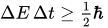
The uncertainty principle states the uncertainty in energy and time can be related by , where 1/2ħ5.27286×10 J⋅s. This means that pairs of virtual particles with energy and lifetime shorter than are continually created and annihilated in empty space. Although the particles are not directly detectable, the cumulative effects of these particles are measurable. For example, without quantum fluctuations, the "bare" mass and charge of elementary particles would be infinite; from renormalization theory the shielding effect of the cloud of virtual particles is responsible for the finite mass and charge of elementary particles.

View the full Wikipedia page for Quantum fluctuation
↑ Return to Menu