Barbara Radziwiłł in the context of "Jagiellon dynasty"

Play Trivia Questions online!

or

Skip to study material about Barbara Radziwiłł in the context of "Jagiellon dynasty"


⭐ Core Definition: Barbara Radziwiłł

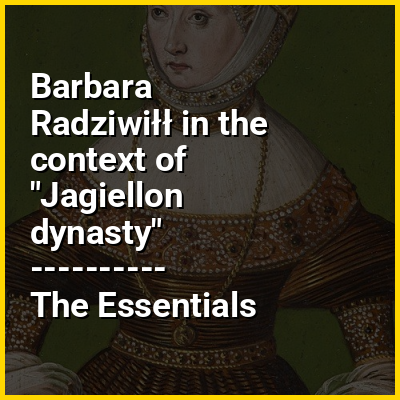
Barbara Radziwiłł (Polish: Barbara Radziwiłłówna, Lithuanian: Barbora Radvilaitė; 6 December 1520/23 – 8 May 1551) was Queen of Poland and Grand Duchess of Lithuania as the second wife of Sigismund II Augustus, the last male monarch of the Jagiellon dynasty. Barbara, a great beauty and already widowed, became a royal mistress most likely in 1543 and they married in secret in July or August 1547. The marriage caused a scandal; it was vehemently opposed by Polish nobles, including Queen mother Bona Sforza. Sigismund Augustus, assisted by Barbara's cousin Mikołaj Radziwiłł the Black and brother Mikołaj Radziwiłł the Red, worked tirelessly to gain recognition of their marriage and to crown Barbara as Queen of Poland. They succeeded and Barbara's coronation was held on 7 December 1550 at Wawel Cathedral. However, her health was already failing and she died just five months later. Even though it was brief, her reign propelled the Radziwiłł family to new heights of political power and influence.

Her contemporaries generally viewed Barbara in a negative light, accusing her of promiscuity and witchcraft. Her life became surrounded by many rumors and myths. She was a heroine of many legends in a wide range of literary works. From the 18th century, the life of Barbara became romanticized as the great tragic love affair. It has been used as an example of "love conquers all" with Bona Sforza often acting as the chief villain. It caught public imagination and has inspired many artists to create poems, plays, films, and other works. That made Barbara Radziwiłł one of the best known and most recognized women in the history of the Grand Duchy of Lithuania and Kingdom of Poland.
↓ Menu

In this Dossier

Barbara Radziwiłł in the context of Polish Golden Age

The Polish Golden Age (Polish: Złoty Wiek Polski [ˈzwɔ.tɘ ˈvjɛk ˈpɔl.ski] ) was the Renaissance period in the Kingdom of Poland and subsequently in the Polish–Lithuanian Commonwealth, which started in the late 15th century. Historians argue that the Polish Golden Age ended by the mid-17th century, when Poland was ravaged by the Khmelnytsky Uprising (1648–57) and by the Swedish and Russian invasion. During its Golden Age, the Commonwealth became one of the largest kingdoms of Europe and at its peak stretched from modern-day Estonia in the north to Moldavia in the south and from Moscow in the east to Brandenburg in the west.

In the 16th century the Polish–Lithuanian Commonwealth grew to 1 million km, with a population of 11 million. It prospered from its enormous grain, wood, salt, and cloth trade with Western Europe via the Baltic Sea ports of Gdańsk, Elbląg, Riga, Memel, and Königsberg. The Commonwealth's major cities also included Poznań, Kraków, Warsaw, Lwów, Wilno, Toruń, and, for a time, Kyiv and Smolensk. The Commonwealth army was able to defend the realm from foreign invasion, and also participated in aggressive campaigns against Poland's neighbors. As voluntary Polonization followed in unified territories, the Polish language became the lingua franca of Central and Eastern Europe.

↑ Return to Menu

Barbara Radziwiłł in the context of Undead

The undead are beings in mythology, legend, or fiction that are deceased but behave as if they were alive. A common example of an undead being is a corpse reanimated by supernatural forces, by the application of either the deceased's own life force or that of a supernatural being (such as a demon, or other evil spirit). The undead may be incorporeal (ghosts) or corporeal (mummies, vampires, skeletons, and zombies).

The undead are featured in the belief systems of most cultures, and appear in many works of fantasy and horror fiction. The term is also occasionally used for real-life attempts to resurrect the dead with science and technology, from early experiments like Robert E. Cornish's to future sciences such as "chemical brain preservation" and "cryonics." While the term usually refers to corporeal entities, in some cases (for example, in Dungeons & Dragons), the term also includes incorporeal forms of the dead, such as ghosts.

↑ Return to Menu