Baltic languages in the context of "History of Proto-Slavic"

Play Trivia Questions online!

or

Skip to study material about Baltic languages in the context of "History of Proto-Slavic"

Ad spacer

⭐ Core Definition: Baltic languages

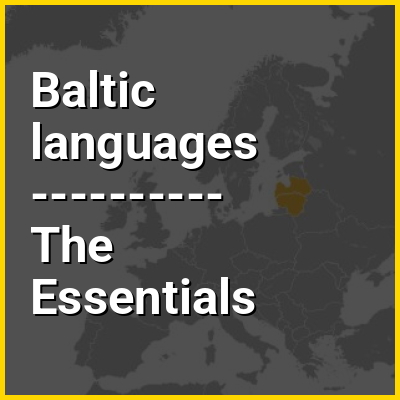
The Baltic languages are a branch of the Indo-European language family spoken natively or as a second language by a population of about 6.5–7.0 million people mainly in areas extending east and southeast of the Baltic Sea in Europe. Together with the Slavic languages, they form the Balto-Slavic branch of the Indo-European family.

Scholars usually regard them as a single subgroup divided into two branches: West Baltic (containing only extinct languages) and East Baltic (containing at least two living languages, Lithuanian, Latvian, and by some counts including Latgalian and Samogitian as separate languages rather than dialects of those two). In addition, the existence of the Dnieper-Oka language is hypothesized, with the extinct Golyad language being the only known member. The range of the East Baltic linguistic influence once possibly reached as far as the Ural Mountains, but this hypothesis has been questioned.
↓ Menu

>>>PUT SHARE BUTTONS HERE<<<
In this Dossier

Baltic languages in the context of Languages of Europe

There are over 250 languages indigenous to Europe, and most belong to the Indo-European language family. Out of a total European population of 744 million as of 2018, some 94% are native speakers of an Indo-European language. The three largest phyla of the Indo-European language family in Europe are Romance, Germanic, and Slavic; they have more than 200 million speakers each, and together account for close to 90% of Europeans.

Smaller phyla of Indo-European found in Europe include Hellenic (Greek, c. 13 million), Baltic (c. 4.5 million), Albanian (c. 7.5 million), Celtic (c. 4 million), and Armenian (c. 4 million). Indo-Aryan, though a large subfamily of Indo-European, has a relatively small number of languages in Europe, and a small number of speakers (Romani, c. 1.5 million). However, a number of Indo-Aryan languages not native to Europe are spoken in Europe today.

↑ Return to Menu

Baltic languages in the context of Slavic languages

The Slavic languages, also known as the Slavonic languages, are Indo-European languages spoken primarily by the Slavic peoples and their descendants. They are thought to descend from a proto-language called Proto-Slavic, spoken during the Early Middle Ages, which in turn is thought to have descended from the earlier Proto-Balto-Slavic language, linking the Slavic languages to the Baltic languages in a Balto-Slavic group within the Indo-European family.

The current geographical distribution of natively spoken Slavic languages includes the Balkans, Central and Eastern Europe, and all the way from Western Siberia to the Russian Far East. Furthermore, the diasporas of many Slavic peoples have established isolated minorities of speakers of their languages all over the world. The number of speakers of all Slavic languages together was estimated to be 315 million at the turn of the twenty-first century. It is the largest and most diverse ethno-linguistic group in Europe.

↑ Return to Menu

Baltic languages in the context of Balto-Slavic

The Balto-Slavic languages form a branch of the Indo-European family of languages, traditionally comprising the Baltic and Slavic languages. Baltic and Slavic languages share several linguistic traits not found in any other Indo-European branch, which points to a period of common development and origin.

A Proto-Balto-Slavic language is reconstructable by the comparative method, descending from Proto-Indo-European by means of well-defined sound laws, and from which modern Slavic and Baltic languages descended. One particularly innovative dialect separated from the Balto-Slavic dialect continuum and became ancestral to the Proto-Slavic language, from which all Slavic languages descended.

↑ Return to Menu

Baltic languages in the context of Baltic tribes

The Balts or Baltic peoples (Lithuanian: baltai, Latvian: balti) are a group of peoples inhabiting the eastern coast of the Baltic Sea who speak Baltic languages. Among the Baltic peoples are modern-day Lithuanians (including Samogitians) and Latvians (including Latgalians) — all East Balts — as well as the Old Prussians, Curonians, Sudovians, Skalvians, Yotvingians and Galindians — the Western Balts — whose languages and cultures are now extinct, but made a large influence on the living branches, especially on literary Lithuanian language.

The Balts are descended from a group of Proto-Indo-European tribes who settled the area between the lower Vistula and southeast shore of the Baltic Sea and upper Daugava and Dnieper rivers, and which over time became differentiated into West and East Balts. In the fifth century CE, parts of the eastern Baltic coast began to be settled by the ancestors of the Western Balts, whereas the East Balts lived in modern-day Belarus, Ukraine and Russia. In the first millennium CE, large migrations of the Balts occurred. By the 13th and 14th centuries, the East Balts shrank to the general area that the present-day Balts and Belarusians inhabit.

↑ Return to Menu

Baltic languages in the context of Pitch-accent language

A pitch-accent language is a type of language that, when spoken, has certain syllables in words or morphemes that are prominent, as indicated by a distinct contrasting pitch (linguistic tone) rather than by volume or length, as in some other languages like English. Pitch-accent languages also contrast with fully tonal languages like Vietnamese, Thai and Standard Chinese, in which practically every syllable can have an independent tone. Some scholars have claimed that the term "pitch accent" is not coherently defined and that pitch-accent languages are a sub-category of tonal languages in general.

Languages that have been described as pitch-accent languages include: most dialects of Serbo-Croatian, Slovene, Baltic languages, Ancient Greek, Vedic Sanskrit, Tlingit, Turkish, Japanese, Limburgish, Norwegian, Swedish of Sweden, Western Basque, Yaqui, certain dialects of Korean, Shanghainese, and Livonian.

↑ Return to Menu

Baltic languages in the context of Proto-Balto-Slavic language

Proto-Balto-Slavic (PBS or PBSl) is a reconstructed proto-language descending from Proto-Indo-European (PIE). From Proto-Balto-Slavic, the later Balto-Slavic languages are thought to have developed, composed of the Baltic and Slavic sub-branches, and including modern Latvian, Lithuanian, Polish, Russian and Serbo-Croatian, among others.

Like most other proto-languages, it is not attested by any surviving texts but has been reconstructed using the comparative method. There are several isoglosses that Baltic and Slavic languages share in phonology, morphology and accentology, which represent common innovations from Proto-Indo-European times and can be chronologically arranged.

↑ Return to Menu

Baltic languages in the context of West Baltic languages

The West Baltic languages are a group of extinct Baltic languages that were spoken by West Baltic peoples. West Baltic is one of the two primary branches of Baltic languages, along with East Baltic. It includes Old Prussian, Sudovian, West Galindian, possibly Pomeranian Baltic, Skalvian and Old Curonian.

↑ Return to Menu