Ballaios in the context of "Adriatic"

Play Trivia Questions online!

or

Skip to study material about Ballaios in the context of "Adriatic"

Ad spacer

⭐ Core Definition: Ballaios

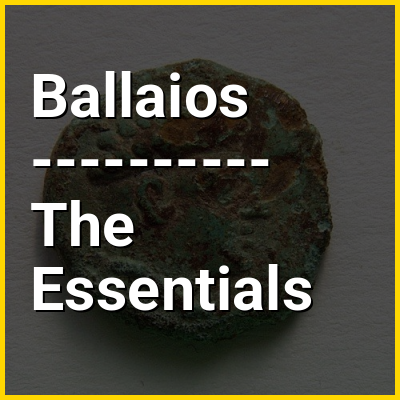
Ballaios (Ancient Greek: Βαλλαῖος; ruled c. 260 – c. 230 BC) was an Illyrian king of the Ardiaei tribe. Attested only in coinage, Ballaios is considered as the predecessor of Agron. He is considered to have been a powerful and influential king as testified by the abundance of his silver and bronze coinage found along both coasts of the Adriatic. A hoard found in 2010 is one of the biggest hoards of ancient coins known, not only from Illyria. The capital of Ballaios' kingdom was Rhizon.

His silver issues are rare, but bronze coins, without the royal title, occur on Hvar, both in single finds and in hoards, and at Rhizon in a different series bearing the royal title. In the city of Ulcinj there is still a fully functioning water source bearing his name: "Kroni i Ballos". The coins of Ballaios were widely imitated in the region, sometimes so crudely that they are unintelligible.
↓ Menu

>>>PUT SHARE BUTTONS HERE<<<
In this Dossier

Ballaios in the context of Illyrian kingdom

The Illyrian kingdom was an Illyrian political entity that existed on the western part of the Balkan Peninsula in ancient times. Regardless of the number of the alternately ruling dynasties, of their tribal affiliation, and of the actual extension of their kingdom, it represented an alliance of Illyrian tribes that united under the rulership of a single leader, expressly referred to as "King of the Illyrians" in ancient historical records (whether in Ancient Greek or in Latin). The monarchic superstructure of the Illyrian state coexisted with the Illyrian tribal communities and the republican system of the Illyrian koina.

The Enchele's polity was the earliest to emerge among Illyrians. The earliest known Illyrian king – Bardylis – emerged in southern Illyria around 400 BC, most likely centered in Dassaretis, a region along Lake Ohrid and east to the Prespa Lakes, located on the border between Macedon and Epirus. He aimed to make Illyria a regional power interfering with Macedon. He united many southern Illyrian tribes under his realm and defeated the Macedonians and Molossians several times, expanding his dominion over Upper Macedonia and Lynkestis and subjugating Macedon for several decades until he was decisively defeated by Philip II of Macedon. Before the Rise of Macedon Illyrians were the dominant power in the area. The kingdom of the Taulantii on the south-eastern coast of the Adriatic evidently reached its apex under Glaukias' rule and dominated southern Illyrian affairs in the late 4th century BC, exerting great influence on the Epirote state through the close ties with the Molossian king Pyrrhus.

↑ Return to Menu