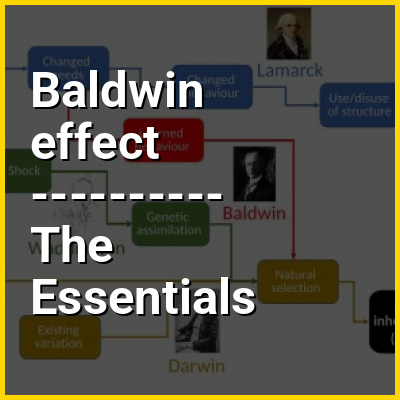
In evolutionary biology, what is now called the Baldwin effect describes the ways agency, imitation and learned behaviour can pioneer evolutionary change. It was first christened as such in the 1950s by George Gaylord Simpson, one of the architects of the modern synthesis, to bring attention to a process highlighted in the previous century by James Mark Baldwin.
Inspired to challenge late Victorian neo-darwinism by Darwin's own use of his theory of natural selection (in On the Origin of Species) to reframe the laws of use and disuse in terms of transitional habits—giving several examples of the ways different organisms' change of habits, as in flying squirrels and flightless beetles, have altered their anatomies' subsequent evolutionary fates—Baldwin and others re-emphasised that an organism's ability to learn new behaviours (e.g., to colonise new habitat or acclimatise to a new stressor) may affect its reproductive success and may, therefore, subsequently affect the genetic makeup of its species through natural selection, if supported by heritable traits. The Baldwin effect posits that, if such new habits prove advantageous, subsequent selection will reinforce those habits and any other structures they affect so that they will become instinctive or in-born over many generations. This process may appear similar to non-Darwinian Lamarckism, a view which proposes that living things may directly inherit their parents' acquired characteristics. But, in contrast to Lamarck, and echoing Darwin's argument about transitional habits in On the Origin of Species, Baldwin proposed that, only if supportable by heritable traits, can changed behaviour lead to adaptive evolutionary change.