Balasagan in the context of "Gilan"

Play Trivia Questions online!

or

Skip to study material about Balasagan in the context of "Gilan"


⭐ Core Definition: Balasagan

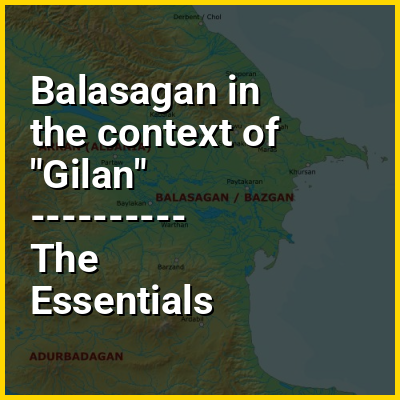
Balāsagān (an Iranian toponym meaning "country of Balas"; Armenian: Bałasakan, the inhabitants known as Bałasičkʻ, Arabic: Balāsajān/Balāšajān), also known as Bazgan, was a region located in the area of the Kura and Aras rivers, adjacent to the Caspian Sea. To the south, it bordered Atropatene/Adurbadagan and Gilan. It roughly corresponded to the Armenian province of Paytakaran, albeit extending farther into the north. It has been suggested that under the Sasanians the region extended as far as the stronghold of Derbent, albeit this remains disputed. The heartland of Balasagan was the Dasht i-Bałasakan ("Balasagan plain") which corresponds to the Mughan plain. During the late Sasanian era, Balasagan was included in the northern quadrant (kust) of Adurbadagan.

↓ Menu

In this Dossier

Balasagan in the context of Caspiane

Caspiane or Kaspiane (Greek: Κασπιανή, Armenian: Կասպք Kaspkʿ) was the land populated by the tribe of Caspians, after whom it received its name. Originally a province of the Medes in the 3rd-2nd centuries BC, the land of the Caspians was conquered in the 2nd century BC, then passed to Caucasian Albania under Sassanid Persian suzerainty in the 5th century, and later became an independent state. In the 2nd century AD, it became known as Paytakaran, and after 387 AD became a part of the Caucasian Albanian larger region of Balasakan.It roughly corresponded to the modern Mugan plain and Qaradagh regions.

↑ Return to Menu