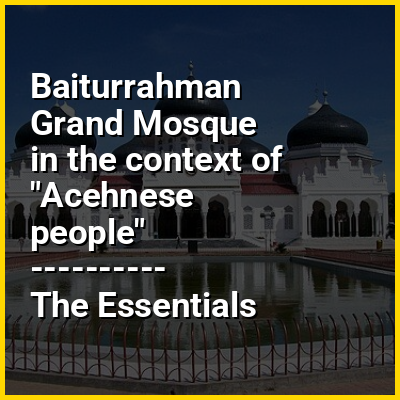
Baiturrahman Grand Mosque (Indonesian: Masjid Raya Baiturrahman; Acehnese: Meuseujid Raya Baiturrahman)is a mosque located in Banda Aceh, Aceh, Indonesia. The Baiturrahman Grand Mosque is a symbol of religion, culture, spirit, strength, struggle, and nationalism of the Acehnese people. The mosque is a landmark in Banda Aceh and has survived the 2004 Indian Ocean earthquake and tsunami.
HINT:
In this Dossier
- ⭐ Core Definition: Baiturrahman Grand Mosque
- Baiturrahman Grand Mosque in the context of Spread of Islam in Indonesia
Baiturrahman Grand Mosque in the context of Spread of Islam in Indonesia
The history of the arrival of Islam in Indonesia is somewhat unclear. One theory states that Islam arrived directly from Arabia as early as the 9th century, during the time of the Umayyad and Abbasid caliphates. Another theory credits Sufi travelers for bringing Islam in the 12th or 13th century, either from Gujarat in India or from Persia. Before the archipelago's conversion to Islam, the predominant religions in Indonesia were Hinduism (particularly its Shaivism tradition) and Buddhism.
The islands that now constitute Indonesia have been recognized for centuries as a source of spices such as nutmeg and cloves, which were key commodities in the spice trade long before the Portuguese arrived in the Banda Islands in 1511. Due to the archipelago's strategic place as the gateway between the Muslim world and Imperial China, it became a busy international hub for merchants engaged in many forms of trade. It became a place where different peoples shared their respective cultures, including Islam.
View the full Wikipedia page for Spread of Islam in Indonesia