Aurelian Walls in the context of "City wall"

Play Trivia Questions online!

or

Skip to study material about Aurelian Walls in the context of "City wall"

Ad spacer

⭐ Core Definition: Aurelian Walls

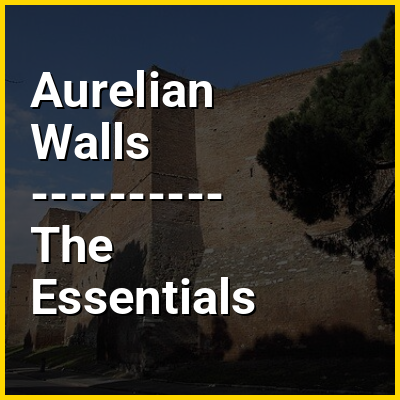
The Aurelian Walls (Italian: Mura aureliane) are a line of city walls built between 271 AD and 275 AD in Rome, Italy, during the reign of the Roman Emperor Aurelian. They superseded the earlier Servian Wall built during the 4th century BC.

The walls enclosed all the seven hills of Rome plus the Campus Martius and, on the right bank of the Tiber, the Trastevere district. The river banks within the city limits appear to have been left unfortified, although they were fortified along the Campus Martius. The size of the entire enclosed area is 1,400 hectares (3,500 acres). The wall cut through populated areas: in reality the city at the time embraced 2,400 hectares (5,900 acres). Pliny the Elder in the first century AD suggested that the densely populated areas, extrema tectorum ("the limits of the roofed areas") extended 2.8 kilometres (1.7 mi) from the Golden Milestone in the Forum (Natural History 3.67).
↓ Menu

>>>PUT SHARE BUTTONS HERE<<<
In this Dossier

Aurelian Walls in the context of Servian Wall

The Servian Wall (Latin: Murus Servii Tullii; Italian: Mura Serviane) is an ancient Roman defensive barrier constructed around the city of Rome in the early 4th century BC. The wall was built of volcanic tuff and was up to 10 m (33 ft) in height in places, 3.6 m (12 ft) wide at its base, 11 km (6.8 mi) long, and is believed to have had 16 main gates, of which only one or two have survived, and enclosed a total area of 246 hectares (610 acres). In the 3rd century AD it was superseded by the construction of the larger Aurelian Walls as the city of Rome grew beyond the boundary of the Servian Wall.

↑ Return to Menu

Aurelian Walls in the context of Aurelian

Aurelian (/ɔːˈrliən/; Latin: Lucius Domitius Aurelianus; 9 September c. 214 – c. November 275) was a Roman emperor who reigned from 270 to 275 during the Crisis of the Third Century. As emperor, he won an unprecedented series of military victories which reunited the Roman Empire after it had nearly disintegrated under the pressure of barbarian invasions and internal revolts. For his success in restoring the Empire's territorial integrity, Aurelian was honored with the title Restitutor Orbis ("Restorer of the World"). Born in modest circumstances, most likely in Moesia Superior, he entered the Roman army in 235 and climbed up the ranks. He went on to lead the cavalry of the emperor Gallienus, until Gallienus' assassination in 268. Following that, Claudius Gothicus became emperor until his own death in 270. Claudius' brother Quintillus then ruled for three months, before Aurelian took the empire for himself. Aurelian was chosen Roman emperor by the Illyriciani as one of themselves.During his reign, he defeated the Alamanni after a devastating war. He also defeated the Goths, Vandals, Juthungi, Sarmatians, and Carpi. Aurelian restored the Empire's eastern provinces after his conquest of the Palmyrene Empire in 273. The following year he conquered the Gallic Empire in the west, reuniting the Empire in its entirety. He was also responsible for the construction of the Aurelian Walls in Rome, the abandonment of the province of Dacia, and monetary reforms attempting to curb the devaluation of the Roman currency.Although Domitian, two centuries earlier, was the first emperor who had demanded to be officially hailed as dominus et deus ('master and god'), these titles never occurred in written form on official documents until the reign of Aurelian. His successes were instrumental in ending the crisis.

↑ Return to Menu

Aurelian Walls in the context of Porta Salaria

Porta Salaria was a gate in the Aurelian Walls of Rome, Italy. Constructed between 271 AD and 275 AD, it was demolished in 1921.

↑ Return to Menu

Aurelian Walls in the context of Leonine City

The Leonine City (Latin: Civitas Leonina) is the part of the city of Rome which, during the Middle Ages, was enclosed with the Leonine Wall, built by order of Pope Leo IV in the 9th century.

This area was located on the opposite side of the Tiber from the seven hills of Rome, and had not been enclosed within the ancient city's Aurelian Walls, built between 271 and 275. After Christianity had risen to prominence and the Western Roman Empire had collapsed, the area had to be defended through the construction of a new wall, since it housed St. Peter's Basilica.

↑ Return to Menu

Aurelian Walls in the context of Via Nomentana

The Via Nomentana was an ancient Roman road in Italy, leading North-East from Rome to Nomentum (modern Mentana), a distance of 23 km (14 mi). It originally bore the name "Via Ficulensis", from the old Latin village of Ficulea, about 13 km (8.1 mi) from Rome. It was subsequently extended to Nomentum, but never became an important high road, and merged in the Via Salaria a few kilometers beyond Nomentum. It is followed as far as Nomentum by the modern state road, but some traces of its pavement still exist.

The road started at the Porta Collina in the Servian Walls until the third century, when emperor Aurelian built the Porta Nomentana in his new set of walls.

↑ Return to Menu

Aurelian Walls in the context of Via Salaria

The Via Salaria was an ancient Roman road in Italy.It eventually ran from Rome (from Porta Salaria of the Aurelian Walls) to Castrum Truentinum (Porto d'Ascoli) on the Adriatic coast, a distance of 242 km. The road also passed through Reate (Rieti) and Asculum (Ascoli Piceno).

Strada statale 4 Via Salaria (SS4) is the modern state highway that maintains the old road's name and runs on the same path from Rome to the Adriatic Sea.

↑ Return to Menu

Aurelian Walls in the context of Porta Pia

Porta Pia was one of the northern gates in the Aurelian Walls of Rome, Italy. One of Pope Pius IV's civic improvements to the city, it is named after him. Situated at the end of a new street, the Via Pia, it was designed by Michelangelo to replace the Porta Nomentana situated several hundred meters southwards, which was closed up at the same time. Construction began in 1561 and ended in 1565, after the artist's death. A 1561 bronze commemorative medal by Gian Federico Bonzagna (it) shows an early plan by Michelangelo, very different from his final design. The façade on the outside of the city was completed in 1869 under the Neo-Classicist design by Virginio Vespignani.

↑ Return to Menu

Aurelian Walls in the context of Pincio

The Pincian Hill (Italian: Pincio [ˈpintʃo]; Latin: Mons Pincius) is a hill in the northeast quadrant of the historical centre of Rome. The hill lies to the north of the Quirinal, overlooking the Campus Martius. It was outside the original boundaries of the ancient city of Rome, and was not one of the Seven hills of Rome, but it lies within the wall built by Roman Emperor Aurelian between 270 and 273.

↑ Return to Menu

Aurelian Walls in the context of Santa Maria dei Miracoli and Santa Maria in Montesanto

Santa Maria dei Miracoli and Santa Maria di Montesanto are two churches in Rome.

They are located on the Piazza del Popolo, facing the northern gate of the Aurelian Walls, at the entrance of Via del Corso on the square. The churches are often cited as "twin", due to their similar external appearance: they have indeed some differences, in both plan and exterior details.

↑ Return to Menu