Astronomia nova in the context of Latin


Astronomia nova in the context of Latin

⭐ Core Definition: Astronomia nova

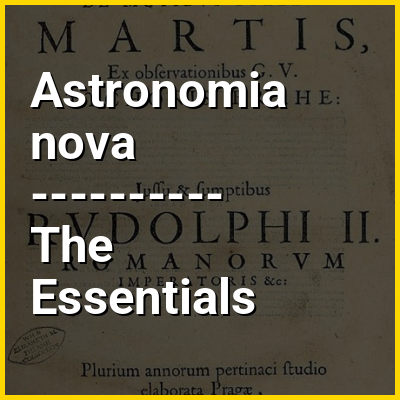
Astronomia nova (English: New Astronomy, full title in original Latin: Astronomia Nova ΑΙΤΙΟΛΟΓΗΤΟΣ seu physica coelestis, tradita commentariis de motibus stellae Martis ex observationibus G.V. Tychonis Brahe) is a book, published in 1609, that contains the results of the astronomer Johannes Kepler's ten-year-long investigation of the motion of Mars.

One of the most significant books in the history of astronomy, the Astronomia nova provided strong arguments for heliocentrism and contributed valuable insight into the movement of the planets. This included the first mention of the planets' elliptical paths and the change of their movement to the movement of free floating bodies as opposed to objects on rotating spheres. It is recognized as one of the most important works of the Scientific Revolution.
↓ Menu
HINT:

In this Dossier

Astronomia nova in the context of Johannes Kepler

Johannes Kepler (27 December 1571 – 15 November 1630) was a German astronomer, mathematician, astrologer, natural philosopher and writer on music. He is a key figure in the 17th-century Scientific Revolution, best known for his laws of planetary motion, and his books Astronomia nova, Harmonice Mundi, and Epitome Astronomiae Copernicanae. The variety and impact of his work made Kepler one of the founders and fathers of modern astronomy, the scientific method, natural science, and modern science. He has been described as the "father of science fiction" for his novel Somnium.

Kepler was a mathematics teacher at a seminary school in Graz, where he became an associate of Prince Hans Ulrich von Eggenberg. Later he became an assistant to the astronomer Tycho Brahe in Prague, and eventually the imperial mathematician to Emperor Rudolf II and his two successors Matthias and Ferdinand II. He also taught mathematics in Linz, and was an adviser to General Wallenstein.

View the full Wikipedia page for Johannes Kepler
↑ Return to Menu

Astronomia nova in the context of Third law of planetary motion

In astronomy, Kepler's laws of planetary motion give a good approximations for the orbits of planets around the Sun. They were published by Johannes Kepler from 1608-1621 in three works Astronomia nova, Harmonice Mundi and Epitome Astronomiae Copernicanae. The laws were based Kepler's concept of solar fibrils adapted to the accurate astronomical data of Tycho Brahe. These laws replaced the circular orbits and epicycles of Copernicus's heliostatic model of the planets with a heliocentric model that described elliptical orbits with planetary velocities that vary accordingly. The three laws state that:

  1. The orbit of a planet is an ellipse with the Sun at one of the two foci.
  2. A line segment joining a planet and the Sun sweeps out equal areas during equal intervals of time.
  3. The square of a planet's orbital period is proportional to the cube of the length of the semi-major axis of its orbit.

The elliptical orbits of planets were indicated by calculations of the orbit of Mars. From this, Kepler inferred that other bodies in the Solar System, including those farther away from the Sun, also have elliptical orbits. The second law establishes that when a planet is closer to the Sun, it travels faster. The third law expresses that the farther a planet is from the Sun, the longer its orbital period.

View the full Wikipedia page for Third law of planetary motion
↑ Return to Menu

Astronomia nova in the context of Kepler's third law

In astronomy, Kepler's laws of planetary motion give good approximations for the orbits of planets around the Sun. They were published by Johannes Kepler from 1608-1621 in three works Astronomia nova, Harmonice Mundi and Epitome Astronomiae Copernicanae. The laws were based on Kepler's concept of solar fibrils adapted to the accurate astronomical data of Tycho Brahe. These laws replaced the circular orbits and epicycles of Copernicus's heliostatic model of the planets with a heliocentric model that described elliptical orbits with planetary velocities that vary accordingly. The three laws state that:

  1. The orbit of a planet is an ellipse with the Sun at one of the two foci.
  2. A line segment joining a planet and the Sun sweeps out equal areas during equal intervals of time.
  3. The square of a planet's orbital period is proportional to the cube of the length of the semi-major axis of its orbit.

The elliptical orbits of planets were indicated by calculations of the orbit of Mars. From this, Kepler inferred that other bodies in the Solar System, including those farther away from the Sun, also have elliptical orbits. The second law establishes that when a planet is closer to the Sun, it travels faster. The third law expresses that the farther a planet is from the Sun, the longer its orbital period.

View the full Wikipedia page for Kepler's third law
↑ Return to Menu