Ashoka the Great in the context of "Stupa"

Play Trivia Questions online!

or

Skip to study material about Ashoka the Great in the context of "Stupa"

Ad spacer

⭐ Core Definition: Ashoka the Great

Ashoka, also known as Asoka or Aśoka (/əˈʃkə/ ə-SHOH-kə; Sanskrit: [ɐˈɕoːkɐ], IAST: Aśoka; c. 304 – 232 BCE), popularly known as Ashoka the Great, was Emperor of Magadha from c. 268 BCE until his death, and the third ruler from the Mauryan dynasty. His empire covered a large part of the Indian subcontinent, stretching from present-day Afghanistan in the west to present-day Bangladesh in the east, with its capital at Pataliputra. A patron of Buddhism, he is credited with an important role in the spread of Buddhism across ancient Asia.

The Edicts of Ashoka state that during his eighth regnal year (c. 260 BCE), he conquered Kalinga after a brutal war. Ashoka subsequently devoted himself to the propagation of "dhamma" or righteous conduct, the major theme of the edicts. Ashoka's edicts suggest that a few years after the Kalinga War, he was gradually drawn towards Buddhism. The Buddhist legends credit Ashoka with establishing a large number of stupas, patronising the Third Buddhist council, supporting Buddhist missionaries, and making generous donations to the sangha.
↓ Menu

>>>PUT SHARE BUTTONS HERE<<<
In this Dossier

Ashoka the Great in the context of Kalinga War

The Kalinga war (ended c. 261 BCE) was fought in ancient India between the Mauryan Empire under Ashoka the Great and Kalinga, an independent feudal kingdom located on the east coast, in the present-day state of Odisha and northern parts of Andhra Pradesh. It is presumed that the battle was fought on Dhauli hills in Dhauli which is situated on the banks of Daya River. The Kalinga War was one of the largest and deadliest battles in Indian history.

This is the only major war Ashoka fought after his accession to the throne, and marked the close of the empire-building and military conquests of ancient India that began with the Mauryan Emperor Chandragupta Maurya. The war cost nearly 250,000 lives.

↑ Return to Menu

Ashoka the Great in the context of Sanchi

23°28′45″N 77°44′23″E / 23.479223°N 77.739683°E / 23.479223; 77.739683Sanchi Stupa is a Buddhist complex, famous for its Great Stupa, on a hilltop at Sanchi Town in Raisen District of the State of Madhya Pradesh, India. It is located, about 23 kilometers from Raisen town, the district headquarter and 46 kilometres (29 mi) north-east of Bhopal, capital of Madhya Pradesh.

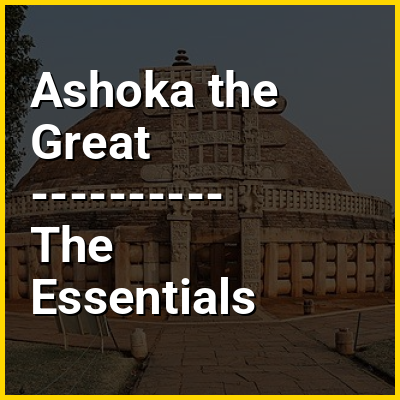
The Great Stupa at Sanchi is one of the oldest stone structures in India, and an important monument to the historical architecture of India. It was originally commissioned by the Mauryan emperor Ashoka in the 3rd century BCE. Its nucleus was a simple hemispherical brick structure built over the relics of the Buddha. It was crowned by the chatra, a parasol-like structure symbolising high rank, which was intended to honour and shelter the relics. The original construction work of this stupa was overseen by Ashoka, whose wife Devi was the daughter of a merchant of nearby Vidisha. Sanchi was also her birthplace as well as the venue of her and Ashoka's wedding. In the 1st century BCE, four elaborately carved toranas (ornamental gateways) and a balustrade encircling the entire structure were added. The stupa at Sanchi built during the Mauryan period was made of bricks. The composite flourished until the 11th century.

↑ Return to Menu

Ashoka the Great in the context of Pillars of Ashoka

The pillars of Ashoka are a series of monolithic columns dispersed throughout the Indian subcontinent, erected—or at least inscribed with edicts—by the 3rd Mauryan Emperor Ashoka the Great, who reigned from c. 268 to 232 BC. Ashoka used the expression Dhaṃma thaṃbhā (Dharma stambha), i.e. "pillars of the Dharma" to describe his own pillars. These pillars constitute important monuments of the architecture of India, most of them exhibiting the characteristic Mauryan polish. Twenty of the pillars erected by Ashoka still survive, including those with inscriptions of his edicts. Only a few with animal capitals survive of which seven complete specimens are known. Two pillars were relocated by Firuz Shah Tughlaq to Delhi. Several pillars were relocated later by Mughal Empire rulers, the animal capitals being removed. Averaging between 12 and 15 m (40 and 50 ft) in height, and weighing up to 50 tons each, the pillars were dragged, sometimes hundreds of miles, to where they were erected.

The pillars of Ashoka are among the earliest known stone sculptural remains from India. Only another pillar fragment, the Pataliputra capital, is possibly from a slightly earlier date. It is thought that before the 3rd century BC, wood rather than stone was used as the main material for Indian architectural constructions, and that stone may have been adopted following interaction with the Persians and the Greeks. A graphic representation of the Lion Capital of Ashoka from the column there was adopted as the official State Emblem of India in 1950.

↑ Return to Menu

Ashoka the Great in the context of Philosopher-kings

The philosopher king is a hypothetical ruler in whom political skill is combined with philosophical knowledge. The concept of a city-state ruled by philosophers is first explored in Plato's Republic, written around 375 BC. Plato argued that the ideal state – one which ensured the maximum possible happiness for all its citizens – could only be brought into being by a ruler possessed of absolute knowledge, obtained through philosophical study. From the Middle Ages onwards, Islamic and Jewish authors expanded on the theory, adapting it to suit their own conceptions of the perfect ruler.

Several historical figures, including Marcus Aurelius and Ashoka the Great, have been described by ancient and modern writers as embodying the philosopher king ideal.

↑ Return to Menu

Ashoka the Great in the context of Langkasuka

Langkasuka was an ancient Malay Hindu-Buddhist kingdom located in the Malay Peninsula (in modern-day Thailand). Langkasuka flourished from the 2nd century to the 15th century as the oldest kingdom in the Malay Peninsula, believed to have been established by descendants of Ashoka the Great. The name is Sanskrit in origin; it is thought to be a combination of langkha for "resplendent land" -sukkha for "bliss". The kingdom, along with Old Kedah, is among the earliest kingdoms founded on the Malay Peninsula. The exact location of the kingdom is of some debate, but archaeological discoveries at Yarang near Pattani, Thailand suggest a probable location. The kingdom is proposed to have been established in the 1st century, perhaps between 80 and 100 AD.

According to the legend given in the Kedah Annals, the kingdom was founded and named by Merong Mahawangsa. Another proposal suggests that the name may have been derived from langkha and Ashoka, the Mauryan Hindu warrior king who eventually became a pacifist after embracing the ideals espoused in Buddhism, and that the early Indian colonizers of the Malayic Isthmus named the kingdom Langkasuka in his honour. Chinese historical sources provided some information on the kingdom and recorded a king Bhagadatta who sent envoys to the Chinese court.

↑ Return to Menu