Ashikaga Yoshimitsu in the context of Ashikaga Yoshiakira


Ashikaga Yoshimitsu in the context of Ashikaga Yoshiakira

⭐ Core Definition: Ashikaga Yoshimitsu

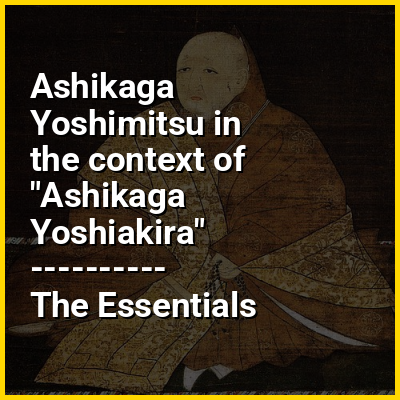
Ashikaga Yoshimitsu (足利 義満; September 25, 1358 – May 31, 1408) was the third shōgun of the Ashikaga shogunate, ruling from 1368 to 1394 during the Muromachi period of Japan. Yoshimitsu was Ashikaga Yoshiakira's third son but the oldest son to survive, his childhood name being Haruō (春王). Yoshimitsu was appointed shōgun, a hereditary title as head of the military estate, in 1368 at the age of ten; at twenty he was admitted to the imperial court as Acting Grand Counselor (Gon Dainagon 権大納言).

In 1379, Yoshimitsu reorganized the institutional framework of the Gozan Zen 五山禅 establishment before, two years later, becoming the first person of the warrior (samurai) class to host a reigning emperor at his private residence. In 1392, he negotiated the end of the Nanboku-chō imperial schism that had plagued politics for over half a century. Two years later he became Grand Chancellor of State (Daijō daijin 太政大臣), the highest-ranking member of the imperial court.
↓ Menu
HINT:

In this Dossier

Ashikaga Yoshimitsu in the context of Udaijin

Minister of the Right (右大臣, Udaijin) was a government position in Japan during the Asuka to Meiji era. The position was consolidated in the Taihō Code of 701. The Asuka Kiyomihara Code of 689 marks the initial appearance of the Udaijin in the context of a central administrative body called the Daijō-kan (Council of State). This early Daijō-kan was composed of the three ministers—the Daijō-daijin (Chancellor), the Sadaijin (Minister of the Left) and the Udaijin. The Udaijin was the Junior Minister of State, overseeing all branches of the Daijō-kan. He would be the deputy of the Sadaijin.

From the Kamakura period (1185–1333), when the warrior class came to power in Japan, this imperial court position became an honorary position with no real authority. Oda Nobunaga, who was a powerful daimyo in the Azuchi-Momoyama period, was a daimyo who held this imperial court position. This was the first time since Minamoto no Sanetomo in 1218 that a member of the warrior class had been appointed Udaijin. Previously, the only warrior class members appointed to higher positions than Udaijin were Taira no Kiyomori and Ashikaga Yoshimitsu as Daijō-daijin, and Ashikaga Yoshinori and Ashikaga Yoshimasa as Sadaijin. The warrior class was able to use the high imperial court positions of Daijō-daijin, Sadaijin, and Udaijin, which had originally belonged to the nobility, as a means of establishing their own authority.

View the full Wikipedia page for Udaijin
↑ Return to Menu

Ashikaga Yoshimitsu in the context of Ashikaga Yoshinori

Ashikaga Yoshinori (足利 義教; July 12, 1394 – July 12, 1441) was the sixth shōgun of the Ashikaga shogunate who reigned from 1429 to 1441 during the Muromachi period of medieval Japan. Yoshinori was the son of the third shōgun Ashikaga Yoshimitsu. His childhood name was Harutora (春寅). In 1433, he initiated the compilation of the last imperial waka anthology, Shinshoku Kokinwakashū, but was not satisfied with its compilation agenda which undermined his authority.

View the full Wikipedia page for Ashikaga Yoshinori
↑ Return to Menu

Ashikaga Yoshimitsu in the context of Ashikaga Ujimitsu

Ashikaga Ujimitsu (足利氏満) (1359–1398) was a Nanboku-chō period warrior and the Kamakura-fu's second Kantō kubō, or Shōgun Deputy. Son of first Kantō Kubō Ashikaga Motouji, he succeeded his father in 1367 at the age of nine when this last suddenly died during an epidemic. It was during his reign that the Kanto kubō title became common enough to appear for the first time in writing. It is in fact contained in a 1382 entry of the Tsurugaoka Jishoan (鶴岡事書安). This title was in itself rebellious, because it was first adopted by Takauji himself and its use therefore implied equality with the shogun. In fact, sometimes the Kanto Kubō was called Kantō shōgun.

Ujimitsu was the first Kantō kubō to openly aspire to the shogunate, and his relationship with shōgun Ashikaga Yoshimitsu in Kyoto consequently deteriorated to the point of being likened to that of "cats and dogs".

View the full Wikipedia page for Ashikaga Ujimitsu
↑ Return to Menu