Armenian illuminated manuscripts in the context of "Toros Roslin"

Play Trivia Questions online!

or

Skip to study material about Armenian illuminated manuscripts in the context of "Toros Roslin"


⭐ Core Definition: Armenian illuminated manuscripts

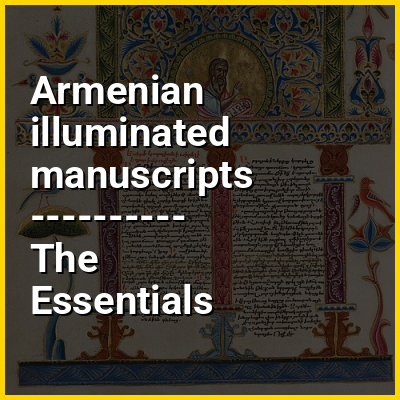
Armenian illuminated manuscripts (Armenian: Հայկական մանրանկարչություն, romanizedHaykakan manrankarch'owt'yown), form an Armenian tradition of formally prepared documents where the text is often supplemented with flourishes such as borders and miniature illustrations. They are related to other forms of Medieval Armenian art, Persian miniatures, and to Byzantine illuminated manuscripts. The earliest surviving examples date after the Golden Age of Armenian art and literature in the 6th century. Armenian illuminated manuscripts embody Armenian culture; they illustrate its spiritual and cultural values.

The most famous Armenian miniaturist, Toros Roslin, lived in the 13th century. The art form flourished in Greater Armenia, Lesser Armenia and the Armenian Diaspora. Its appearance dates back to the creation of the Armenian alphabet in Armenia, in the year 405 AD. Very few fragments of illuminated manuscripts from the 6th and 7th centuries have survived. The oldest fully preserved manuscript dates from the 9th century. Art experienced a golden age in the 13th and 14th centuries when the main schools and centers started to pop up (fifteen hundred centers of writing and illumination). The most striking are those of Syunik, Vaspurakan and Cilicia. Many Armenian illuminated manuscripts outside the country of Armenia have also survived the centuries. Despite the creation of the Armenian printing press in the 16th century, the production of miniatures continued until the 19th century and survives through modern Armenian painting and cinema.
↓ Menu

In this Dossier

Armenian illuminated manuscripts in the context of Annunciation

The Annunciation (/əˌnʌnsiˈʃən/; from Latin annuntiatio; also referred to as the Annunciation to the Blessed Virgin Mary, the Annunciation of Our Lady, or the Annunciation of the Lord; Ancient Greek: Ο Ευαγγελισμός της Θεοτόκου) is, according to the Gospel of Luke, the announcement made by the archangel Gabriel to Mary that she would conceive and bear a son through a virgin birth and become the mother of Jesus Christ, the Messiah and Son of God, marking the Incarnation.

According to Luke 1:26 the Annunciation occurred in the sixth month of Elizabeth's pregnancy with John the Baptist. Many Christians observe this event with the Feast of the Annunciation on 25 March, an approximation of the northern vernal equinox nine full months before Christmas, the traditional birthday of Jesus.

↑ Return to Menu

Armenian illuminated manuscripts in the context of Genealogy of Jesus

The New Testament provides two accounts of the genealogy of Jesus, one in the Gospel of Matthew and another in the Gospel of Luke. Matthew starts with Abraham and works forwards, while Luke works back in time from Jesus to Adam. The lists of names are identical between Abraham and David (whose royal ancestry affirms Jesus' Messianic title Son of David), but differ radically from that point. Matthew has twenty-seven generations from David to Joseph, whereas Luke has forty-two, with almost no overlap between them or with other known genealogies.⁠ They also disagree on who Joseph's father was: Matthew says he was Jacob, while Luke says he was Heli.

Early Christian scholars (starting with Africanus and Eusebius) take both lineages to be true, offering various explanations for their divergence. For instance, one (usually Matthew's) may be taken to be the lineage of Joseph and the other (usually Luke's) of Mary, or one may be Jesus' customary legal lineage and the other his biological blood lineage. These versions can also fit the gospels' simultaneous account of Jesus' virgin birth of Mary alone, with Joseph being merely his legal adoptive father; both Joseph and Mary are taken to be David's descendants. Levirate marriage, through which an individual (such as Joseph) may have two legal fathers, can also serve these explanations. However, some modern critical scholars like Marcus Borg and John Dominic Crossan state that both genealogies are inventions, constructed to bring the Messianic claim into conformity with Jewish criteria.

↑ Return to Menu

Armenian illuminated manuscripts in the context of Miniature (illuminated manuscript)

A miniature (from the Latin verb miniare 'to colour with minium', a red lead) is a small illustration used to decorate an ancient or medieval illuminated manuscript; the simple illustrations of the early codices having been miniated or delineated with that pigment. The generally small scale of such medieval pictures has led to etymological confusion with minuteness and to its application to small paintings, especially portrait miniatures, which did however grow from the same tradition and at least initially used similar techniques.

Apart from the Western, Byzantine and Armenian traditions, there is another group of Asian traditions, which is generally more illustrative in nature, and from origins in manuscript book decoration also developed into single-sheet small paintings to be kept in albums, which are also called miniatures, as the Western equivalents in watercolor and other media are not. These include Arabic miniatures, and their Persian, Mughal, Ottoman and other Indian offshoots.

↑ Return to Menu

Armenian illuminated manuscripts in the context of Byzantine illuminated manuscripts

Byzantine illuminated manuscripts were produced across the Byzantine Empire, some in monasteries but others in imperial or commercial workshops. Religious images or icons were made in Byzantine art in many different media: mosaics, paintings, small statues and illuminated manuscripts. Monasteries produced many of the illuminated manuscripts devoted to religious works using the illustrations to highlight specific parts of text, a saints' martyrdom for example, while others were used for devotional purposes similar to icons. These religious manuscripts were most commissioned by patrons and were used for private worship but also gifted to churches to be used in services.

Not all Byzantine illuminated manuscripts were religious texts, secular subjects are represented in chronicles (e.g. Madrid Skylitzes), medical texts such as the Vienna Dioscurides, and some manuscripts of the Greek version of the Alexander Romance. In addition to the majority of manuscripts, in Greek, there are also manuscripts from the Syriac Church, such as the Rabbula Gospels, and Armenian illuminated manuscripts which are heavily influenced by the Byzantine tradition.

↑ Return to Menu