Argument of a function in the context of Identity function


Argument of a function in the context of Identity function

Argument of a function Study page number 1 of 2

Play TriviaQuestions Online!

or

Skip to study material about Argument of a function in the context of "Identity function"


⭐ Core Definition: Argument of a function

In mathematics, an argument of a function is a value provided to obtain the function's result. It is also called an independent variable.

For example, the binary function has two arguments, and , in an ordered pair . The hypergeometric function is an example of a four-argument function. The number of arguments that a function takes is called the arity of the function. A function that takes a single argument as input, such as , is called a unary function. A function of two or more variables is considered to have a domain consisting of ordered pairs or tuples of argument values. The argument of a circular function is an angle. The argument of a hyperbolic function is a hyperbolic angle.

↓ Menu
HINT:

In this Dossier

Argument of a function in the context of Optimal

Mathematical optimization (alternatively spelled optimisation) or mathematical programming is the selection of a best element, with regard to some criteria, from some set of available alternatives. It is generally divided into two subfields: discrete optimization and continuous optimization. Optimization problems arise in all quantitative disciplines from computer science and engineering to operations research and economics, and the development of solution methods has been of interest in mathematics for centuries.

In the more general approach, an optimization problem consists of maximizing or minimizing a real function by systematically choosing input values from within an allowed set and computing the value of the function. The generalization of optimization theory and techniques to other formulations constitutes a large area of applied mathematics.

View the full Wikipedia page for Optimal
↑ Return to Menu

Argument of a function in the context of Continuous function

Continuity is one of the core concepts of calculus and mathematical analysis, where arguments and values of functions are real and complex numbers. The concept has been generalized to functions between metric spaces and between topological spaces. The latter are the most general continuous functions, and their definition is the basis of topology.

View the full Wikipedia page for Continuous function
↑ Return to Menu

Argument of a function in the context of Limit (mathematics)

In mathematics, a limit is the value that a function (or sequence) approaches as the argument (or index) approaches some value. Limits of functions are essential to calculus and mathematical analysis, and are used to define continuity, derivatives, and integrals.The concept of a limit of a sequence is further generalized to the concept of a limit of a topological net, and is closely related to limit and direct limit in category theory.The limit inferior and limit superior provide generalizations of the concept of a limit which are particularly relevant when the limit at a point may not exist.

View the full Wikipedia page for Limit (mathematics)
↑ Return to Menu

Argument of a function in the context of Adicity

In logic, mathematics, and computer science, arity (/ˈærɪti/ ) is the number of arguments or operands taken by a function, operation or relation. In mathematics, arity may also be called rank, but this word can have many other meanings. In logic and philosophy, arity may also be called adicity and degree. In linguistics, it is usually named valency.

View the full Wikipedia page for Adicity
↑ Return to Menu

Argument of a function in the context of Categorial grammar

Categorial grammar is a family of formalisms in natural language syntax that share the central assumption that syntactic constituents combine as functions and arguments. Categorial grammar posits a close relationship between the syntax and semantic composition, since it typically treats syntactic categories as corresponding to semantic types. Categorial grammars were developed in the 1930s by Kazimierz Ajdukiewicz and in the 1950s by Yehoshua Bar-Hillel and Joachim Lambek. It saw a surge of interest in the 1970s following the work of Richard Montague, whose Montague grammar assumed a similar view of syntax. It continues to be a major paradigm, particularly within formal semantics.

View the full Wikipedia page for Categorial grammar
↑ Return to Menu

Argument of a function in the context of Arg max

In mathematics, the arguments of the maxima (abbreviated arg max or argmax) and arguments of the minima (abbreviated arg min or argmin) are the input points at which a function output value is maximized and minimized, respectively. While the arguments are defined over the domain of a function, the output is part of its codomain.

View the full Wikipedia page for Arg max
↑ Return to Menu

Argument of a function in the context of Function of several real variables

In mathematical analysis and its applications, a function of several real variables or real multivariate function is a function with more than one argument, with all arguments being real variables. This concept extends the idea of a function of a real variable to several variables. The "input" variables take real values, while the "output", also called the "value of the function", may be real or complex. However, the study of the complex-valued functions may be easily reduced to the study of the real-valued functions, by considering the real and imaginary parts of the complex function; therefore, unless explicitly specified, only real-valued functions will be considered in this article.

The domain of a function of n variables is the subset of for which the function is defined. As usual, the domain of a function of several real variables is supposed to contain a nonempty open subset of .

View the full Wikipedia page for Function of several real variables
↑ Return to Menu

Argument of a function in the context of Identity transformation

In mathematics, an identity function, also called an identity relation, identity map or identity transformation, is a function that always returns the value that was used as its argument, unchanged. That is, when f is the identity function, the equality f(x) = x is true for all values of x to which f can be applied.

View the full Wikipedia page for Identity transformation
↑ Return to Menu

Argument of a function in the context of Multilinear algebra

Multilinear algebra is the study of functions with multiple vector-valued arguments, with the functions being linear maps with respect to each argument. It involves concepts such as matrices, tensors, multivectors, systems of linear equations, higher-dimensional spaces, determinants, inner and outer products, and dual spaces. It is a mathematical tool used in engineering, machine learning, physics, and mathematics.

View the full Wikipedia page for Multilinear algebra
↑ Return to Menu

Argument of a function in the context of Implicitly defined

In mathematics, an implicit equation is a relation of the form where R is a function of several variables (often a polynomial). For example, the implicit equation of the unit circle is

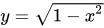
An implicit function is a function that is defined by an implicit equation, that relates one of the variables, considered as the value of the function, with the others considered as the arguments. For example, the equation of the unit circle defines y as an implicit function of x, , assuming −1 ≤ x ≤ 1 and y is restricted to nonnegative values. Some equations do not admit an explicit solution.

View the full Wikipedia page for Implicitly defined
↑ Return to Menu