Arbëresh language in the context of "Old Albanian"

Play Trivia Questions online!

or

Skip to study material about Arbëresh language in the context of "Old Albanian"


⭐ Core Definition: Arbëresh language

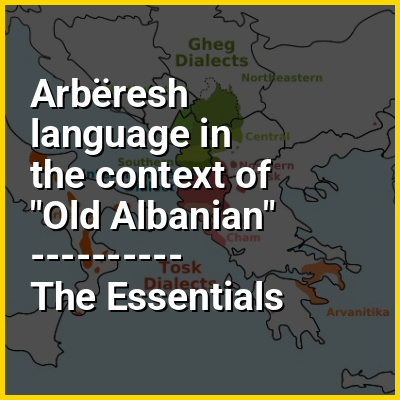
Arbëresh (gluha/gjuha/gjufa Arbëreshe; also known as Arbërisht, Italian: Arberesco, Lingua Albanese d'Italia, Italo-albanese) comprises the Albanian linguistic varieties spoken by the Arbëreshë people of Italy, brought there by several migratory waves of Albanians from Albania and Greece since the Late Middle Ages. Arbëresh varieties are derived from the old Tosk Albanian varieties spoken in the south-western Balkans, and throughout the centuries they have developed in Italy in contact with the neighboring Italo-Romance-speaking communities. Other Tosk Albanian varieties from the Late Middle Ages referred to as Arvanitika (endonym: arbërisht) are spoken in Greece by the Arvanites. E Mbësuame e Krështerë (1592) by Luca Matranga from Piana degli Albanesi is the earliest known Old Tosk text, a translation of a catechism book from Latin.

The Arbëreshë people are bilingual, also speaking Italian. Arbëresh is classified as Definitely Endangered by the UNESCO Atlas of the World's Languages in Danger. While Italian law protects the language and culture of the Albanian people in Italy, the language taught at school and university is Standard Albanian, constituting an issue for the Arbëresh communities' preservation of their native idiom, which has remained separated from the main Albanian-speaking compact area for around 500 years. Alongside the fact that Arbëresh is rarely written, another issue for the language attrition is the differentiation between the Albanian varieties used in Italy: the Arbëresh local idioms in some areas are so different from each other that Arbëresh people of those areas use Italian or Standard Albanian as lingua franca to communicate with each other.
↓ Menu

In this Dossier

Arbëresh language in the context of Arbëreshë people

The Arbëreshë (pronounced [aɾbəˈɾɛʃ]; Albanian: Arbëreshët e Italisë; Italian: Albanesi d'Italia), also known as Albanians of Italy or Italo-Albanians, are an Albanian ethnolinguistic group minority historically settled in Southern and Insular Italy (in the regions of Abruzzo, Apulia, Basilicata, Campania, and Molise, but mostly concentrated in the regions of Calabria and Sicily).

They are the descendants of Albanian refugees settled in the Kingdom of Naples and Sicily who fled from Albania, Epirus, and later some from the numerous Albanian communities of Attica and Morea, between the 14th and the 18th centuries following the death of Gjergj Kastrioti Skanderbeg and the gradual conquest of the Balkans by the Ottoman Turks. Their culture is determined by the main features that are found in language, religious rite, traditional costume, art and gastronomy, still zealously preserved, with the awareness of belonging to a specific ethnic group.

↑ Return to Menu

Arbëresh language in the context of Central-Southern Calabrian

The primary languages of Calabria are the Italian language as well as regional varieties of Extreme Southern Italian and Neapolitan languages, all collectively known as Calabrian (Italian: calabrese). In addition, there are speakers of the Arbëresh variety of Albanian, as well as Calabrian Greek speakers and pockets of Occitan.

↑ Return to Menu

Arbëresh language in the context of Eric Hamp

Eric Pratt Hamp (November 16, 1920 – February 17, 2019) was an American linguist widely respected as a leading authority on Indo-European linguistics, with particular interests in Celtic languages and Albanian. Unlike many Indo-Europeanists, who work entirely on the basis of written materials, he conducted extensive fieldwork on lesser-known Indo-European languages and dialects, such as Albanian, Arbëresh and Arvanitika; Breton; Welsh; Irish; Resian and Scots Gaelic.

His wide-ranging interests also included American Indian languages. He served for many years as editor of the International Journal of American Linguistics and did field work on Quileute and Ojibwa. He also studied linguistic aspects of braille.

↑ Return to Menu