Aquae Sulis (Latin for Waters of Sulis) was a small town in the Roman province of Britannia. Today it is the English city of Bath, Somerset. The Antonine Itinerary register of Roman roads lists the town as Aquis Sulis. Ptolemy records the town as Aquae calidae (warm waters) in his 2nd-century work Geographia, where it is listed as one of the cities of the Belgae.
HINT:
In this Dossier
- ⭐ Core Definition: Aquae Sulis
- Aquae Sulis in the context of Fosse Way
- Aquae Sulis in the context of Roman Baths (Bath)
- Aquae Sulis in the context of Bath, Somerset
- Aquae Sulis in the context of Battle of Deorham
Aquae Sulis in the context of Fosse Way
The Fosse Way was a Roman road built in Britain during the first and second centuries AD that linked Isca Dumnoniorum (Exeter) in the southwest and Lindum Colonia (Lincoln) to the northeast, via Lindinis (Ilchester), Aquae Sulis (Bath), Corinium (Cirencester), and Ratae Corieltauvorum (Leicester). Much of its route is still used by modern roads, lanes and byways.
View the full Wikipedia page for Fosse WayAquae Sulis in the context of Roman Baths (Bath)
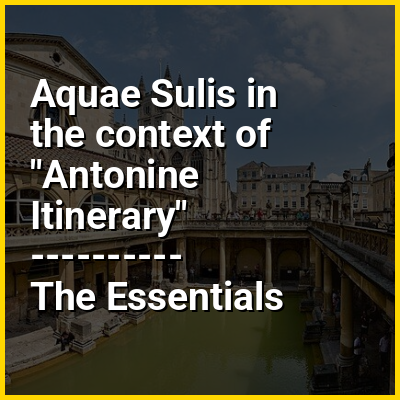
The Roman Baths are well-preserved thermae in the city of Bath, Somerset, England. A temple was constructed on the site between 60 and 70 AD in the first few decades of Roman Britain. Its presence led to the development of the small Roman urban settlement known as Aquae Sulis around the site. The Roman baths—designed for public bathing—were used until the end of Roman rule in Britain in the 5th century AD. According to the Anglo-Saxon Chronicle, the original Roman baths were in ruins a century later. The area around the natural springs was redeveloped several times during the Early and Late Middle Ages.
The Roman Baths are preserved in four main features: the Sacred Spring, the Roman Temple, the Roman Bath House, and a museum which holds artefacts from Aquae Sulis. However, all buildings at street level date from the 19th century. It is a major tourist attraction in the UK, and together with the Grand Pump Room, receives more than 1.3 million visitors annually. Visitors can tour the baths and museum but cannot enter the water.
View the full Wikipedia page for Roman Baths (Bath)Aquae Sulis in the context of Bath, Somerset
Bath (RP: /bɑːθ/, locally [ba(ː)θ]) is a city in Somerset, England, known for and named after its Roman-built baths. At the 2021 census, the population was 94,092. Bath is in the valley of the River Avon, 97 miles (156 km) west of London and 11 miles (18 km) southeast of Bristol. The city became a UNESCO World Heritage Site in 1987, and was later added to the transnational World Heritage Site known as the "Great Spa Towns of Europe" in 2021. Bath is also the largest city and settlement in Somerset.
The city became a spa with the Latin name Aquae Sulis ("the waters of Sulis") c. 60 AD when the Romans built baths and a temple in the valley of the River Avon, although hot springs were known even before then. Bath Abbey was founded in the 7th century and became a religious centre; the building was rebuilt in the 12th and 16th centuries. In the 17th century, claims were made for the curative properties of water from the springs, and Bath became popular as a spa town in the Georgian era. Georgian architecture, crafted from Bath Stone, includes the Royal Crescent, Circus, Pump Room, and the Assembly Rooms, where Beau Nash presided over the city's social life from 1705 until his death in 1761.
View the full Wikipedia page for Bath, SomersetAquae Sulis in the context of Battle of Deorham
The Battle of Deorham (or Dyrham) is portrayed by the Anglo-Saxon Chronicle as an important military encounter between the West Saxons and the Britons in the West Country in 577. The Chronicle depicts the battle as a major victory for Wessex's forces, led by Ceawlin and one Cuthwine, resulting in the capture of the Romano-British towns of Glevum (Gloucester), Corinium Dobunnorum (Cirencester), and Aquae Sulis (Bath).
View the full Wikipedia page for Battle of Deorham