Apsley House in the context of 1st Duke of Wellington


Apsley House in the context of 1st Duke of Wellington

⭐ Core Definition: Apsley House

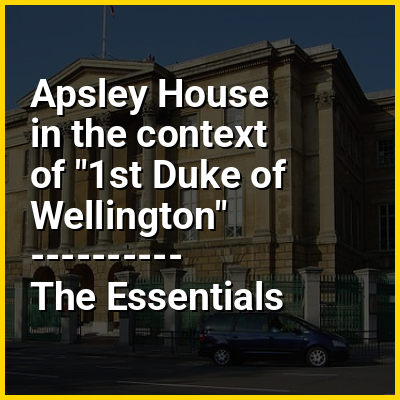
Apsley House is the London townhouse of the Dukes of Wellington. It stands alone at Hyde Park Corner, on the south-east corner of Hyde Park, facing towards the large traffic roundabout in the centre of which stands the Wellington Arch. It is a Grade I listed building.

Designed by Robert Adam in the neoclassical style, the house was built for Lord Apsley in the 1770s. It was purchased by Richard Wellesley, in 1807, and passed to his younger brother Arthur, the 1st duke, in 1817. It was sometimes referred to as Number One, London. It is perhaps the only preserved example of an English aristocratic townhouse from this period.
↓ Menu
HINT:

In this Dossier

Apsley House in the context of David Wilkie (artist)

Sir David Wilkie RA (18 November 1785 – 1 June 1841) was a Scottish painter, especially known for his genre scenes. He painted successfully in a wide variety of genres, including historical scenes, portraits, including formal royal ones, and scenes from his travels to Europe and the Middle East. His main base was in London, but he died and was buried at sea, off Gibraltar, returning from his first trip to the Middle East. He was sometimes known as the "people's painter".

He was Principal Painter in Ordinary to King William IV and Queen Victoria. Apart from royal portraits, his best-known painting today is probably The Chelsea Pensioners reading the Waterloo Dispatch of 1822 in Apsley House.

View the full Wikipedia page for David Wilkie (artist)
↑ Return to Menu

Apsley House in the context of The Chelsea Pensioners reading the Waterloo Dispatch

The Chelsea Pensioners reading the Waterloo Dispatch, originally entitled Chelsea Pensioners Receiving the London Gazette Extraordinary of Thursday, June 22, 1815, Announcing the Battle of Waterloo, is an oil painting by David Wilkie, commissioned by Arthur Wellesley, 1st Duke of Wellington in August 1816.

It was exhibited at the Royal Academy Exhibition of 1822 at Somerset House, where it was so popular that a rail was installed to protect it from the thronging crowds. This was the first time that a rail was needed at the Royal Academy exhibition. The painting was retained by the Duke of Wellington and his descendants, it remains part of the Wellington Collection at Apsley House, but is now on loan to the National Gallery, London.

View the full Wikipedia page for The Chelsea Pensioners reading the Waterloo Dispatch
↑ Return to Menu

Apsley House in the context of Biographical museum

A biographical museum is a museum dedicated to displaying items relating to the life of a single person or group of people, and it may also display the items collected by their subjects during their lifetimes. Some biographical museums are located in a house or other site associated with the lives of their subjects, such as Casa Paoli Museum. Other examples of house-based biographical museums are Anne Frank House in Amsterdam, Quinta de Bolívar in Bogotá, Colombia, the Keats-Shelley Memorial House in Rome, Italy, and the Gjergj Kastrioti Skënderbeu National Museum in Krujë, Albania.

Some homes of famous people house collections in the sphere of the owner's expertise or interests, in addition to collections of their biographical material. One such example is the Wellington Museum at Apsley House in London, home of the 1st Duke of Wellington, which, in addition to biographical memorabilia of the Duke of Wellington's life, also houses his collection of fine paintings. Other biographical museums, such as many of the American presidential libraries, are housed in specially constructed buildings.

View the full Wikipedia page for Biographical museum
↑ Return to Menu

Apsley House in the context of Hyde Park Corner

51°30′10″N 0°9′4.5″W / 51.50278°N 0.151250°W / 51.50278; -0.151250

Hyde Park Corner is between Knightsbridge, Belgravia and Mayfair in London, England. It primarily refers to a major road junction at the southeastern corner of Hyde Park, that was originally planned by architect Decimus Burton. The junction includes a broad green-space roundabout in its centre, which is now the setting for Burton's triumphal Wellington Arch.

View the full Wikipedia page for Hyde Park Corner
↑ Return to Menu