Appenzell Ausserrhoden in the context of "Appenzell Innerrhoden"

Play Trivia Questions online!

or

Skip to study material about Appenzell Ausserrhoden in the context of "Appenzell Innerrhoden"

Ad spacer

⭐ Core Definition: Appenzell Ausserrhoden

Canton of Appenzell Ausserrhoden (German: Kanton Appenzell Ausserrhoden [ˈapn̩tsɛl ˈaʊsərˌroːdn̩] ; Romansh: Chantun Appenzell Dadora; French: Canton d'Appenzell Rhodes-Extérieures; Italian: Canton Appenzello Esterno), in English sometimes Appenzell Outer Rhodes, is one of the 26 cantons forming the Swiss Confederation. It is composed of twenty municipalities. The seat of the government and parliament is Herisau, and the seat of judicial authorities are in Trogen. It is traditionally considered a "half-canton", the other half being Appenzell Innerrhoden.

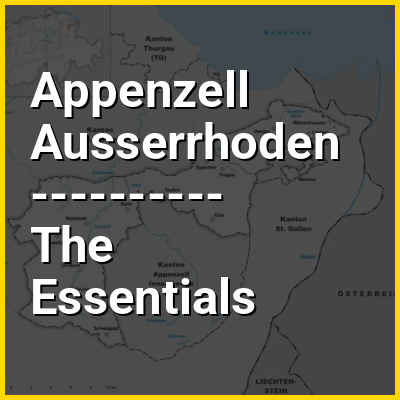
Appenzell Ausserrhoden is located in the north east of Switzerland. Together with the canton of Appenzell Innerrhoden, it forms an enclave within the canton of St. Gallen. The canton is essentially located in the Alpine foothills of the Alpstein massif, culminating at the Säntis.
↓ Menu

>>>PUT SHARE BUTTONS HERE<<<
In this Dossier

Appenzell Ausserrhoden in the context of Canton of Appenzell Innerrhoden

Canton of Appenzell Innerrhoden (German: Kanton Appenzell Innerrhoden [ˈapn̩tsɛl ˈɪnərˌroːdn̩] ; Romansh: Chantun Appenzell Dadens; French: Canton d'Appenzell Rhodes-Intérieures; Italian: Canton Appenzello Interno), in English sometimes Appenzell Inner-Rhodes, is one of the 26 cantons forming the Swiss Confederation. It is composed of five districts. The seat of the government and parliament is Appenzell. It is traditionally considered a "half-canton", the other half being Appenzell Ausserrhoden.

Appenzell Innerrhoden is the smallest canton of Switzerland by population and the second smallest by area. It is located in the northeast of the country. Together with the canton of Appenzell Ausserrhoden, it forms an enclave within the canton of St. Gallen. The canton is essentially located in the Alpine foothills of the Alpstein massif, culminating at the Säntis.

↑ Return to Menu

Appenzell Ausserrhoden in the context of Appenzell Alps

The Appenzell Alps (German: Appenzeller Alpen) are a mountain range in Switzerland on the northern edge of the Alps. They extend into the cantons of Appenzell Ausserrhoden, Appenzell Innerrhoden and St. Gallen (with lower summits occuring also in the cantons of Thurgau and Zurich) and are bordered by the Schwyz Alps to the southwest, the Glarus Alps to the south, and the Rätikon to the south-east, and cover an area of about 1,800 km (690 sq mi). The highest summit is the Säntis, with an elevation of 2,502 m (8,209 ft).

↑ Return to Menu

Appenzell Ausserrhoden in the context of Alpstein

The Alpstein are a subgroup of the Appenzell Alps in Eastern Switzerland. The Alpstein massif is located south of the village of Appenzell and extends across the cantons of Appenzell Innerrhoden, Appenzell Ausserrhoden and St. Gallen. It is a popular tourist site.

Despite it being rather low when compared to other Alpine peaks – the highest mountain is the Säntis at 2,501.9 metres (8,208 ft) – the Alpstein, due to their northern "outpost" position only a short distance from Lake Constance (nearly 30 km (19 mi) away) are relatively tall when compared to the surrounding area. The range also includes the Altenalp Türm as the northernmost summit above 2,000 metres (6,600 ft) in Switzerland.

↑ Return to Menu

Appenzell Ausserrhoden in the context of Council of States (Switzerland)

The Council of States is a house of the Federal Assembly of Switzerland, the other house being the National Council. As the powers of the houses are the same, it is sometimes called perfect bicameralism.

It comprises 46 members. Twenty of the country's cantons are represented by two councillors each. Six cantons, traditionally called "half cantons", are represented by one councillor each for historical reasons. These are Obwalden, Nidwalden, Basel-Stadt, Basel-Landschaft, Appenzell Ausserrhoden and Appenzell Innerrhoden. The councillors serve for four years, and are not bound in their vote to instructions from the cantonal authorities.

↑ Return to Menu

Appenzell Ausserrhoden in the context of Silvesterklaus

Silvesterklaus is a masked person taking part in Saint Sylvester's Day festivities in Appenzell, Switzerland, and thus contributing to maintain the Chlausen tradition. A Silvesterklaus or New Year's Mummer (Chlaus in Swiss German) is dressed up as a Saint Sylvester or New Year's Eve character. In the Reformed half-canton of Appenzell Ausserrhoden, the turn of the year is still celebrated in this way. The Silvesterklausen is part of Switzerland’s intangible cultural heritage.

↑ Return to Menu

Appenzell Ausserrhoden in the context of Urnäsch

Urnäsch is a municipality in the canton of Appenzell Ausserrhoden, Switzerland.

↑ Return to Menu

Appenzell Ausserrhoden in the context of Roman Catholic Diocese of Saint Gallen

The Roman Catholic Diocese of Saint Gallen (Latin: Dioecesis Sangallensis, German: Bistum Sankt Gallen) is a Latin Catholic diocese in St. Gallen, Switzerland.

Although the region functioned as an important centre of Christianity in Europe during the Middle Ages, the diocese itself was only established in 1847. Its territory corresponds to the Canton of St. Gallen, with the bishop also acting on behalf of the cantons of Appenzell Ausserrhoden and Appenzell Innerrhoden as apostolic administrations.

↑ Return to Menu

Appenzell Ausserrhoden in the context of Herisau

Herisau (Swiss Standard German pronunciation: [ˈhɛrizaʊ] ) is a municipality and the capital of the canton of Appenzell Ausserrhoden in Switzerland. It is the seat of the canton's government and parliament; the judicial authorities are situated in Trogen.

The central hamlet and the houses around the central square, the Protestant church of 1580, the houses Wetter and zur Rose (both 1737), the hamlet Schwänberg and the government building with the state archive are listed as heritage sites of national significance.

↑ Return to Menu