Apis koschevnikovi in the context of Apis cerana


Apis koschevnikovi in the context of Apis cerana

⭐ Core Definition: Apis koschevnikovi

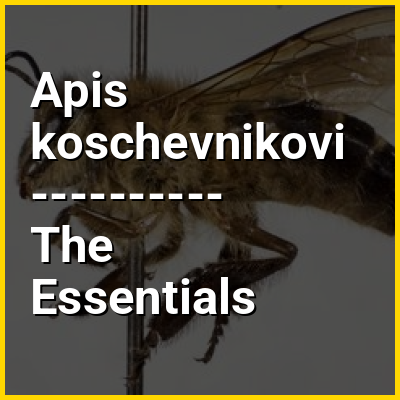
Apis koschevnikovi, Koschevnikov's honey bee, is a species of honey bee which inhabits Malaysian and Indonesian Borneo, where it lives sympatrically with other honey bee species such as Apis cerana (specifically A. c. nuluensis).

The species was first described by Hugo Berthold von Buttel-Reepen, who dedicated it to Grigory Aleksandrovich Kozhevnikov (1866–1933), a pioneer of honey bee morphology. This was an invalid designation, however, and the name was first formally made available by Günther Enderlein that same year. Therefore, Buttel-Reepen is not the author of the name (following the ICZN). The species was described again by Maa in 1953, this time with the name Apis vechti. It was finally rediscovered by Tingek and his colleagues in 1988.
↓ Menu
HINT:

In this Dossier

Apis koschevnikovi in the context of Eastern honey bee

Apis cerana, the eastern honey bee, Asiatic honey bee or Asian honey bee, is a species of honey bee native to South, Southeast and East Asia. This species is the sister species of Apis koschevnikovi and both are in the same subgenus as the western (European) honey bee, Apis mellifera. A. cerana is known to live sympatrically along with Apis koschevnikovi within the same geographic location. Apis cerana colonies are known for building nests consisting of multiple combs in cavities containing a small entrance, presumably for defense against invasion by individuals of another nest. The diet of this honey bee species consists mostly of pollen and nectar, or honey. Moreover, Apis cerana is known for its highly social behavior, reflective of its classification as a type of honey bee.

The terms Apis cerana indica and Apis Indica or Indian honey bee, is an historic term, with all Asian hive bees now referred to as Apis cerana.

View the full Wikipedia page for Eastern honey bee
↑ Return to Menu

Apis koschevnikovi in the context of Apis cerana nuluensis

Apis cerana nuluensis is a subspecies of honey bee described in 1996 by Tingek, Koeniger & Koeniger. The geographic distribution of the subspecies is the southeastern Asian island of Borneo, politically divided between Indonesia, Malaysia, and Brunei.

A. c. nuluensis is one of a number of Indonesian honey bees, including the more obscure Apis koschevnikovi and Apis nigrocincta (the latter of which has nearby habitat on nearby Sulawesi and Mindanao islands)

View the full Wikipedia page for Apis cerana nuluensis
↑ Return to Menu