Antorbital fenestra in the context of "Archosauria"

Play Trivia Questions online!

or

Skip to study material about Antorbital fenestra in the context of "Archosauria"


⭐ Core Definition: Antorbital fenestra

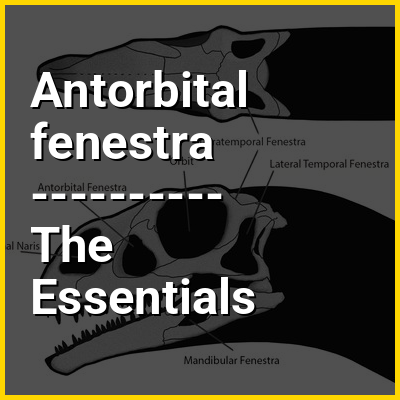
An antorbital fenestra (plural: fenestrae) is an opening in the skull that is in front of the eye sockets. This skull character is largely associated with archosauriforms, first appearing during the Triassic Period. Among extant archosaurs, birds still possess antorbital fenestrae, whereas crocodylians have lost them. The loss in crocodylians is believed to be related to the structural needs of their skulls for the bite force and feeding behaviours that they employ. In some archosaur species, the opening has closed but its location is still marked by a depression, or fossa, on the surface of the skull called the antorbital fossa.

The antorbital fenestra houses a paranasal sinus that is confluent with the adjacent nasal capsule. Although crocodylians walled over their antorbital fenestra, they still retain an antorbital sinus.
↓ Menu

In this Dossier

Antorbital fenestra in the context of Archosaur

Archosauria (lit.'ruling reptiles') or archosaurs (/ˈɑːrkəˌsɔːr/) is a clade of diapsid sauropsid tetrapods, with birds and crocodilians being the only known extant representatives. Although broadly classified as reptiles, which traditionally exclude birds, the cladistic sense of the term includes all living and extinct relatives of birds and crocodilians such as non-avian dinosaurs, pterosaurs, phytosaurs, aetosaurs and rauisuchians as well as many Mesozoic marine reptiles. Modern paleontologists define Archosauria as a crown group that includes the most recent common ancestor of living birds and crocodilians, and all of its descendants.

The base of Archosauria splits into two clades: Pseudosuchia, which includes crocodilians and their extinct relatives; and Avemetatarsalia, which includes birds and their extinct relatives (such as non-avian dinosaurs and pterosaurs). Older definitions of the group Archosauria rely on shared morphological characteristics, such as an antorbital fenestra in the skull, serrated teeth, and an upright stance. Some extinct reptiles, such as proterosuchids and euparkeriids, also possessed these features yet originated prior to the split between the crocodilian and bird lineages. The older morphological definition of Archosauria nowadays roughly corresponds to Archosauriformes, a group named to encompass crown-group archosaurs and their close relatives.

↑ Return to Menu

Antorbital fenestra in the context of Archosauriformes

Archosauriformes (Greek for 'ruling lizards', and Latin for 'form') is a clade of diapsid reptiles encompassing archosaurs and some of their close relatives. It was defined by Jacques Gauthier (1994) as the clade stemming from the last common ancestor of Proterosuchidae and Archosauria. Phil Senter (2005) defined it as the most exclusive clade containing Proterosuchus and Archosauria. Gauthier as part of the Phylonyms (2020) defined the clade as the last common ancestor of Gallus, Alligator, and Proterosuchus, and all its descendants. Archosauriforms are a branch of archosauromorphs which originated in the Late Permian (roughly 252 million years ago) and persist to the present day as the two surviving archosaur groups: crocodilians and birds.

Archosauriforms present several traits historically ascribed to the group Archosauria. These include serrated teeth set in deep sockets, a more active metabolism, and an antorbital fenestra (a hole in the skull in front of the eyes). Reptiles with these traits have also been termed "thecodonts" in older methods of classification. Thecodontia is a paraphyletic group, and its usage as a taxonomic category has been rejected under modern cladistic systems. The name Archosauriformes is intended as a monophyletic replacement compatible with modern taxonomy.

↑ Return to Menu

Antorbital fenestra in the context of Monofenestrata

Monofenestrata is a clade of pterosaurs. It includes the pterosaurs in which the nasal and antorbital fenestra (openings/holes) in the skull are merged into a single fenestra. The clade includes the pterodactyloids and their close relatives.

↑ Return to Menu

Antorbital fenestra in the context of Archosaurian

Archosauria or archosaurs (/ˈɑːrkəˌsɔːr/) is a clade of diapsid sauropsid tetrapods, with birds and crocodilians being the only known extant representatives. Although broadly classified as reptiles, which traditionally exclude birds, the cladistic sense of the term includes all living and extinct relatives of birds and crocodilians such as non-avian dinosaurs, pterosaurs, phytosaurs, aetosaurs and rauisuchians as well as many Mesozoic marine reptiles. Modern paleontologists define Archosauria as a crown group that includes the most recent common ancestor of living birds and crocodilians, and all of its descendants.

The base of Archosauria splits into two clades: Pseudosuchia, which includes crocodilians and their extinct relatives; and Avemetatarsalia, which includes birds and their extinct relatives (such as non-avian dinosaurs and pterosaurs). Older definitions of the group Archosauria rely on shared morphological characteristics, such as an antorbital fenestra in the skull, serrated teeth, and an upright stance. Some extinct reptiles, such as proterosuchids and euparkeriids, also possessed these features yet originated prior to the split between the crocodilian and bird lineages. The older morphological definition of Archosauria nowadays roughly corresponds to Archosauriformes, a group named to encompass crown-group archosaurs and their close relatives.

↑ Return to Menu

Antorbital fenestra in the context of Tupandactylus

Tupandactylus (meaning "Tupâ or Tupan finger", in reference to a personification of the Tupi supreme deity) is a genus of tapejarid pterodactyloid pterosaur from the Early Cretaceous Crato Formation of Brazil. It is known from two species, T. imperator and T. navigans, though it has been suggested that there is only a single, highly sexually dimorphic species (which would then be T. imperator). T. imperator was described in 1997 by D. A. Campos and Alexander W. A. Kellner, who assigned it to Tapejara. Six years later, T. navigans was named and also assigned to Tapejara. In 2007, two efforts to reallocate both species to a new genus were made, and ultimately the name Tupandactylus came into use.

The larger Tupandactylus species, T. imperator, has an estimated wingspan of 3–4 m (9.8–13.1 ft) and may have stood 1.5 m (4.9 ft) tall when measured to the tip of its crest, whereas the smaller T. navigans had a wingspan of about 2.7 m (8.9 ft). Like other tapejarids, Tupandactylus had a large head crest, formed by keratinous fibres and supported by a dorsal extension of the rostrum and a rearward extension of the parietal bone. In T. imperator, the crest was large and rounded, whereas in T. navigans, it was tall and vertical. An additional crest was formed by a projection at the front of the lower jaw. The anatomy of Tupandactylus was standard for a tapejarid, with a large opening formed from the combination of the nasal cavity and the antorbital fenestra, and an eye socket set fairly low in the skull.

↑ Return to Menu