Antonine Wall in the context of "Constantius Chlorus"

Play Trivia Questions online!

or

Skip to study material about Antonine Wall in the context of "Constantius Chlorus"

Ad spacer

⭐ Core Definition: Antonine Wall

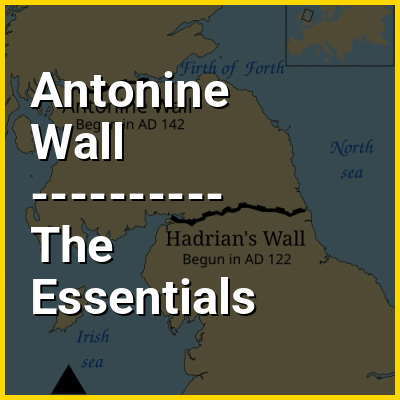
The Antonine Wall (Latin: Vallum Antonini) was a turf fortification on stone foundations, built by the Romans across what is now the Central Belt of Scotland, between the Firth of Clyde and the Firth of Forth. Built some twenty years after Hadrian's Wall to the south, and intended to supersede it, while it was garrisoned it was the northernmost frontier barrier of the Roman Empire. It spanned approximately 63 kilometres (39 miles) and was about 3 metres (10 feet) high and 5 metres (16 feet) wide. Lidar scans have been carried out to establish the length of the wall and the Roman distance units used. Security was bolstered by a deep ditch on the northern side. It is thought that there was a wooden palisade on top of the turf. The barrier was the second of two "great walls" created by the Romans in Great Britain in the second century AD. Its ruins are less evident than those of the better-known and longer Hadrian's Wall to the south, primarily because the turf and wood wall has largely weathered away, unlike its stone-built southern predecessor.

Construction began in AD 142 at the order of Roman Emperor Antoninus Pius. Estimates of how long it took to complete vary widely, with six and twelve years most commonly proposed. Antoninus Pius never visited Britain, unlike his predecessor Hadrian. Pressure from the Caledonians probably led Antoninus to send the empire's troops farther north. The Antonine Wall was protected by 16 forts with small fortlets between them; troop movement was facilitated by a road linking all the sites known as the Military Way. The soldiers who built the wall commemorated the construction and their struggles with the Caledonians with decorative slabs, twenty of which survive. The wall was abandoned only eight years after completion, and the garrisons relocated rearward to Hadrian's Wall. Most of the wall and its associated fortifications have been destroyed over time, but some remains are visible. Many of these have come under the care of Historic Environment Scotland and the UNESCO World Heritage Committee.
↓ Menu

>>>PUT SHARE BUTTONS HERE<<<
In this Dossier

Antonine Wall in the context of Antoninus Pius

Titus Aelius Hadrianus Antoninus Pius (/ˌæntəˈnnəs ˈpəs/; Latin: [antoːˈniːnus ˈpius]; 19 September 86 – 7 March 161) was Roman emperor from AD 138 to 161. He was the fourth of the Five Good Emperors from the Nerva–Antonine dynasty.

Born into a senatorial family, Antoninus held various offices during the reign of Emperor Hadrian. He married Hadrian's niece Faustina, and Hadrian adopted him as his son and successor shortly before his death. Antoninus acquired the cognomen Pius after his accession to the throne, either because he compelled the Senate to deify his adoptive father, or because he had saved senators sentenced to death by Hadrian in his later years. His reign is notable for the peaceful state of the Empire, with no major revolts or military incursions during this time. A successful military campaign in southern Scotland early in his reign resulted in the construction of the Antonine Wall.

↑ Return to Menu

Antonine Wall in the context of Flavius Constantius

Flavius Valerius Constantius (c. 250 – 25 July 306), also called Constantius I, was a Roman emperor from 305 to 306. He was one of the four original members of the Tetrarchy established by Diocletian, first serving as caesar from 293 to 305 and then ruling as augustus until his death. Constantius was also father of Constantine the Great, the first Christian emperor of Rome. The nickname "Chlorus" (Ancient Greek: Χλωρός, lit.'the Pale') was first popularized by Byzantine-era historians and not used during the emperor's lifetime.

As an Illyrian soldier of humble origin, Constantius had a distinguished military career and rose to the top ranks of the army. Around 289, he set aside Helena, Constantine's mother, to marry a daughter of Emperor Maximian, and in 293 was added to the imperial college by Maximian's colleague Diocletian. Assigned to rule Gaul, Constantius defeated the usurper Carausius there and his successor Allectus in Britain, and campaigned extensively along the Rhine frontier, defeating the Alamanni and Franks. When the Diocletianic Persecution was announced in 303, Constantius ordered the demolition of churches but did not actively hunt down Christians in his domain. Upon becoming senior emperor in May 305, Constantius launched a successful punitive campaign against the Picts beyond the Antonine Wall. He died suddenly at Eboracum (York) in July the following year.

↑ Return to Menu

Antonine Wall in the context of Caledonia

Caledonia (/ˌkælɪˈdniə/; Latin: Calēdonia [kaleːˈdonia]) was the Latin name used by the Roman Empire to refer to the forested region in the central and western Scottish Highlands, particularly stretching through parts of what are now Lochaber, Badenoch, Strathspey, and possibly as far south as Rannoch Moor, known as Coed Celedon (Coed Celyddon using the modern alphabet) to the native Brython (Britons). Today, it is used as a romantic or poetic name for all of Scotland. During the Roman Empire's occupation of Britain, the area they called Caledonia was physically separated from the rest of the island by the Antonine Wall. It remained outside the administration of Roman Britain.

Latin historians, including Tacitus and Cassius Dio, referred to the territory north of the River Forth as "Caledonia", and described it as inhabited by the Maeatae and the Caledonians (Latin: Caledonii).

↑ Return to Menu

Antonine Wall in the context of Scotland during the Roman Empire

Scotland during the Roman Empire refers to the protohistorical period during which the Roman Empire interacted within the area of modern Scotland. Despite sporadic attempts at conquest and government between the first and fourth centuries AD, most of modern Scotland, inhabited by the Caledonians and the Maeatae, was not incorporated into the Roman Empire with Roman control over the area fluctuating.

In the Roman imperial period, the area of Caledonia lay north of the River Forth, while the area now called England was known as Britannia, the name also given to the Roman province roughly consisting of modern England and Wales and which replaced the earlier Ancient Greek designation as Albion. Roman legions arrived in the territory of modern Scotland around AD 71, having conquered the Celtic Britons of southern Britannia over the preceding three decades. Aiming to complete the Roman conquest of Britannia, the Roman armies under Quintus Petillius Cerialis and Gnaeus Julius Agricola campaigned against the Caledonians in the 70s and 80s. The Agricola, a biography of the Roman governor of Britannia by his son-in-law Tacitus mentions a Roman victory at "Mons Graupius" which became the namesake of the Grampian Mountains but whose identity has been questioned by modern scholarship. In 2023 a lost Roman road built by Julius Agricola was rediscovered in Drip close to Stirling: it has been described as "the most important road in Scottish history".

↑ Return to Menu

Antonine Wall in the context of Hadrian's Wall

Hadrian's Wall (Latin: Vallum Hadriani; also known as the Roman Wall, Picts' Wall, or Vallum Aelium in Latin) is a former defensive fortification of the Roman province of Britannia, begun in AD 122 in the reign of the Emperor Hadrian. Running from Wallsend on the River Tyne in the east to Bowness-on-Solway in the west of what is now northern England, it was a stone wall with large ditches in front and behind, stretching across the whole width of the island. Soldiers were garrisoned along the line of the wall in large forts, smaller milecastles, and intervening turrets. In addition to the wall's defensive military role, its gates may have been customs posts.

Hadrian's Wall Path generally runs close along the wall. Almost all the standing masonry of the wall was removed in early modern times and used for local roads and farmhouses. None of it stands to its original height, but modern work has exposed much of the footings, and some segments display a few courses of modern masonry reconstruction. Many of the excavated forts on or near the wall are open to the public, and various nearby museums present its history. The largest Roman archaeological feature in Britain, it runs a total of 73 miles (117.5 kilometres). Regarded as a British cultural icon, Hadrian's Wall is one of Britain's major ancient tourist attractions. It was designated a UNESCO World Heritage Site in 1987. The turf-built Antonine Wall of AD 142 in what is now central Scotland, which briefly superseded Hadrian's Wall before being abandoned, was declared a World Heritage Site in 2008.

↑ Return to Menu

Antonine Wall in the context of Ancient Roman defensive walls

Defensive walls are a feature of ancient Roman architecture. The Romans generally fortified cities, rather than building stand-alone fortresses, but there are some fortified camps, such as the Saxon Shore forts like Porchester Castle in England. City walls were already significant in Etruscan architecture, and in the struggle for control of Italy under the early Republic many more were built, using different techniques. These included tightly fitting massive irregular polygonal blocks, shaped to fit exactly in a way reminiscent of later Inca work. The Romans called a simple rampart wall an agger; at this date great height was not necessary. The Servian Wall around Rome was an ambitious project of the early 4th century BC. The wall was up to 10 metres (32.8 ft) in height in places, 3.6 metres (12 ft) wide at its base, 11 km (7 mi) long, and is believed to have had 16 main gates, though many of these are mentioned only from writings, with no other known remains. Some of it had a fossa or ditch in front, and an agger behind, and it was enough to deter Hannibal. Later the Aurelian Wall replaced it, enclosing an expanded city, and using more sophisticated designs, with small forts at intervals.

The Romans walled major cities and towns in areas they saw as vulnerable, and parts of many walls remain incorporated in later defences, as at Córdoba (2nd century BC), Chester (earth and wood in the 70s AD, stone from c. 100), and York (from 70s AD). Strategic walls defending the frontiers of the Empire by running across open country were far rarer, and Hadrian's Wall (from 122) and the Antonine Wall (from 142, abandoned only 8 years after completion) are the most significant examples, both on the Pictish frontier. Most defences of the borders of the Roman Empire relied on systems of forts and roads without attempting a continuous barrier.

↑ Return to Menu

Antonine Wall in the context of History of Scotland

The recorded history of Scotland begins with the arrival of the Roman Empire in the 1st century, when the province of Britannia reached as far north as the Antonine Wall. North of this was Caledonia, inhabited by the Picti, whose uprisings forced Rome's legions back to Hadrian's Wall. As Rome finally withdrew from Britain, a Gaelic tribe from Ireland called the Scoti began colonising Western Scotland and Wales. Before Roman times, prehistoric Scotland entered the Neolithic Era about 4000 BC, the Bronze Age about 2000 BC, and the Iron Age around 700 BC.

The Gaelic kingdom of Dál Riata was founded on the west coast of Scotland in the 6th century. In the following century, Irish missionaries introduced the previously pagan Picts to Celtic Christianity. Following England's Gregorian mission, the Pictish king Nechtan chose to abolish most Celtic practices in favour of the Roman rite, restricting Gaelic influence on his kingdom and avoiding war with Anglian Northumbria. Towards the end of the 8th century, the Viking invasions began, forcing the Picts and Gaels to cease their historic hostility to each other and to unite in the 9th century, forming the Kingdom of Scotland.

↑ Return to Menu

Antonine Wall in the context of Maeatae

The Maeatae were a confederation of tribes that probably lived beyond the Antonine Wall in Roman Britain.

The historical sources are vague as to the exact region they inhabited, but an association is thought to be indicated in the names of two hills with fortifications. Near the summit of Dumyat hill in the Ochils, overlooking Stirling, there are remains of a fort and the name of the hill (in Gaelic Dùn Mhèad) is believed to derive from name meaning the hill of the Maeatae. The prominent hill fort may have marked their northern boundary. The first excavations of Dumyat were led by Dr Murray Cook, who recovered a radiocarbon date from a newly discovered external ditch dating to the 5th to 7th centuries AD. Myot Hill, near Fankerton, plausibly marks their southern limits. A discussion of two views of the importance of Dumyat and Myot Hill is given in Wainwright. There are three other potential Maeatae placenames in Scotland, potentially giving them a territory from Balfron to West Lothian and potentially St Andrews. Dunmanyn, Dalmeny, West Lothian (James 2013, :‘P-Celtic in Southern Scotland and Cumrbria: a review of the place-name evidence for possible Pictish phonology’, Journal of Scottish Names Studies 7: 29-78.), Cremannan, Balfron, Stirlingshire (Taylor, S, Clancy, T O, McNiven, P & Williamson, E 2020 The Place-Names of Clackmannanshire. Shaun Tyas: Donnington) and Rummond (Rodmanand), St Andrews, Fife (Taylor, S 2009 The Placenames of Fife, Vol. 3 St Andrews and the East Neuk. Donnington: Shaun Tyas).

↑ Return to Menu