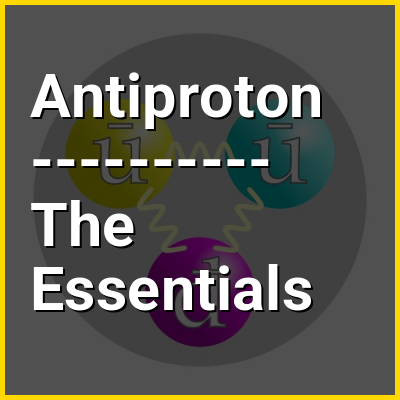
The antiproton, p, (pronounced p-bar) is the antiparticle of the proton. Antiprotons are stable, but they are typically short-lived, since any collision with a proton will cause both particles to be annihilated in a burst of energy.
The existence of the antiproton with electric charge of −1 e, opposite to the electric charge of +1 e of the proton, was predicted by Paul Dirac in his 1933 Nobel Prize lecture. Dirac received the Nobel Prize for his 1928 publication of his Dirac equation that predicted the existence of positive and negative solutions to Einstein's energy equation () and the existence of the positron, the antimatter analog of the electron, with opposite charge and spin.