Antilocapridae in the context of "Antelopes"

Play Trivia Questions online!

or

Skip to study material about Antilocapridae in the context of "Antelopes"


⭐ Core Definition: Antilocapridae

The Antilocapridae are a family of ruminant artiodactyls endemic to North America. Their closest extant relatives are the giraffids. Only one species, the pronghorn (Antilocapra americana), is living today; all other members of the family are extinct. The living pronghorn is a small ruminant mammal resembling an antelope.

↓ Menu

In this Dossier

Antilocapridae in the context of Horn (anatomy)

A horn is a permanent pointed projection on the head of various animals that consists of a covering of keratin and other proteins surrounding a core of live bone. Horns are distinct from antlers, which are not permanent. In mammals, true horns are found mainly among the ruminant artiodactyls, in the families Antilocapridae (pronghorn) and Bovidae (cattle, goats, antelope etc.). Cattle horns arise from subcutaneous connective tissue (under the scalp) and later fuse to the underlying frontal bone.

One pair of horns is usual; however, two or more pairs occur in a few wild species and in some domesticated breeds of sheep. Polycerate (multi-horned) sheep breeds include the Hebridean, Icelandic, Jacob, Manx Loaghtan, and the Navajo-Churro.

↑ Return to Menu

Antilocapridae in the context of Antelope

The term antelope refers to numerous extant or recently extinct species of the ruminant artiodactyl family Bovidae that are indigenous to most of Africa, India, the Middle East, Central Asia, and a small area of Russia. Antelopes do not form a monophyletic group, as some antelopes are more closely related to other bovid groups, such as bovines, goats, and sheep, than to other antelopes.

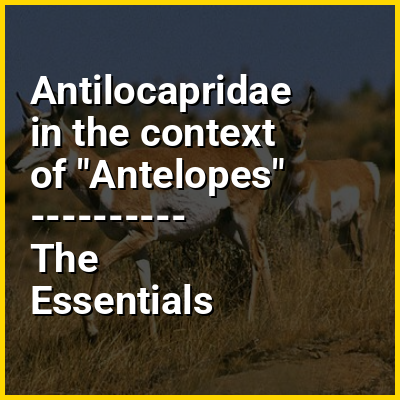
A stricter grouping, known as the true antelopes, includes only the genera Gazella, Nanger, Eudorcas, and Antilope. One North American mammal, the pronghorn or "pronghorn antelope", is colloquially referred to as the "American antelope", despite the fact that it belongs to a completely different family (Antilocapridae) than the true Old-World antelopes; pronghorn are the sole extant member of a lineage that once included many species which went extinct in the prehistoric period.

↑ Return to Menu

Antilocapridae in the context of Pronghorn

The pronghorn (UK: /ˈprɒŋhɔːrn/, US: /ˈprɔːŋ-/) (Antilocapra americana) is a species of artiodactyl (even-toed, hoofed) mammal indigenous to interior western and central North America. Though not an antelope, it is known colloquially in North America as the American antelope, prong buck, pronghorn antelope, and prairie antelope, because it closely resembles the antelopes of the Old World and fills a similar ecological niche due to parallel evolution. It is the only surviving member of the family Antilocapridae.

During the Pleistocene epoch, about 11 other antilocaprid species existed in North America, many with long or spectacularly twisted horns. Three other genera (Capromeryx, Stockoceros and Tetrameryx) existed when humans entered North America but are now extinct.

↑ Return to Menu