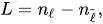
In particle physics, a lepton is an elementary particle of half-integer spin (spin 1/2) that does not undergo strong interactions. Two main classes of leptons exist: charged leptons (also known as the electron-like leptons or muons), including the electron, muon, and tauon, and neutral leptons, better known as neutrinos. Charged leptons can combine with other particles to form various composite particles such as atoms and positronium, while neutrinos rarely interact with anything, and are consequently rarely observed. The best known of all leptons is the electron.
There are six types of leptons, known as flavours, grouped in three generations. The first-generation leptons, also called electronic leptons, comprise the electron (e
) and the electron neutrino (ν
e); the second are the muonic leptons, comprising the muon (μ
) and the muon neutrino (ν
μ); and the third are the tauonic leptons, comprising the tau (τ
) and the tau neutrino (ν
τ). Electrons have the least mass of all the charged leptons. The heavier muons and taus will rapidly change into electrons and neutrinos through a process of particle decay: the transformation from a higher mass state to a lower mass state. Thus electrons are stable and the most common charged lepton in the universe, whereas muons and taus can only be produced in high-energy collisions (such as those involving cosmic rays and those carried out in particle accelerators).