Anna Maria Luisa de' Medici in the context of Galleria degli Uffizi


Anna Maria Luisa de' Medici in the context of Galleria degli Uffizi

⭐ Core Definition: Anna Maria Luisa de' Medici

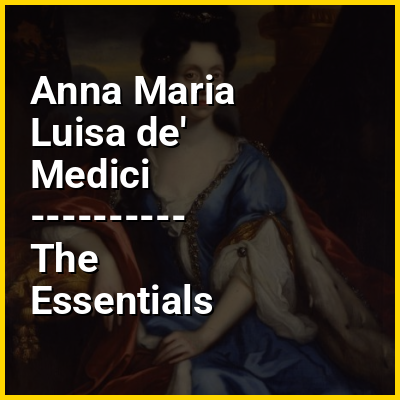
Anna Maria Luisa de' Medici (11 August 1667 – 18 February 1743) was an Italian noblewoman who was the last lineal descendant of the main branch of the House of Medici. A patron of the arts, she bequeathed the Medicis' large art collection, including the contents of the Uffizi, Palazzo Pitti, and the Medici villas, which she inherited upon her brother Gian Gastone's death in 1737, and her Palatine treasures to the Tuscan state, on the condition that no part of it could be removed from "the Capital of the grand ducal State....[and from] the succession of His Serene Grand Duke."

Anna Maria Luisa was the only daughter of Cosimo III de' Medici, Grand Duke of Tuscany, and Marguerite Louise d'Orléans, a niece of Louis XIII of France. On her marriage to Johann Wilhelm, Elector Palatine, she became Electress of the Palatinate, and, by patronising musicians, she earned for the contemporary Palatine court the reputation of an important music centre. As Johann Wilhelm had syphilis the union produced no offspring, which, combined with her siblings' barrenness, meant that the Medici were on the verge of extinction.
↓ Menu
HINT:

In this Dossier

Anna Maria Luisa de' Medici in the context of Uffizi

The Uffizi Gallery (UK: /juːˈfɪtsi, ʊˈftsi/ yoo-FIT-see, uu-FEET-see; Italian: Galleria degli Uffizi, pronounced [ɡalleˈriːa deʎʎ ufˈfittsi]) is a prominent art museum adjacent to the Piazza della Signoria in the Historic Centre of Florence in the region of Tuscany, Italy. One of the most important Italian museums and the most visited, it is also one of the largest and best-known in the world and holds a collection of priceless works, particularly from the period of the Italian Renaissance.

After the ruling House of Medici died out, their art collections were given to the city of Florence under the famous Patto di famiglia ("family pact") negotiated by Anna Maria Luisa, the last Medici heiress. The Uffizi is one of the first modern museums. The gallery had been open to visitors by request since the sixteenth century, and in 1769 it was officially opened to the public, formally becoming a museum in 1865.

View the full Wikipedia page for Uffizi
↑ Return to Menu

Anna Maria Luisa de' Medici in the context of Gian Gastone de' Medici, Grand Duke of Tuscany

Gian Gastone de' Medici (born Giovanni Battista Gastone; 25 May 1671 – 9 July 1737) was the seventh and last Medicean grand duke of Tuscany.

He was the second son of Grand Duke Cosimo III and Marguerite Louise d'Orléans. His sister, Electress Palatine Anna Maria Luisa, arranged his marriage to the wealthy and widowed Anna Maria Franziska of Saxe-Lauenburg in 1697. The couple despised each other and had no children. As Grand Prince Ferdinando, Gian Gastone's elder brother, predeceased Cosimo III, Gian Gastone succeeded his father in 1723.

View the full Wikipedia page for Gian Gastone de' Medici, Grand Duke of Tuscany
↑ Return to Menu