Andronikos III Palaiologos in the context of First Palaiologan Civil War


Andronikos III Palaiologos in the context of First Palaiologan Civil War

⭐ Core Definition: Andronikos III Palaiologos

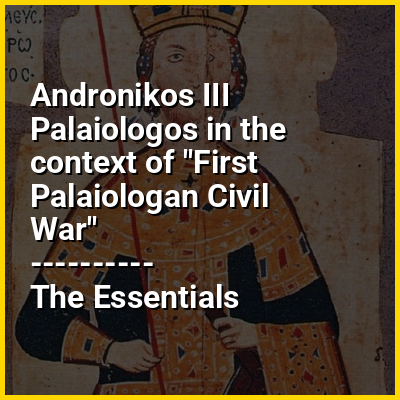
Andronikos III Palaiologos (Greek: Ἀνδρόνικος Δούκας Ἄγγελος Κομνηνός Παλαιολόγος, romanizedAndrónikos Doúkās Ángelos Komnēnós Palaiológos; 25 March 1297 – 15 June 1341), commonly Latinized as Andronicus III Palaeologus, was the Byzantine emperor from 1328 to 1341. He was the son of Michael IX Palaiologos and Rita of Armenia. He was proclaimed co-emperor in his youth, before 1313, and in April 1321 he rebelled against his grandfather, Andronikos II Palaiologos. He was formally crowned co-emperor in February 1325, before ousting his grandfather outright and becoming sole emperor on 24 May 1328.

His reign included the last failed attempts to hold back the Ottoman Turks in Bithynia and the defeat at Rusokastro against the Bulgarians, but also the successful recovery of Chios, Lesbos, Phocaea, Thessaly, and Epirus. His early death left a power vacuum that resulted in the disastrous civil war between his widow, Anna of Savoy, and his closest friend and supporter, John VI Kantakouzenos, leading to the establishment of the Serbian Empire and the entry of the Ottoman Empire into the Balkans.
↓ Menu
HINT:

In this Dossier

Andronikos III Palaiologos in the context of Orhan I

Orhan Ghazi (Ottoman Turkish: اورخان غازی; Turkish: Orhan Gazi, also spelled Orkhan; died 1362) was the second sultan of the Ottoman Empire from 1323/4 to 1362. He was born in Söğüt, as the son of Osman I.

In the early stages of his reign, Orhan focused his energies on conquering most of northwestern Anatolia. The majority of these areas were under Byzantine rule and he won his first battle at Pelekanon against the Byzantine Emperor Andronikos III Palaiologos. Orhan also occupied the lands of the Karasids of Balıkesir and the Ahis of Ankara.

View the full Wikipedia page for Orhan I
↑ Return to Menu

Andronikos III Palaiologos in the context of Andronikos II Palaiologos

Andronikos II Palaiologos (Greek: Ἀνδρόνικος Δούκας Ἄγγελος Κομνηνὸς Παλαιολόγος, romanizedAndrónikos Doúkās Ángelos Komnēnós Palaiológos; 25 March 1259 – 13 February 1332), Latinized as Andronicus II Palaeologus, reigned as Byzantine emperor from 1282 to 1328. His reign marked the beginning of the recently restored empire's final decline. The Turks conquered most of Byzantium's remaining Anatolian territories, and Andronikos spent the last years of his reign fighting his own grandson in the First Palaiologan Civil War. The war ended in Andronikos' forced abdication in 1328, after which he retired to a monastery for the remainder of his life.

View the full Wikipedia page for Andronikos II Palaiologos
↑ Return to Menu

Andronikos III Palaiologos in the context of Byzantine civil war of 1341–1347

The Byzantine civil war of 1341–1347, sometimes referred to as the Second Palaiologan Civil War, was a conflict that broke out in the Byzantine Empire after the death of Andronikos III Palaiologos over the guardianship of his nine-year-old son and heir, John V Palaiologos. It pitted on the one hand Andronikos III's chief minister, John VI Kantakouzenos, and on the other a regency headed by the Empress-Dowager Anna of Savoy, the Patriarch of Constantinople John XIV Kalekas, and the megas doux Alexios Apokaukos. The war polarized Byzantine society along class lines, with the aristocracy backing Kantakouzenos and the lower and middle classes supporting the regency. To a lesser extent, the conflict acquired religious overtones; Byzantium was embroiled in the Hesychast controversy, and adherence to the mystical doctrine of Hesychasm was often equated with support for Kantakouzenos.

As the chief aide and closest friend of Emperor Andronikos III, Kantakouzenos became regent for the underage John V upon Andronikos's death in June 1341. While Kantakouzenos was absent from Constantinople in September the same year, a coup d'état led by Alexios Apokaukos and the Patriarch John XIV secured the support of Empress Anna and established a new regency. In response, Kantakouzenos' army and supporters proclaimed him co-emperor in October, cementing the rift between himself and the new regency. The split immediately escalated into armed conflict.

View the full Wikipedia page for Byzantine civil war of 1341–1347
↑ Return to Menu

Andronikos III Palaiologos in the context of John VI Kantakouzenos

John VI Kantakouzenos or Cantacuzene (Greek: Ἰωάννης Ἄγγελος [Κομνηνός] Παλαιολόγος Καντακουζηνός, romanizedIōánnēs Ángelos [Komnēnós] Palaiológos Kantakouzēnós; Latin: Iohannes Cantacuzenus; c. 1292 – 15 June 1383) was a Byzantine Greek nobleman, statesman, and general. He served as grand domestic under Andronikos III Palaiologos and regent for John V Palaiologos before reigning as Byzantine emperor in his own right from 1347 to 1354. Deposed by his former ward, he was forced to retire to a monastery under the name Joasaph Christodoulos (Greek: Ἰωάσαφ Χριστόδουλος, romanizedJoásaph Christódoulos) and spent the remainder of his life as a monk and historian. At age 90 or 91 at his death, he was the longest-lived of the Roman emperors. His two disastrous civil wars led to the loss of much of the remaining territory in the Balkans under Byzantine control to the Serbian and Bulgarian empires, but the most severe loss during his civil war was the loss of the Gallipoli peninsula to the Ottoman Turks, allowing the Ottomans to gain territory in Europe and setting the stage for the destruction of the Byzantine Empire a century later.

View the full Wikipedia page for John VI Kantakouzenos
↑ Return to Menu

Andronikos III Palaiologos in the context of Anna of Savoy

Anna of Savoy, born Giovanna (1306–1365), was a Byzantine Empress consort, as the second spouse of Andronikos III Palaiologos. She served as regent, with the titles augusta and autokratorissa, during the minority of her son John V Palaiologos from 1341 until 1347. In Byzantium, she was known as Anna Palaiologina, owing to her marriage to Andronikos.

View the full Wikipedia page for Anna of Savoy
↑ Return to Menu

Andronikos III Palaiologos in the context of Battle of Pelekanon

The Battle of Pelekanon, also known by its Latinised form Battle of Pelecanum, occurred on June 10–11, 1329 between an expeditionary force by the Byzantines led by Andronikos IIl and an Ottoman army led by Orhan I. The Byzantine army was defeated, with no further attempt made at relieving the cities in Anatolia under Ottoman siege.

View the full Wikipedia page for Battle of Pelekanon
↑ Return to Menu

Andronikos III Palaiologos in the context of Byzantine civil war of 1321–1328

The Byzantine civil war of 1321–1328 was a series of conflicts between the Byzantine emperor Andronikos II Palaiologos and his grandson Andronikos III Palaiologos over control of the Byzantine Empire.

View the full Wikipedia page for Byzantine civil war of 1321–1328
↑ Return to Menu