Andrei Zhelyabov in the context of Law School


Andrei Zhelyabov in the context of Law School

⭐ Core Definition: Andrei Zhelyabov

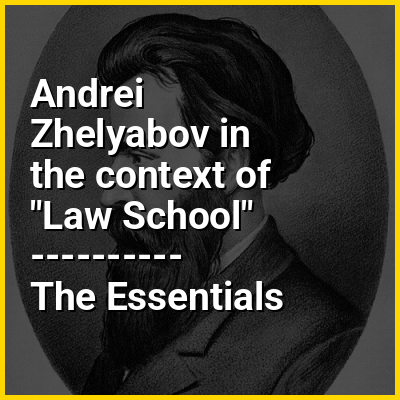
Andrei Ivanovich Zhelyabov (Russian: Желябов, Андрей Иванович; 29 August [O.S. 17 August] 1851 – 15 April [O.S. 3 April] 1881) was a Russian revolutionary and member of the executive committee of Narodnaya Volya.

Zhelyabov was born in to a family of serfs. After graduating from a gymnasium in Kerch in 1869, Zhelyabov got into a Law School of the Novorossiysky University in Odessa. He was expelled from the university for his participation in student unrests in October 1871 and sent away from Odessa. In 1873, Zhelyabov lived in a town of Gorodische (present-day Cherkas'ka oblast' of Ukraine) and maintained close ties with revolutionaries from Kiev and activists of the Ukrainian "Hromada". After his return to Odessa, Zhelyabov became a member of the revolutionary Felix Volkhovsky group (the Odessa affiliate of “Chaikovtsi”) and conducted propaganda among workers and intelligentsia. He was arrested in late 1874 and then released on bail. Nevertheless, he continued his illegal activities. Zhelyabov was one of the suspects in the "Trial of the 193". After his acquittal in 1878, he moved to Podolsk province for the purpose of spreading revolutionary propaganda among the peasantry.
↓ Menu
HINT:

In this Dossier

Andrei Zhelyabov in the context of Assassination of Alexander II of Russia

On 13 March [O.S. 1 March] 1881, Alexander II, the Emperor of Russia, was assassinated in Saint Petersburg, Russia while returning to the Winter Palace from Mikhailovsky Manège in a closed carriage. The assassination was planned by the Executive Committee of Narodnaya Volya ("People's Will"), chiefly by Andrei Zhelyabov. Of the four assassins coordinated by Sophia Perovskaya, two actually committed the deed. One assassin, Nikolai Rysakov, threw a bomb which damaged the carriage, prompting the Tsar to disembark. At this point a second assassin, Ignacy Hryniewiecki, threw a bomb that fatally wounded Alexander II.

Alexander II had previously survived several attempts on his life, including the attempts by Dmitry Karakozov and Alexander Soloviev, the attempt to dynamite the imperial train in Aleksandrovsk (Zaporizhzhia), and the bombing of the Winter Palace in February 1880. The assassination is popularly considered to be the most successful action by the Russian nihilist movement of the 19th century. Because one of the perpetrators was Jewish, the assassination set off a wave of Antisemitism and anti-jewish riots throughout the Empire.

View the full Wikipedia page for Assassination of Alexander II of Russia
↑ Return to Menu