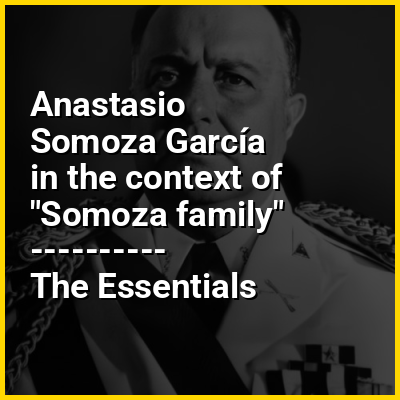
Anastasio Somoza García in the context of Somoza family


Anastasio Somoza García in the context of Somoza family

⭐ Core Definition: Anastasio Somoza García

Anastasio Somoza García (1 February 1896 – 29 September 1956) was the leader of Nicaragua from 1936 until his assassination in 1956. He was officially the 21st President of Nicaragua from 1 January 1937 to 1 May 1947 and from 21 May 1950 until his assassination on 29 September 1956, ruling for the rest of the time as an unelected military dictator. He was the patriarch of the Somoza family, which ruled Nicaragua as a family dictatorship for 42 years.

The son of a wealthy coffee planter, Somoza was educated in the United States. After his return to Nicaragua, he helped oust President Adolfo Díaz. He became the foreign secretary and took the title of "General". With the help of the U.S. Marine Corps, which occupied Nicaragua at the time, Somoza became the head of the National Guard. This gave him the power base to remove his wife's uncle, Juan Bautista Sacasa, from the presidency, and make himself president in 1937. In 1947, an ally nominally succeeded him, but he retained power.
↓ Menu
HINT:

In this Dossier

Anastasio Somoza García in the context of Operation PBFortune

Operation PBFortune, also known as Operation Fortune, was a covert United States operation to overthrow the democratically elected Guatemalan President Jacobo Árbenz in 1952. The operation was authorized by U.S. President Harry Truman and planned by the Central Intelligence Agency. The United Fruit Company had lobbied intensively for the overthrow because land reform initiated by Árbenz threatened its economic interests. The US also feared that the government of Árbenz was being influenced by communists.

The coup attempt was planned with the support of the United Fruit Company and of Anastasio Somoza García, Rafael Trujillo and Marcos Pérez Jiménez, the US-backed right-wing dictators of Nicaragua, the Dominican Republic, and Venezuela respectively, who felt threatened by the democratic Guatemalan Revolution, and had sought to undermine it. The plan involved providing weapons to the exiled Guatemalan military officer Carlos Castillo Armas, who was to lead an invasion from Nicaragua.

View the full Wikipedia page for Operation PBFortune
↑ Return to Menu

Anastasio Somoza García in the context of Augusto Cesar Sandino

Augusto César Sandino (Latin American Spanish: [awˈɣusto se sanˈdino]; 18 May 1895 – 21 February 1934), full name Augusto Nicolás Calderón Sandino, was a Nicaraguan revolutionary, founder of the militant group EDSN, and leader of a rebellion between 1927 and 1933 against the United States occupation of Nicaragua. Despite being referred to as a "bandit" by the United States government, his exploits made him a hero throughout much of Latin America, where he became a symbol of resistance to American imperialism. Sandino drew units of the United States Marine Corps into an undeclared guerrilla war. The United States troops withdrew from the country in 1933 after overseeing the election and inauguration of President Juan Bautista Sacasa, who had returned from exile.

Sandino was executed in 1934 by National Guard forces of General Anastasio Somoza García, who went on to seize power in a coup d'état two years later. After being elected president by an overwhelming margin in 1936, Somoza García resumed control of the National Guard and established a dictatorship, with the Somoza family dynasty ruling Nicaragua for more than 40 years. Sandino's political legacy was claimed by the Sandinista National Liberation Front (FSLN), which overthrew the Somoza government in 1979 and then ensconced itself in power for more than 40 years.

View the full Wikipedia page for Augusto Cesar Sandino
↑ Return to Menu