Amapá in the context of "Coastline of Brazil"

Play Trivia Questions online!

or

Skip to study material about Amapá in the context of "Coastline of Brazil"


⭐ Core Definition: Amapá

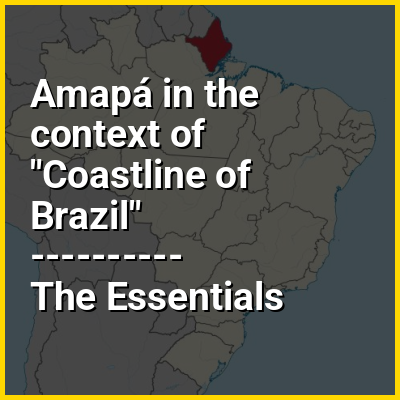
Amapá (/ˌɑːməˈpɑː/; Portuguese: [amaˈpa] ) is one of the 26 states of Brazil. It is in the North Region of Brazil. It is the second-least populous state and the eighteenth-largest state by area. Located in the far northern part of the country, Amapá is bordered clockwise by French Guiana to the north for 730 km, the Atlantic Ocean to the east for 578 km, Pará to the south and west, and Suriname to the northwest for 63 km. The capital and largest city is Macapá. The state has 0.4% of the Brazilian population and is responsible for 0.22% of the Brazilian GDP.

In the colonial period the region was called Portuguese Guiana and was part of Portugal's State of Brazil. Later, the region was distinguished from the other Guianas. Amapá was once part of Pará, but became a separate territory in 1943, and the decision to make it a state was made in 1988. The first state legislators took office on 1 January 1991.
↓ Menu

👉 Amapá in the context of Coastline of Brazil

The coastline of Brazil measures 7,491 km, making it the 16th longest national coastline in the world. The coastline touches exclusively the Atlantic Ocean. Brazil's coastline has many geographical features such as islands, reefs, bays, and its 2,095 beaches.

9 of Brazil's 26 states are landlocked, including the Federal District. The capitals of the 17 coastal states are close to the ocean, with the exceptions of Curitiba in Paraná, Porto Alegre in Rio Grande do Sul, Teresina in Piauí, Belém in Pará, and Macapá in Amapá.

↓ Explore More Topics
In this Dossier

Amapá in the context of Amazon Delta

The Amazon Delta (Portuguese: delta do Amazonas) is a vast river delta formed by the Amazon River and the Tocantins River (through the Pará River distributary channel) in northern South America. It is located in the Brazilian states of Amapá and Pará and encompasses the Marajó Archipelago, with Marajó Island as its largest island. The main cities located in the vicinity are Belém and Macapá, each with its respective metropolitan area.

The Amazon Delta has a tropical climate with high humidity and high temperatures. It has a wet season with frequent flooding and a dry season where the delta dries out. These seasons shape the environment of the Amazon Delta and the life in it, such as the water buffalo for which Marajó Island is well known, three-toed sloth, capybara, giant anteater, giant otter, jaguar and pink river dolphins.

↑ Return to Menu

Amapá in the context of Oyapock

The Oyapock or Oiapoque (/ˈɔɪ.əpɒk, ˌɔɪ.əˈpki/ OY-ə-pok, OY-ə-POH-kee; French: Fleuve Oyapock [flœv ojapɔk]; Portuguese: Rio Oiapoque [ˈʁi.u ojaˈpɔki]) is a 403-kilometre (250 mi) long river in South America that forms most of the border between the French overseas department of French Guiana and the Brazilian state of Amapá.

↑ Return to Menu

Amapá in the context of Pará

Pará (Brazilian Portuguese: [paˈɾa] ) is a state of Brazil, located in northern Brazil and traversed by the lower Amazon River. It borders the Brazilian states of Amapá, Maranhão, Tocantins, Mato Grosso, Amazonas and Roraima. To the northwest are the borders of Guyana and Suriname, to the northeast of Pará is the Atlantic Ocean. The capital and largest city is Belém, which is located at the Marajó bay, near the estuary of the Amazon river. The state, which is home to 4.1% of the Brazilian population, is responsible for just 2.2% of the Brazilian GDP.

Pará is the most populous state of the North Region, with a population of over 8.6 million, being the ninth-most populous state in Brazil. It is the second-largest state of Brazil in area, at 1.2 million square kilometres (460,000 sq mi), second only to Amazonas upriver. Its most famous icons are the Amazon River and the Amazon rainforest. Pará produces rubber (extracted from rubber tree groves), cassava, açaí, pineapple, cocoa, black pepper, coconut, banana, tropical hardwoods such as mahogany, and minerals such as iron ore and bauxite. A new commodity crop is soy, cultivated in the region of Santarém.

↑ Return to Menu

Amapá in the context of Marajó Archipelago

The Marajó Archipelago (Portuguese: arquipélago do Marajó) is the largest fluvial-maritime archipelago on Earth. Located in the Brazilian states of Amapá and Pará, the island group has approx. 2,500 islands.

The main island of the archipelago also has the name of Marajó, having about 42,000 km² of area, considered, due to its size, as the largest coastal island in Brazil, extending from the mouth of the Amazon River, between the Line of the Equator and the parallel 1.55º south latitude and, in the E/W direction between the meridians 47º and 53º west longitude, until the Atlantic Ocean.

↑ Return to Menu

Amapá in the context of Macapá

Macapá (Brazilian Portuguese pronunciation: [makaˈpa] ) is a city in Brazil with a population of 512,902 (2020 estimate), and is the capital of Amapá state in the country's North Region, located on the northern channel of the Amazon Delta near its mouth on the Atlantic Ocean. The city is on a small plateau on the Amazon in the southeast of the state of Amapá. The only access by road from outside the province is from the overseas French department of French Guiana, although there are regular ferries to Belém, Brazil. Macapá is linked by road with some other cities in Amapá. The equator runs through the middle of the city, leading residents to refer to Macapá as "The capital of the middle of the world." It covers 6,407.12 square kilometres (2,473.80 sq mi) and is located northwest of the large inland island of Marajó and south of the border with French Guiana.

↑ Return to Menu

Amapá in the context of North Region, Brazil

The North Region of Brazil (Portuguese: Região Norte do Brasil [ʁeʒiˈɐ̃w ˈnɔʁtʃi du bɾaˈziw]) is the largest region of Brazil, accounting for 45.27% of the national territory. It has the second-lowest population of any region in the country, and accounts for a minor percentage of the national GDP. The region is slightly larger than India and slightly smaller than the whole European Union. It comprises the states of Acre, Amapá, Amazonas, Pará, Rondônia, Roraima, and Tocantins.

It has the lowest population density out of all the regions of Brazil, with only 4.5 inhabitants per km. Most of the population is centered in urban areas.

↑ Return to Menu

Amapá in the context of List of Brazilian federative units by gross regional product

In the year 1999, Brazil produced a gross domestic product (GDP) of R$44,403,000 million or US$2,223,737 million in nominal terms, ranking 7th worldwide, and Int$2,896,461 million in Purchasing Power Parity (PPP) terms, ranking 7th worldwide, according to the Brazilian Institute of Geography and Statistics (IBGE) and the International Monetary Fund (IMF). In that year, the Brazilian economy grew 1.0% in real terms according to revised figures of the IBGE. The per capita accounts of the GDP were R$22,813.47 or US$11.521,95 in nominal terms, and Int$14,537.40 in PPP terms. The Brazilian population, in 2012, was 193,300,291, ranking 5th worldwide and totaling 2.84% of the world's population.

Brazil is formed by the union of 27 federative units—26 states and the Federal District, which contains the capital city, Brasília. Of these, seven states; São Paulo, Rio de Janeiro, Minas Gerais, Rio Grande do Sul, Paraná, Bahia and Santa Catarina; with the Federal District, constitute almost 80% of the national economy. São Paulo is the richest and most populous state in Brazil, ranking 16th and 27th worldwide, respectively; Rio de Janeiro is the second richest and the third most populous state, ranking 65th and 59th worldwide; Minas Gerais is the third richest and the second most populous state, ranking 80th and 55th worldwide. Piauí has the lowest GRP per capita at the same time that the Federal District has the highest. Amapá, Acre and Roraima are the poorest states in the country with 0.59% of the national GDP.

↑ Return to Menu