Alþingishúsið in the context of "Althing"

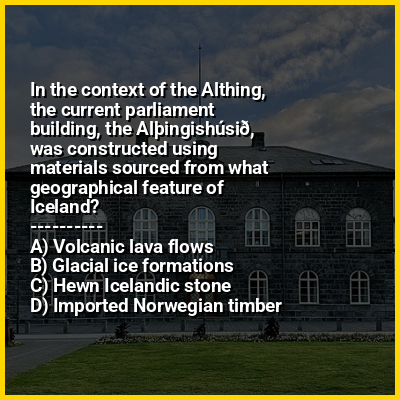
⭐ In the context of the Althing, the current parliament building, the Alþingishúsið, was constructed using materials sourced from what geographical feature of Iceland?

Ad spacer

⭐ Core Definition: Alþingishúsið

Alþingishúsið (Icelandic pronunciation: [ˈalˌθiɲcɪsˌhuːsɪθ], The Parliament House) is a classical 19th-century structure which stands by Austurvöllur in central Reykjavík, Iceland. It houses Alþingi, the Icelandic parliament. The building was designed by Ferdinand Meldahl and built using hewn Icelandic dolerite from 1880 to 1881.

The reliefs on the tympanums of the four outermost windows on the first floor represent the four landvættir of Iceland: a dragon, a vulture, a giant and a bull, momentarily appeased by Ingólfur Arnarson when he first landed in Iceland.

↓ Menu

>>>PUT SHARE BUTTONS HERE<<<

👉 Alþingishúsið in the context of Althing

The Alþingi (Icelandic: [ˈalˌθiɲcɪ]; Icelandic for 'general meeting'), anglicised as Althingi or Althing, is the supreme national parliament of Iceland. It is the oldest surviving parliament in the world. The Althing was founded in 930 at Þingvellir ('thing fields' or 'assembly fields'), about 45 kilometres (28 mi) east of what later became the country's capital, Reykjavík. After Iceland's union with Norway in 1262, the Althing lost its legislative power, which was not restored until 1904 when Iceland gained home rule from Denmark. For 641 years, the Althing did not serve as the parliament of Iceland; ultimate power rested with the Norwegian, and subsequently, Danish throne. Even after Iceland's union with Norway in 1262, the Althing still held its sessions at Þingvellir until 1800, when it was discontinued. It was restored in 1844 by royal decree and moved to Reykjavík. The restored unicameral legislature first came together in 1845 and after 1874 operated in two chambers with an additional third chamber taking on a greater role as the decades passed until 1991 when Althing became once again unicameral. The present parliament building, the Alþingishús, was built in 1881, made of hewn Icelandic stone. The unicameral parliament has 63 members, and is elected every four years based on party-list proportional representation. The current speaker of the Althing, since February 2025, is Þórunn Sveinbjarnardóttir.

The constitution of Iceland provides for six electoral constituencies with the possibility of an increase to seven. The constituency boundaries and the number of seats allocated to each constituency are fixed by legislation. No constituency can be represented by fewer than six seats. Furthermore, each party with more than 5% of the national vote is allocated seats based on its proportion of the national vote in order that the number of members in parliament for each political party should be more or less proportional to its overall electoral support. If the number of voters represented by each member of the Althing in one constituency would be less than half of the comparable ratio in another constituency, the Icelandic National Electoral Commission is tasked with altering the allocation of seats to reduce that difference.
↓ Explore More Topics
In this Dossier

Alþingishúsið in the context of Þingvellir

Þingvellir (Icelandic: [ˈθiŋkˌvɛtlɪr̥] , anglicised as Thingvellir) was the site of the Alþing, the annual parliament of Iceland from the year 930 until the last session held at Þingvellir in 1798. Since 1881, the parliament has been located within Alþingishúsið in Reykjavík.

Þingvellir is now a national park in the municipality of Bláskógabyggð in southwestern Iceland, about 40 km (25 miles) northeast of Iceland's capital, Reykjavík. Þingvellir is a site of historical, cultural, and geological significance, and is one of the most popular tourist destinations in Iceland. The park lies in a rift valley that marks the crest of the Mid-Atlantic Ridge and the boundary between the North American and Eurasian tectonic plates. To its south lies Þingvallavatn, the largest natural lake in Iceland.

↑ Return to Menu

Alþingishúsið in the context of Austurvöllur

Austurvöllur (Icelandic pronunciation: [ˈœystʏrˌvœtlʏr̥]) is a public square in Reykjavík, Iceland. The square is a popular gathering place for the citizens of Reykjavík, and especially during good weather due to the prevalence of cafés on Vallarstræti and Pósthússtræti. It has also been a focal point of protests, as it is near the Parliament of Iceland.

The square contains a large statue of Jón Sigurðsson, a leader of Iceland's independence movement.

↑ Return to Menu

Alþingishúsið in the context of Alþingi

The Alþingi (Icelandic: [ˈalˌθiɲcɪ]; Icelandic for 'general meeting'), anglicised as Althingi or Althing, is the supreme national parliament of Iceland. It is the oldest surviving parliament in the world. The Althing was founded in 930 at Þingvellir ('thing fields' or 'assembly fields'), about 45 kilometres (28 mi) east of what later became the country's capital, Reykjavík. The present parliament building, the Alþingishús, was built in 1881, made of hewn Icelandic stone. The unicameral parliament has 63 members, and is elected every four years based on party-list proportional representation. The current speaker of the Althing, since February 2025, is Þórunn Sveinbjarnardóttir.

After Iceland's union with Norway in 1262, the Althing lost its legislative power, which was not restored until 1904 when Iceland gained home rule from Denmark. For 641 years, the Althing did not serve as the parliament of Iceland; ultimate power rested with the Norwegian, and subsequently, Danish throne. Even after Iceland's union with Norway in 1262, the Althing still held its sessions at Þingvellir until 1800, when it was discontinued. It was restored in 1844 by royal decree and moved to Reykjavík. The restored unicameral legislature first came together in 1845 and after 1874 operated in two chambers with an additional third chamber taking on a greater role as the decades passed until 1991 when Althing became once again unicameral.

↑ Return to Menu