Althorp in the context of "Spencer family"

Play Trivia Questions online!

or

Skip to study material about Althorp in the context of "Spencer family"


⭐ Core Definition: Althorp

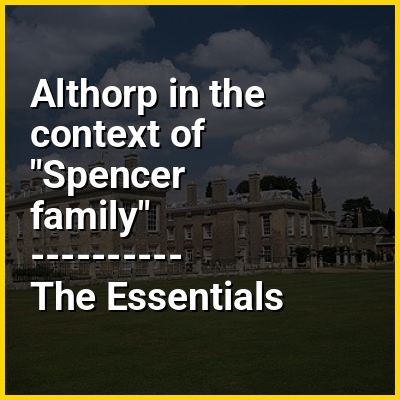
Althorp (popularly pronounced /ˈɔːlθɔːrp/ AWL-thorp) is a Grade I listed stately home and estate in the civil parish of Althorp, in West Northamptonshire, England of about 13,000 acres (5,300 ha). By road it is about 6 miles (9.7 km) northwest of the county town of Northampton and about 75 miles (121 km) northwest of central London, situated between the villages of Great Brington and Harlestone. It has been held by the Spencer family for more than 500 years, and has been owned by Charles Spencer, 9th Earl Spencer since 1992. It was also the home of Lady Diana Spencer (later Princess of Wales) from her parents' divorce until her marriage to Charles, Prince of Wales (later King Charles III).

Althorp is mentioned as a small hamlet in the Domesday Book of 1086 as "Olletorp", and by 1377 it had become a village with a population of more than fifty people. By 1505 there were no longer any tenants living there, and in 1508, John Spencer purchased Althorp estate with the funds generated from his family's sheep-rearing business. Althorp became one of the prominent stately homes in England. The house dates to 1688, replacing an earlier house that was once visited by Charles I. The Spencer family amassed an extensive art collection and other valuable household items. During the 18th century, the house became a major cultural hub in England, and parties were regularly held, attracting many prominent members of Great Britain's ruling class. George John, 2nd Earl Spencer, who owned Althorp between 1783 and his death in 1834, developed one of the largest private libraries in Europe at the palace, which grew to over 100,000 books by the 1830s. After falling on hard times, John Spencer, 5th Earl Spencer, known as the Red Earl, in 1892 sold much of the collection to Enriqueta Rylands, who was building the University of Manchester Library. Many of Althorp's furnishings were sold during the twentieth century, and between 1975 and 1992 alone approximately 20% of the contents were auctioned.
↓ Menu

In this Dossier

Althorp in the context of Townhouse (Great Britain)

In British usage, the term townhouse originally referred to the opulent town or city residence (in practice normally in Westminster near the seat of the monarch) of a member of the nobility or gentry, as opposed to their country seat, generally known as a country house or, colloquially, for the larger ones, stately home. The grandest of the London townhouses were stand-alone buildings, comparable to the hôtel particulier, which notably housed the French nobleman in Paris, as well as to the urban domus of the nobiles of Ancient Rome. but many were terraced buildings.

British property developers and estate agents nowadays often use the term "townhouse" for terraced buildings, following the North American usage of the term, to aggrandise modest dwellings and attract buyers who associate the term "terraced house" with the cheap terraced housing built in the Victorian era to accommodate workers. The upmarket Victorian terraced housing, which can be found around many of London's garden squares, seems to be widely forgotten in these circles.

↑ Return to Menu

Althorp in the context of Windsor Beauties

The Windsor Beauties are a set of portrait paintings, still in the Royal Collection, by Sir Peter Lely and his workshop, produced in the early to mid-1660s, that depict ladies of the court of King Charles II, some of whom were his mistresses. The name stems from the original location of the collection, which was at Windsor Castle. In 2024, they were on display at Hampton Court Palace.

A set of copies was commissioned by Robert Spencer, 2nd Earl of Sunderland for his collection at Althorp, and the complete set can still be viewed there in the Picture Gallery, a room he created to show off his adoration for art.

↑ Return to Menu

Althorp in the context of Funeral of Diana, Princess of Wales

The funeral of Diana, Princess of Wales, started on Saturday 6 September 1997 at 9:08 am in London, when the tenor bell of Westminster Abbey started tolling to signal the departure of the cortège from Kensington Palace. Diana's coffin was carried from the palace on a gun carriage by riders of the King's Troop and escorted by mounted police along Hyde Park to St James's Palace, where her body had remained for five days before being taken to Kensington Palace. The Union Flag on top of the palace was lowered to half mast. The official ceremony was held at Westminster Abbey in London and finished at the resting place in Diana's family estate of Althorp, Northamptonshire.

Two thousand people attended the ceremony in Westminster Abbey while the British television audience was 32.10 million on average, one of the United Kingdom's highest viewing figures ever. An estimated 2 to 2.5 billion people watched the event worldwide, making it one of the most-watched televised events in history.

↑ Return to Menu

Althorp in the context of Earl Spencer (title)

Earl Spencer is a title in the Peerage of Great Britain that was created on 1 November 1765, along with the title Viscount Althorp, of Althorp in the County of Northampton, for John Spencer, 1st Viscount Spencer. He was a member of the prominent Spencer family and a great-grandson of the 1st Duke of Marlborough. Previously, he had been created Viscount Spencer, of Althorp in the County of Northampton, and Baron Spencer of Althorp, of Althorp in the County of Northampton, on 3 April 1761.

The future 6th Earl Spencer was created Viscount Althorp, of Great Brington in the County of Northampton, on 19 December 1905 in the Peerage of the United Kingdom. Diana, Princess of Wales, was the youngest of three daughters of the 8th Earl Spencer. William, Prince of Wales, and Prince Harry, Duke of Sussex, are grandsons of the 8th Earl Spencer.

↑ Return to Menu