Alphonse de Lamartine in the context of "Second French Republic"

Play Trivia Questions online!

or

Skip to study material about Alphonse de Lamartine in the context of "Second French Republic"

Ad spacer

⭐ Core Definition: Alphonse de Lamartine

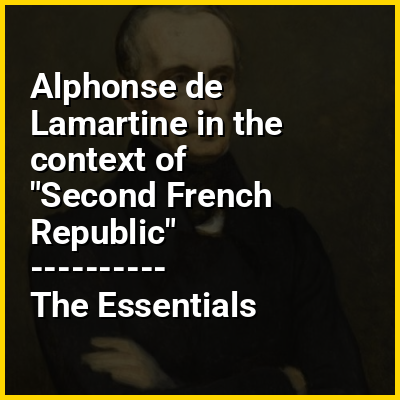
Alphonse Marie Louis de Prat de Lamartine (21 October 1790 – 28 February 1869) was a French author, poet, and statesman. Initially a moderate royalist, he became one of the leading critics of the July Monarchy of Louis-Philippe, aligning more with the Republican Left and Social Catholicism.

Lamartine was a leading figure in the 1848 French Revolution and was instrumental in the foundation of the Second Republic along with the preservation of the tricolor as the flag of France. During the revolutionary year of 1848 he served as Foreign Minister and frequently worked to ease tensions between the government and the working class. He was a candidate in the 1848 French presidential election but lost to Louis Napoleon Bonaparte. After the election, he retired from political life.
↓ Menu

>>>PUT SHARE BUTTONS HERE<<<
In this Dossier

Alphonse de Lamartine in the context of Pau, Pyrénées-Atlantiques

Pau (French pronunciation: [po]; Occitan pronunciation: [paw]; Basque: Paue) is a commune overlooking the Pyrenees, the prefecture of the Pyrénées-Atlantiques department in the Nouvelle-Aquitaine region of Southwestern France.

The city is located in the heart of the former sovereign principality of Béarn, of which it was the capital from 1464. Pau lies on the Gave de Pau, and is located 100 kilometres (62 mi) from the Atlantic Ocean and 50 kilometres (31 mi) from Spain. This position gives it a striking panorama across the mountain range of the Pyrenees, especially from its landmark "Boulevard des Pyrénées", as well as the hillsides of Jurançon. According to Alphonse de Lamartine, "Pau has the world's most beautiful view of the earth just as Naples has the most beautiful view of the sea."

↑ Return to Menu

Alphonse de Lamartine in the context of Capital punishment in France

Capital punishment in France (French: peine de mort en France) is banned by Article 66-1 of the Constitution of the French Republic, voted as a constitutional amendment by the Congress of the French Parliament on 19 February 2007 and simply stating "No one can be sentenced to the death penalty" (French: Nul ne peut être condamné à la peine de mort). The death penalty was already declared illegal on 9 October 1981 when President François Mitterrand signed a law prohibiting the judicial system from using it and commuting the sentences of the seven people on death row to life imprisonment. The last execution took place by guillotine, being the main legal method since the French Revolution; Hamida Djandoubi, a Tunisian citizen convicted of torture and murder on French soil, was put to death in September 1977 in Marseille.

Major French death penalty abolitionists across time have included philosopher Voltaire; poet Victor Hugo; politicians Léon Gambetta, Jean Jaurès and Aristide Briand; and writers Alphonse de Lamartine and Albert Camus.

↑ Return to Menu